Tuesday, July 23, 2024

Firehouse Recollections

CELEBRATING FIFTY YEARS OF THE ORAL HISTORY PROJECT


Chester West (or “Westchester” backwards as he liked to say) served in the Greenwich Fire Department from 1970 to 1986. On six occasions in the years 1987 and 1988, he described many situations he encountered over those years to Oral History Project volunteer Penny Bott-Haughwout. Chet loved his job and had already compiled his experiences over the years into books totaling 2400 pages (“unedited”). “I enjoyed doing it. It was something I could look back at with pleasure.”


Chet West
Courtesy of Greenwich Library
Oral History Project

Until 1978, Chet was assigned firefighting duty in Byram. “At the time there was a residency requirement that the town police and fire departments live in Greenwich.”  Although Byram had “high potential” for fires because “we had lumberyards and gasoline and oil storage…they had the smallest area to cover.” In addition, “Byram is the only place that is very well hydrated. If you notice, you’ll see hydrants just about every place. You don’t have to lay too much hose in Byram.”  Of course, with its proximity to I-95, the fire house handled many situations from car fires to motorists asking directions. “One guy had his car burning up, the back seat on fire. He pulls it right into the ambulance bay. He thought that this was a drive-in fire department… Well, the ambulance bay is right next to the gasoline pump!”


Chet remembered well the horrific fire at Gulliver’s discotheque in 1974, and the shocking Mianus River Bridge collapse in 1983. He was on duty at the dispatch desk the night the bridge fell into the Mianus River. However, most of his recollections for the OHP interview were of the everyday experiences he encountered in the department. Chet described Byram as “the friendly neighborhood fire department. We knew everybody We did have the relationship, the compassion, and the respect from the public. It was a very good, secure feeling I lived right next door, so it was easy You’d have a lot of the neighborhood people stop in and say hello Some referred to Byram as “going to the country club.”


Chet did quite a bit of cooking at the fire house and it was not unusual for the cop on the beat or people in the neighborhood to stop by and say, “’What’s that smell?’ Well, you knew their motive. They wanted to stay for lunch We always gave them something.’’ Chet and his cooking partner Hank were not above experimenting with rabbit, venison, or other game Hank had hunted. One dish he described was raccoon, “And it was very good. It had a white sauce on it We all ate it.” Chet did have to admit to someone who asked for the recipe, that it really wasn’t turkey a la king.


Preparing firehouse food
Courtesy of Greenwich Library

Oral History Project

An event that was popular in the community was the annual turkey roll with chances for prizes along with the ever-popular free chowder. “I think it was a seventy-quart pot Everybody was willing to help It was very nice.” After seven years on the job, Chet noticed himself getting weaker.  then my fingers were getting an atrophy situation, and I was just getting tired quicker That was May, 1978.” Chet described his diagnosis as a “spinal muscular atrophy type.” However, as he wanted to continue to serve the fire department in a useful capacity, he was transferred to “Central” in Greenwich as a dispatcher, a position he held until his retirement in 1986.


Studying a Greenwich map in the Watch Room
Courtesy of Greenwich Library
Oral History Project

Going to “Central” (the main headquarters on Havemeyer Place) was like “a rural country boy going to the big city for the first time Being in the main business section of town, there was very little of the neighborhood atmosphere that I was so used to in Byram. I was assigned mainly to the watch room.”  The term “watchman” has a long history. “In the old days, firemen used to patrol the streets, watching out for fires, and the name just carried over.” While that role was normally rotated within the department, for Chet, “my assignment was permanent watch. It’s called the ‘hot seat.’ You have to make decisions. If you’re right, you’re praised. If you’re wrong, well, you’re really condemned.” Some of these crucial decisions included determining how to respond to a call -- two pumpers and a ladder truck? two ladder trucks? assistance from neighboring district stations? Chet became acutely aware of the size and complexity of Greenwich and its 265 miles of roads with approximately 1,034 names. 


From his viewpoint as a watchman, Chet developed a unique perspective on people from the many calls he had to field. “Sometimes people call us for the most menial things We’ve become the main information service for the town when the Town Hall closes.” Some of these requests fell into the category of “full moon callers.”  As Chet described the phenomenon, “The full moon brings out a lot of callers Whether it’s coincidence or fact, I really couldn’t tell you. But from my point of view, on a full moon, I’m usually ready for it You get them (calls) both day and night, but the night is more frequent because people can’t sleep, or something’s been bothering them. They want to talk to somebody. Well, who can you talk to at midnight? I don’t expect to get any sleep that night.”


Answering calls at "Central"
Courtesy of Greenwich Library
Oral History Project

Chet recounted calls ranging from complaints about landlords, to requests for child care on snow days, to inquiries about zip code numbers. Perhaps that is why Chet stated that “a lot of times, GFD is not only Greenwich Fire Department, it’s ‘Gifted For Diplomacy’ Unfortunately, our productivity is only measured in the number of fire calls. It’s not measured in the number of calls we answer.”


In this blog we must limit our reciting of the myriad memories that Chet West described in his one-hundred-and-twenty-seven-page interview with the Oral History Project. His reminisces are vivid and colorful, and full of fondness for his days in the Greenwich Fire Department. “I liked that job. As I say, I was a hometown boy I looked forward to going to work.”


The interview “Firehouse Recollections” may be read in its entirety or checked out at Greenwich Library and is available for purchase at the OHP office. The OHP is sponsored by Friends of Greenwich Library. Visit the website at glohistory.org. Our narrator’s recollections are personal and have not been subjected to factual scrutiny. Mary Jacobson serves as blog editor. 

Monday, July 8, 2024


Terry Betteridge: Renaissance Man

by Mary A: Jacobson

Scott Mitchell

Mention the name Albert “Terry” E. Betteridge III to most residents in Greenwich and they will associate it with the esteemed jewelry stores in Greenwich, Palm Beach, Aspen, or Vail.

However, the Terry Betteridge who was interviewed by Oral History Project volunteer Jan DeAngelo in 2013 is the home-grown boy whose endearing memories of growing up in Greenwich bring a smile and, at times, a tear.

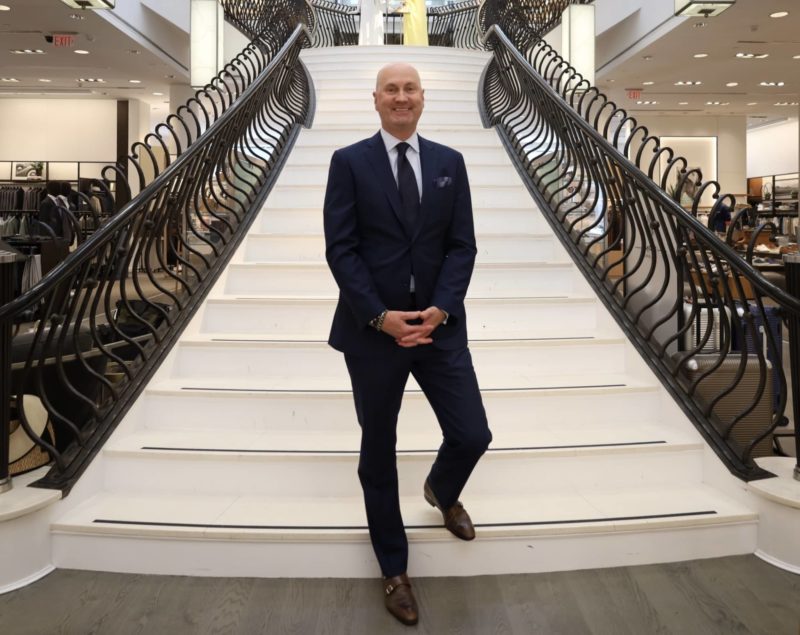
The Betteridge family legacy in jewelry goes back to 1897. Photo by Regan Avery.

The first name “Albert” goes back to his great-grandfather, who emigrated to the States from England to Ellis Island in the 1890s. “So, we all had nicknames just to separate one from another. I became Terry because I was terrible.”

Until the age of six, he lived in a home in Riverside. He and his sister, just two years older, would go out fishing in a “fake Boston Whaler” with a “seven-and-a-half horsepower Evinrude. My father used to say that two of the horses had died and a couple had thrown shoes, because it just barely putted.”

The next home which the Betteridges inhabited was on Riversville Road, across from the Boy Scout reservation. On about eight acres, there was plenty to explore and plenty of mischief to get into. Terry’s job was cutting grass and taking care of the sheep. “My father thought all children should take care of animals, so we had sheep and goats.” Terry’s memories included “riding my sheep around the yard. We’d ride them like horses.”

What kind of activities filled the idle hours of a young boy in Greenwich before video games and computers? “It was just a fun place in those days… I would go down through the woods, follow the west branch of the Byram River, exploring the long-gone Wilcox Nut and Bolt Works factory dam and millpond.” Terry reminisced, “In the winter, we would ice skate on that pond, had great big hockey games there, and if you hit the puck across the dam, it would go off thirty feet. There was always that concern that one of us was going to take the fatal dive, but our parents kind of let us do anything in those days. We just had to be home by dark.”

When Terry managed to save up money as a child, he would happily go to Molly’s stationery store and buy a balsa-wood plane. “Then I’d ride my bike out to Westchester Airport, because I knew some of the pilots there and I was fascinated with flying. They’d let me fly my balsa-wood airplane on the runway… right alongside a Cessna. Then I had to be home by dark. No more concern than that. It was really a lovely time.”

Terry’s memories of Parkway School centered mostly on the long ride on the school bus. “It was quite a trek over, hour each way. First ones on, last ones off, so you got to be good friends.” A number of those who shared this “Room of Gloom” bus ride remain lifelong friends. Terry decided with one of them to find a way to make a little extra money by setting up a toll road on Riversville Road. “So, we got a long stick, and we closed off Riversville Road, and as the cars stopped, we’d say, ‘It’s a quarter to go any further.’ And, amazingly, about the first five people each gave us a quarter.” However, the sixth car was a police car “and he made us go find the people. We knew who they were because if you drove up Riversville in those days, you were going home.” However, further disgrace came after the policeman took them back home “and we had to tell our parents what we were doing, and how awful we were.”

Terry’s favorite, most memorable, teacher was Mrs. Kawolski in the fourth grade. “She taught me all sorts of silly things including how to fold a letter… and I still do it. It’s the superior way.” In Greenwich High School, Dan Barrett, an oceanography teacher, was “a complete inspiration to me… everything a teacher should be… one of the gems of public education.” He took the entire class to the Grand Bahamas to go diving. First, the students took diving classes at the YMCA to become certified. Then, they had to raise money to go on the trip through “bake sales, movies, snowplowing, and shoveling.” He and local boy Hans Isbrandtsen “would get up at two in the morning to go plow and shovel out people in snowstorms to make the money to go on the trip.”

Terry’s interest in natural history took him to Connecticut College, where he pursued interests in ornithology and ecology with some thought of becoming an environmental lawyer and following his maternal side of the family into law. However, Terry’s OHP interview encompasses a wide range of experiences from working in the Everglades to Zambia (where he met Steve Irwin) to guiding tourists in British Columbia. Eventually, “I began to miss New England a little bit, truthfully.”

His return to Connecticut was precipitated by his dad’s’ heart attack and the bankruptcy of the family jewelry business in Greenwich in 1973. Terry answered his father’s despondency by reminding him that “you still have the faith and credit of the guy who was in the business a long time and well-known. Let’s start it up again.” Also looming was the Betteridge family legacy dating back to his great-grandfather, who listed his occupation on his immigration papers in the 1890s as “goldsmith.” However, Terry found that his dad, “a big robust drill sergeant kind of a dad… didn’t want to come in anymore, so it was up to me.”

The Betteridges still owned the building on Greenwich Avenue, even if “the business was then defunct, and the building also empty.” Terry decided to learn the business from diamond dealer friends of his dad’s, from setters, and from polishers. “I knew a lot of the diamond dealers on a very friendly basis, because I’d sit and grade things for them.”

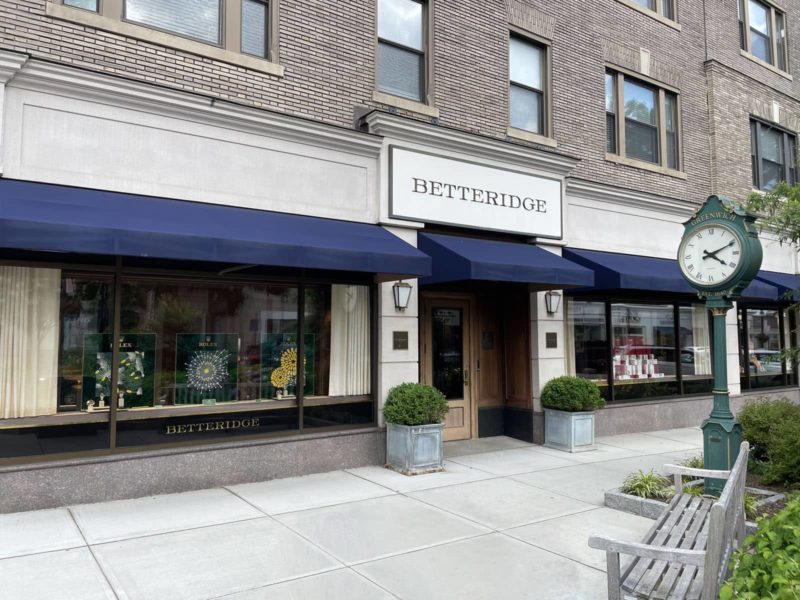
Suffice it to say that the store reopened and an expanded Betteridge’s three times its original size relocated in 2017 to the corner of Greenwich Avenue and East Elm Street. As of 2022, it was acquired by Watches of Switzerland. This home-grown Greenwich boy can now witness the Betteridge name achieve a global reach.

The interview “Terry Betteridge: Renaissance Man” may be read in its entirety or checked out at Greenwich Library and is available for purchase at the OHP office. The OHP is sponsored by Friends of Greenwich Library. Visit the website at glohistory.org. Our narrator’s recollections are personal and have not been subjected to factual scrutiny. Mary Jacobson serves as blog editor.
Betteridge at its present location on Greenwich Avenue. Photo by Regan Avery.