Friday, May 26, 2023


Inspiring Music Mentors
by Mary A. Jacobson

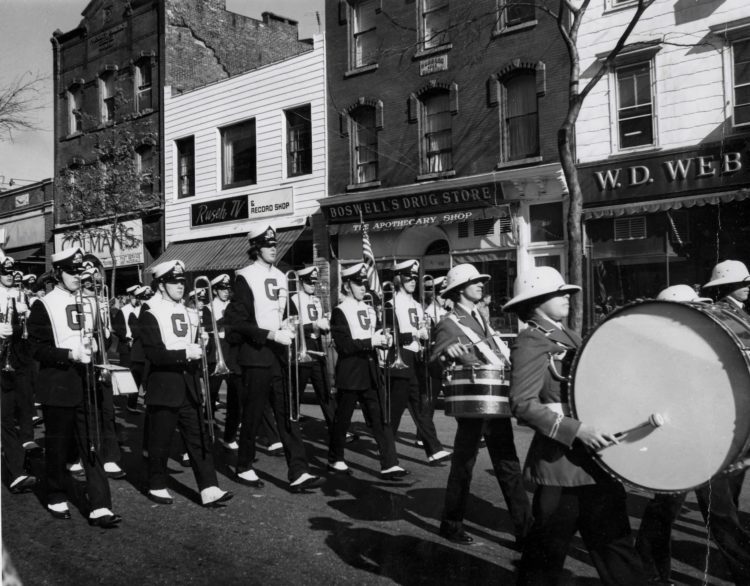
Greenwich High School marching band. Courtesy of the Oral History Project.

As the school year draws to a close, it seems fitting to highlight a few teachers who made an indelible imprint on the music program in Greenwich and inspired countless students to love and play music. George Gray and Raymond Malone were interviewed for the Oral History Project in 1989 by Mary B. Coan. Collectively, they served sixty-five years in the music department.

George Gray discovered his dad had a violin when he was a seventh grader in the Greenwich schools. “It happened, I guess, that somebody discovered I had a talent, so there you go.” At the age of twenty-four, with degrees from Juilliard and Columbia University Teachers College, George sought a position teaching strings. “Then this job opened up in Greenwich, a string teaching job, and I think it was one of the first in the country…It was exactly what I wanted to do.” The year was 1938 and the annual salary was $1,700.

As a novice teacher, Gray’s supervisor, Mary Donovan, instructed him to introduce himself to all the principals of the eleven district schools in which he would be teaching. He fondly recalled meeting Frank Parker, Principal of Hamilton Avenue School, whose reaction was, “What in the hell is a string teacher?” Gray’s job involved teaching in at least two schools a day. “It was about the best job that anybody that wanted to teach strings could have ever asked for…The kids enjoyed it and I enjoyed it…We developed a pretty good high school group, high school orchestra, and I also had an interschool orchestra that met on Saturday mornings.”

In the late 1940s, when the position of Supervisor of Music became available, Gray was encouraged to apply for it. One of his biggest responsibilities as Supervisor of Music was the selection of music teachers. “If I had maybe two opening for teachers in a particular year, I might have a hundred or more applicants for those jobs.” This responsibility also entailed some traveling. “If you couldn’t find a good teacher, you were really wasting your time trying to supervise a teacher that wasn’t any good, because they don’t change very much…I don’t think I ever hired a teacher unless I saw them teach…It makes all the difference in the world.”

One of the most memorable positions that George Gray filled was in the spring of 1956. Gray had traveled to Potsdam State Teachers College, one of the best New York State music schools, according to him, to interview a highly recommended choral conductor. His name was Peter Bagley and Gray heard “what a wonderful conductor he was, how the kids loved to perform under him.”

Gray brought him to a choral rehearsal at Eastern Junior High. “What a job he did with that! The kids loved him. There was an intensity and electricity about the man…He had every individual’s attention. He would look right at them, and he had a tremendous amount of energy.” After Peter Bagley taught four years, he left to pursue a doctoral degree. Later, in a 2012 interview as Professor Emeritus of University of Connecticut, Bagley said, “I loved being in Greenwich. I was the first African American teaching in Greenwich. That was a milestone; 1957 was pre-civil rights…. I didn’t know what to expect. And the unspoken response was, ‘You’re here. Teach. Be yourself. Do what you want to do. Do what you love.’ That’s what I did…I had some of my best years in that situation. I loved the parents, the students, the community, and I think I can safely say they loved me, too.”
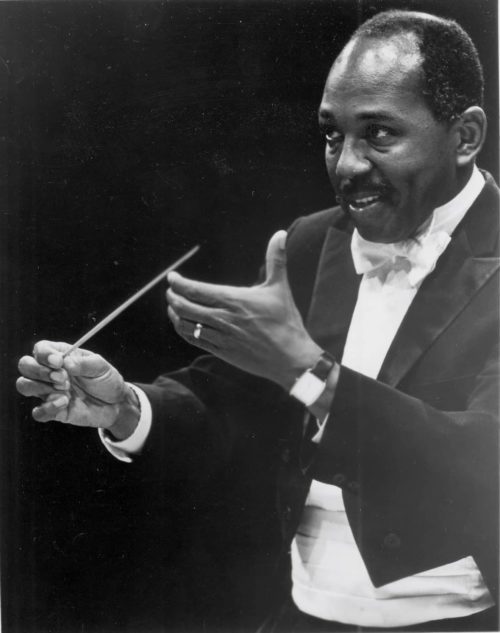
Peter Bagley conducting. Courtesy of Peter Bagley


Another teacher Gray recalled hiring was Ray Malone in 1953. “I watched Ray teaching in a couple of classes…where all the desks and chairs were screwed down to the floor…The first thing he does, he puts his foot up on the desk and starts strumming his guitar and singing, and pretty soon these kids were singing. Then he had them stand up, and they were dancing in the aisles, and this was going on all at once. He had the kids all singing and dancing, and this music was going on…The kids just loved this for a music class. So, at that point he was hired. He was terrific.” Malone remained in the Greenwich school system until his retirement in 1983.

Gray mused, “There have been any number of students who have gone on professionally in music. A lot of them came up through Ray Harrington at the high school.” One of the students in particular that Gray recalled was Erich Kunzel (GHS graduate, 1953) who used to play string bass in Gray’s string ensemble. Among his many later musical achievements, Kunzel conducted the Cincinnati Pops Orchestra for more than three decades. In 2006, three years before his death, he was awarded the National Medal of Arts by President George W. Bush.

George Gray believed in building a strong program from the lower grades and that that was the core strength of the Greenwich music department, recognized nationally. He also believed in giving his teachers some autonomy and creative freedom. As Ray Malone said, “That was the secret to the success of the music program, because each of us had the individual freedom to follow our own pursuits, which drove us into music in the first place…The kids are going to see that. They are going to recognize here’s a guy that really loves music. That really makes quite a force on a child.”

The interview entitled “The Music Men” may be read in its entirety at Greenwich Library and is available for purchase at the Oral History Project office. The OHP is sponsored by Friends of Greenwich Library. Visit the website at glohistory.org. Our narrators’ recollections are personal and have not been subject to factual scrutiny. Mary Jacobson serves as blog editor.
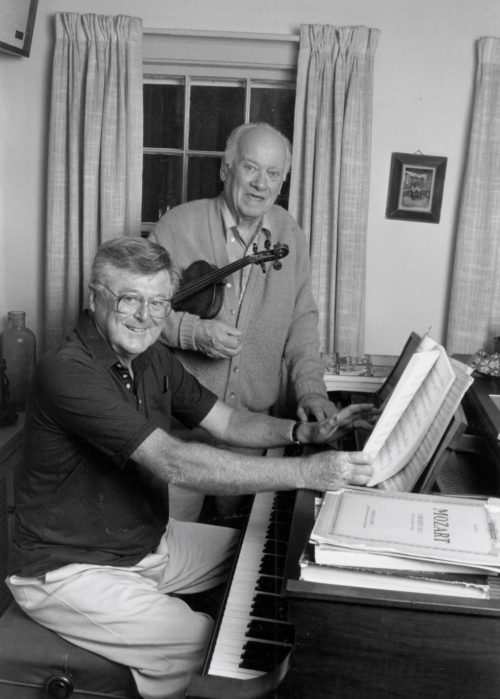
Ray Malone and George Gray. Photograph by Karl Gleeson, courtesy of the Oral History Project.

Monday, May 1, 2023

Recollections of the Bruce Museum – Part II: 1979-2023

by Mary A. Jacobson

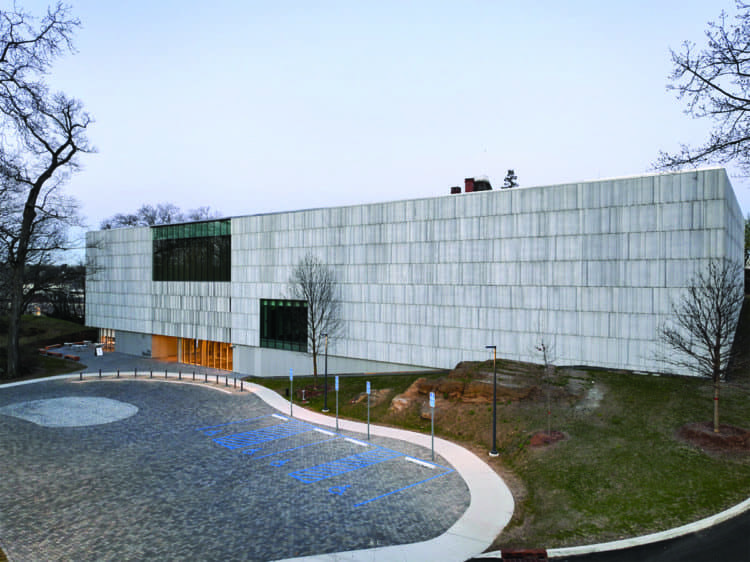
Exterior of the Bruce Museum after its 1993 renovation. Photo courtesy of the Bruce Museum.

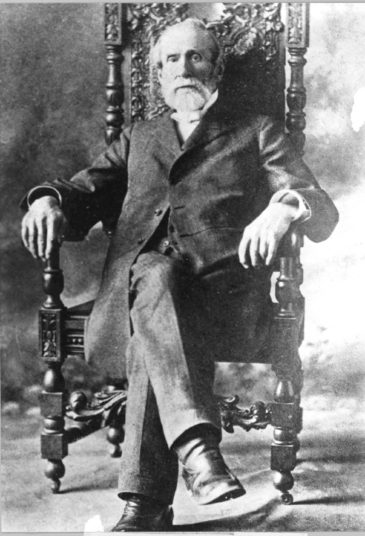
From 1909 to 1978, the leaders of the Bruce Museum sought to oversee the transformation of Robert Moffat Bruce’s 1859 Victorian home into a museum of art, science, and history. This was the mandate stipulated by Mr. Bruce in his will when he bequeathed his home to the Town of Greenwich upon his death in 1909 at the age of 86. The newly reopened and reimagined Bruce Museum of 2023 melds this original conceptual challenge with a state-of-the-art edifice for the twenty-first century.


Robert Moffat Bruce, c. 1900, courtesy of the Historical Society of the Town of Greenwich.


In 2007 the Oral History Project conducted a series of interviews which were compiled into a book entitled “The Bruce Museum – A Century of Change.” These interviews chronicle the stories of leaders associated with the Bruce Museum from 1918-2007 in their own words and according to their own unique perspectives and recollections.

John Clark directed the Bruce Museum from 1979 to 1995. He had previously worked as Curator of Geology at the Morris Museum of Arts and Sciences in Morristown, New Jersey. From his perspective, the “museum had a lot of potential but seemed to have no storage. It seemed to have everything out on exhibit… ‘The Good, the Bad, and the Ugly.’” He noted that in Greenwich, “There was a strong interest in good quality programming and exhibitions; whether it was to be a children’s museum, an art museum, a science museum.”

During Clark’s tenure, the decision was made to close the zoo part of the museum. Clark stated, “It was decided that the Bruce Museum wasn’t a zoo . . . When I first came here, we had three monkeys and three parrots.” New placements were found for them “in spite of the fact that one of the birds swore like a drunken sailor!”

As the museum continued to raise its profile in Greenwich, it added to its subsidy base from the town with growing community support from the Bruce Associates. Over time, according to John Clark, it became apparent that the museum building was in need of renovation. "It hadn't been updated or upgraded... there was a black-and-white checkerboard tile floor, like back in the fifties. One gallery was painted pink, the next one was painted canary yellow, and the next, robin's egg blue... Most of the windows were boarded up and painted battleship gray.”

Clark stated that seven million dollars was raised, and ground was broken for the construction project in December of 1992. To celebrate the onset of the project, “We closed the old building (now stripped back to the original walls) with something called a bare-bones party…We let people graffiti the walls. They left their own personal messages. And it was just a fun farewell.”

Hollister Sturges, director from 1995 to 2000, was the first museum director with an art or art history background. During his tenure, the museum received accreditation from the American Association of Museums. “I arrived at a moment of great opportunity because the new (renovated) museum had opened in 1993…I think one mandate was for a strong art program.”

Over time, “the budget expanded, the audience almost doubled…We became the second most visited art museum in Connecticut, after the Wadsworth Atheneum.” Sturges evidenced pride in the strides made during his tenure to upgrade the art exhibitions. However, he stated, “I think the biggest problem in the end for me was the transition from a volunteer-led period to a professional staff-led period. That was a transition that was taking place during my tenure.”

Homer McK. Rees, a retired businessman, acted as interim director from 2000-2001 to guide the museum while a new director was sought. “It was perfectly true that I wasn’t an art professional or a science professional, but I had run businesses before….and just simply applied the same principles to the museum that I would to any business.” A goal was to “change the mindset of the board from being a managing board to a governing board.” At the conclusion of his tenure, Rees reflected that working at the Bruce Museum “was one of the most, if not the most, rewarding experiences of my business career.”

In 2001, Peter Sutton became the museum’s first executive director. He hailed from a number of curatorial and directorship positions in the world of art. Interviewed in 2005, he stated, “We’ve managed to balance the budget and improve the reputation of the institution and raise its profile.” With fourteen to sixteen shows a year, 600 annual educational programs, 20,000 yearly schoolchildren visits, “Something is happening all the time, every day, almost every hour of every day.” Sutton stated that three-quarters of the museum’s budget must be privately raised “and it’s wonderful that it all comes to this public municipal institution.” Sutton’s vision for the future included an expansion to bring more widespread recognition of this community gem.

The “new” Bruce Museum opened to the public on April 2, 2023, under the leadership of the Museum’s executive director since 2019, Robert Wolterstorff, who hails from the Bennington Museum in Vermont. This impressive, reimagined space combines art, science, education, and community with expanded collection storage, permanent and changing art gallery venues, a new entrance lobby, cafĂ© and lecture hall, doubling its size from 30,000 to 60,000 square feet.

Surely Robert Bruce would be amazed and proud to see what his 1859 home, donated to the Town of Greenwich in 1909, has become, one hundred and fourteen years later. His desire, that it be used “as a natural history, historical and art museum for the use and benefit of the public” has been more than realized and will be enjoyed by thousands more in the years to come.

The collection of interviews entitled “The Bruce Museum – A Century of Change” may be read in its entirety at Greenwich Library and is available for purchase at the Oral History Project office. The OHP is sponsored by Friends of Greenwich Library. Visit the website at glohistory.org. This blog is not intended as an historical account. Our narrators’ recollections are personal and have not been subject to factual scrutiny. Mary Jacobson serves as blog editor.
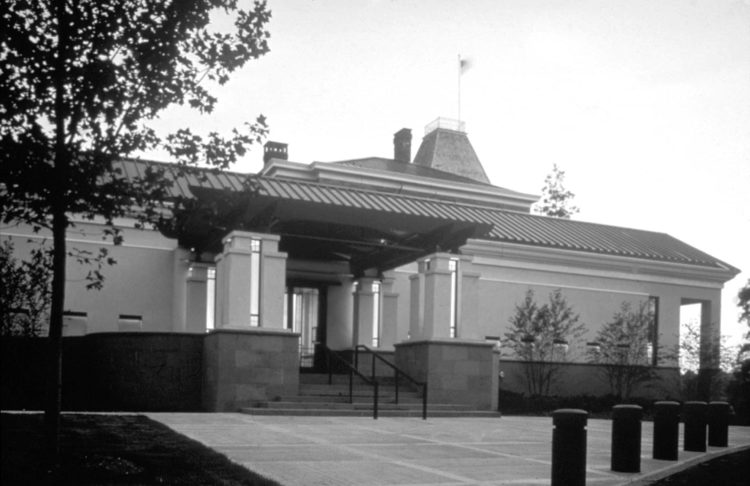
The new Bruce Museum which opened to the public April 2, 2023. Photo courtesy of the Bruce Museum.