Friday, March 27, 2026

WWII Veterans and Tod’s Point -- Celebrating America 250

By Mary A. Jacobson

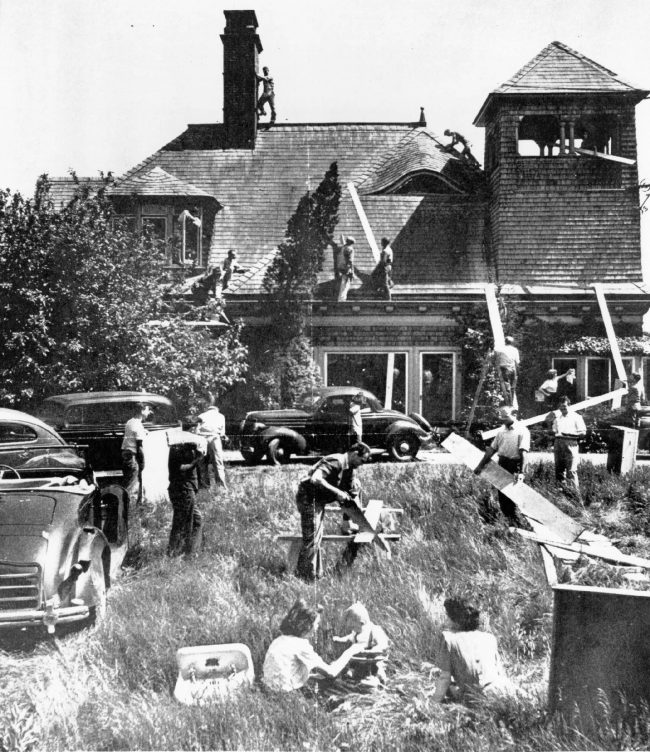
Veteran tenant families renovating the mansion to accommodate thirteen families. Courtesy of Life Magazine, June 17, 1946.

While thousands of people enjoy the beauty and sanctuary of Tod’s Point, known now as Greenwich Point, few are aware of its connection to our WWII veterans. The longtime owners of Tod’s Point were Mr. and Mrs. J. Kennedy Tod. From 1946 to 1961, their former mansion served as a residence for WWII veterans and their families.

To preserve the history of Tod’s Point for present and future generations, the Oral History Project interviewed 67 narrators and published its book Tod’s’ Point, An Oral History in 1981. It is from this rich trove that the stories of the WWII veterans are excerpted.

In 1945 the Town of Greenwich purchased the 148acre property of Tod’s Point from Presbyterian Hospital, to whom it had been bequeathed upon J. Kennedy Tod’s death, for the sum of $550,000. The mansion on the property had not been used as a residence since 1939. Concurrently, with the end of WWII, veterans were returning home to Greenwich to a severe housing shortage. Approval was given by the Town of Greenwich to lease the mansion to thirteen veteran families for one dollar a year.

Before these families could move into the mansion in 1946, its thirty-nine rooms needed to be converted into thirteen apartments. The veterans formed an independent nonprofit corporation called Vetaptco (Veterans’ Apartment Corporation) and each family floated a $1,000 loan from The Greenwich Trust Company. According to resident Thiel Ficker, “We paid (monthly) rent to our own corporation. I think forty dollars was the cheapest and seventy dollars was the most expensive. Of that, twentynine dollars went to the bank. The balance went into our Vetaptco account, and from that we paid for our oil, our heat, our electric, and so forth.”

The original Tod home was beautifully appointed. “You would find lovely casement windows in certain areas with just lovely hardware, the kind that would be very, very expensive; leaded glass, that sort of thing.” To ready the apartments for thirteen families, Ficker continued, “This contractor (Peter Danziger) did the basic work and we did all the finishing work. We did all the painting and some of the plastering and a lot of the carpentry.” When the job was done, “and everybody’s apartment was finally fixed up, we decided we ought to have an open house because people all over town were curious about this… Hordes of people came down and walked through the whole place… and were quite astounded at what had been done.”

Thiel Ficker reminisced, “Because practically every woman in the place was pregnant, we called it “Stork Point” for a while… None of us would ever choose to go back to that time again, of course, but for that particular time -we were all young, just out of the army – it was fun. It was sort of communal living in a way. We kept the integrity and privacy of each individual family.”

Wintertime living at Tod’s Point had its challenges. The Town agreed to only plow snow to the entrance of the Point. On December 26, 1947, one of the worst blizzards occurred in Greenwich with 26.5 inches of snow. Ficker recalled, “Well, we didn’t have any snow shovels… so we took these sheets of aluminum and cut them up and made long wooden handles, and nailed these rectangular pieces of aluminum to the wooden handles and made about thirteen shovels…We shoveled all day long, and at six o’clock at night, we finally broke through to Shore Road where they had plowed it.”

Another emergency requiring a communal response was the inadequate septic system that gave out on Thanksgiving Day, 1946. As Ficker described it, “There was a poor old septic tank, and it just couldn’t take it any longer.” That day the men dug a whole dry field. “We dug trenches through that. We honeycombed that whole field, laid tiles, filled in gravel, and connected it in with the septic tank which was across the road. All that on Thanksgiving Day. We worked up an appetite for turkey. Although some of us didn’t have much of an appetite.”
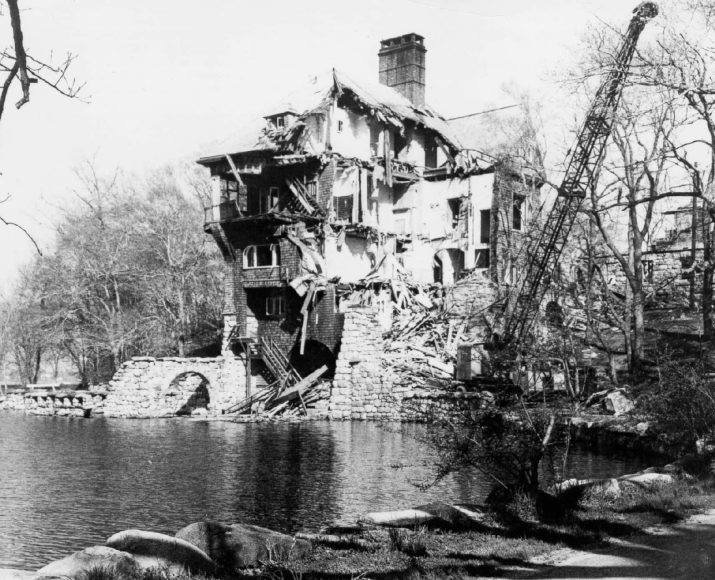
Demolition of the mansion, 1961. Courtesy of the Oral History Project.

Summertime was a busy time. “You can imagine it was like living on Coney Island on a Sunday. On a nice day in July, it was a steady stream of cars, and people used to drive up the driveway and right around the big circle there. So, we were happy when fall came and they closed the beach. Then it was peaceful and quiet.” Joseph Callachan remembered fondly the flock of snowy white egrets that would return to Tod’s Point in the fall. “Of course, Tod’s Point is, and was then, a sort of paradise for bird watchers.” Thiel Ficker remembered Sunday mornings down at the pond with his two sons. “We had a big net on the end of a long pole and we’d catch blue crabs Oh, boy! Blue crabs were all over the place!”

By 1961, the last family moved out. According to Ficker, “I think it ended simply because time had run out on it… The Town had said they wouldn’t renew the lease, and there was good reason… It was really starting to get run down. It would have taken a tremendous amount of money to put it into any shape at all… And then there was the decision to demolish the house. Of course, we were sad to see it go.” Joseph Callachan heartily agreed. “It was just a simply marvelous experience.”

On May 9, as part of the celebration of “America’s 250th|Greenwich,” Seaside Gardens at Greenwich Point will be the site of a festival of handbell choirs, featuring a commissioned work by Jonathan Vaughn entitled “Let Freedom Ring!” One might muse of the connection from the theme of this music to the brave American WWII veterans who moved to Greenwich Point eighty years ago, after their years of dedicated service in the defense of freedom.

The Oral History Project is proud to present blogs derived from its collection of recorded interviews as part of the Project’s celebration of “America’s 250th|Greenwich – Greenwich History is American History.” The OHP is sponsored by Friends of Greenwich Library. Visit the website at glohistory.org. Interviews may also be read in their entirety or checked out at the main library. They are also available for purchase by contacting the OHP office.

Recollections are personal and have not been subjected to factual scrutiny. Mary Jacobson serves as blog editor.
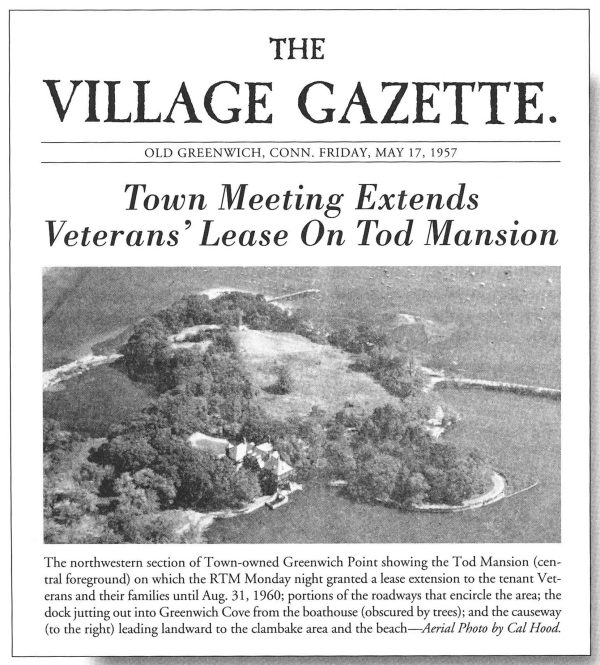
Lease extension granted by RTM in 1957. Aerial photo of by Cal Hood. Courtesy of The Village Gazette.

Friday, March 6, 2026

Greenwich Winters Through the Ages -- Celebrating America 250

by Mary A. Jacobson

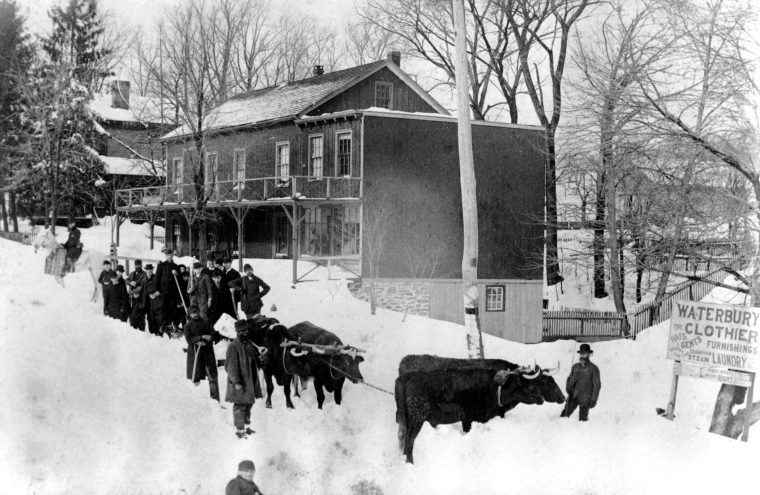
Oxen used to help clear lower Greenwich Avenue, 1888. Courtesy of Greenwich Library.

By Mary A. Jacobson

The winter of 2025-2026 is one of the harshest ones remembered by many Greenwich residents in a very long time. With thermometers reading zero degrees and wind chill temperatures in the negative double-digits, with ice and over a foot of snow lingering seemingly endlessly, it is a winter. With that in mind, it seems fitting to resurrect the remembrances of numerous past Oral History Project narrators who can recount their winter recollections and perhaps give ours a different perspective.

Horace Bassett, a Greenwich dentist born in 1905, was interviewed in 1976 by OHP volunteer Richard W. Howell. He reminisced about the winter of 1918, one of the harshest in his memory. At that time, coal to heat homes “was delivered to Greenwich by barges, not by railroad… Greenwich harbor was completely frozen, so the barges couldn’t get in (to Steamboat Road). The schools were closed because they ran out of fuel… It froze all the way out to the Captain’s Islands.” Horses pulling sleighs traveled on the ice to the stranded barges to transport coal to Maher Brothers, a coal importer on Steamboat Road.

Being young and carefree, Horace and some friends walked over the ice that year to Island Beach to visit its caretaker there, Fred Metzger. Metzger asked the boys to return the next day with his mail from the Post Office and the teens readily agreed. The next day “it must have been towards the end of the cold spell, because the ice was rather weak. My dad happened to be down around Indian Harbor. He saw us out there, met us halfway, and just reprimanded us very severely… Even today I think of what might have been if that ice had caved in.”

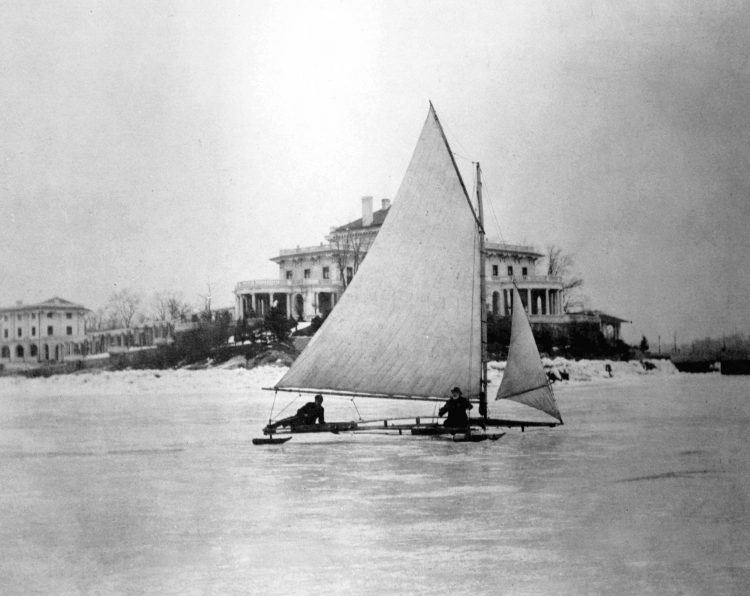
Another remarkable year was 1934. William Erdmann, captain of the Island Beach ferry for thirty years, was interviewed in 1975 by OHP volunteer Marge Curtis. As a young man of 24, he recalled that “in 1934 we had a particularly severe winter. It was a combination of real cold weather and no wind, so the Sound was frozen over.” The ice “got real thick at that time. I skated out to the island Ice boating in Greenwich Harbor. Courtesy of Greenwich Library. (Island Beach) to visit the Metzger family who were very low on food supplies. I thought to myself, ‘Boy, I’m a dope for ever being out here on skates all alone.’”

The next time he went to Island Beach, in order to deliver food to the Metzgers, Erdmann put his rowboat on a sled. “I’d pull the boat up on the ice and put the sled underneath it, and I’d walk the rest of the way back in, towing the boat.”

Erdmann had a theory to explain that “awful, heavy ice… That was Depression days, and they just didn’t have much boat traffic, either. So, as long as there was no boat traffic to keep the ice broken up, the ice just got stronger and thicker and thicker and stronger.”

Hugh Dougherty served as dockmaster at Tod’s Point for many years. He was interviewed by Esther H. Smith in 1975 at the age of 72. “We seemed to have much more bitter winters in those days than what you have today, and the Sound would freeze up almost every winter.” He described how, at high tide, along the shore, the ice would “break into cakes and you had what we called ‘cakey.’ Then to get back and forth you had to walk the cakes. I do remember my father being on one and the cake turned over and dumped him in the water… Luckily, we had very few drownings… Old Captain Gardner, who was a very cautious man, warned us if we ever went out to the lighthouse, be sure and take a long sled with us so that if the ice started to get weak at all, you could get on the sled and spread your weight out over a greater area. Then you’d push it along until you got back onto hard ice again.” One of Dougherty’s favorite pastimes was on an iceboat with “a very light frame, with runners on it and a goodsized sail. It did go very fast and it was bitter cold riding on it.”

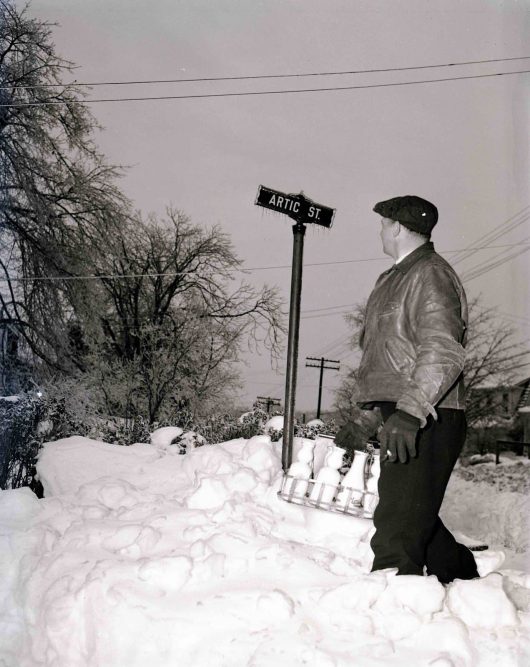
Cherry Grafton Taylor had somewhat less dramatic, but no less memorable times skating on icy ponds, which she related to OHP volunteer Marjorie Schwier in 1989. “It seemed to me that we had many, many weeks of ice skating and we would take lanterns and skate at night in the moonlight. There’s a pond we used to call Shop Pond where there was an old mill. That was a beautiful place to skate at night when the moon was full and the ice was very thick and black. “Sometimes we would make sails out of an old bedsheet and let the wind take us from one end of the pond to the other.” She, too, had memories of the Blizzard of 1934 “skiing down to Glenville to get milk and eggs.” There was purportedly more than three feet of snow that year in Greenwich and the snowplows couldn’t maneuver. “It was quite a horrendous blizzard.”

Space does not allow us to include the classic nor’easter of 1888 with snowdrifts of twenty feet, or the storm fiftynine years later in 1947, which dumped 25 inches of snow, again stranding residents with dwindling fuel and food. Yet, with these harsh winters and others to follow, the sense of community and the kindness of Greenwich neighbors to one another have remained notable, steadfast, and true.

The Oral History Project is proud to present blogs derived from its collection of recorded interviews as part of the Project’s celebration of “America’s 250th | Greenwich – Greenwich History is American History.” The OHP is sponsored by Friends of Greenwich Library. Visit the website at glohistory.org. Interviews may also be read in their entirety or checked out at the main library. They are also available for purchase by contacting the OHP office. Our narrators’ recollections are personal and have not been subjected to factual scrutiny. Mary Jacobson serves as blog editor.
Milkman Francis Connally delivers in the snow to his customers. Courtesy of Greenwich Library.
Ice boating in Greenwich Harbor. Courtesy of Greenwich Library.