Monday, April 29, 2024


Greenwich in the Early 1900s -- Celebrating 50 Years of the Oral History Project
by Mary A. Jacobson

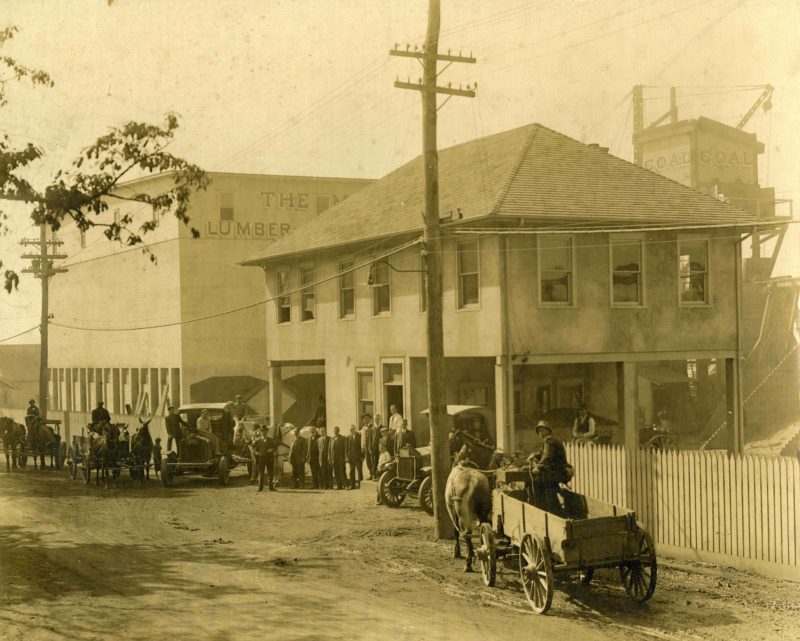
Maher Bros. Lumber Yard and Coal Tower on Steamboat Road, circa 1920. Courtesy of Greenwich Historical Society.

“I don’t know how we lived through that. That’s the God’s truth. The people today couldn’t do it.” So spoke Frances Sprague who, with husband William Sprague, were Irish immigrants to Greenwich in the 1890s. They were interviewed in 1976 by Oral History Project volunteer Betsy Cullen. Well into their eighties by then, their memories of life in the early 1900s in Greenwich were vivid. Often finishing each other’s sentences, they were never at a loss for words describing their early years on Steamboat Road.

Harsh winters played a major role in many of their recollections. The year 1917 was a particularly severe one. “The Showboat Motel (now the Delamar) … that’s where the coal yard was. Barges of coal would come in there… but they were froze out by Captain’s Island. Three barges of coal… So, they had to get sleds and horses, and they went out there (on the ice) and brought some of the coal in.” The depth of the ice in the Sound at that time “was twenty-seven inches of saltwater ice.”

The Sprague marital home on Steamboat Road was situated on stilts. “Our house, it was moved (around 1890). That little house is an old yacht club. It was moved from Tweed Island…You know the porches they have on yacht clubs? Well, they was all the way around…The house was moved on a barge… Patsy the clam man, he seen it moved.”

Steamboat Road was no stranger to flooding. “At very high tide the water would come up…We were right on the water… You could sit on the porch and watch the fish jump there.” One of eight children, Frances had spent her early years in another house on Steamboat Road. She remembered its cold, blustery winters. “We had no heat. Built our own fires. My father used to saw wood and saw wood, and he had the whole place full of it. Wood burning all the time… We got all the heat from the kitchen. No heat up in the bedrooms…The water we would bring up at night would be frozen in the morning… You couldn’t see through the windows for three months of the year. Windows all froze up.”

Lights? Frances recounted: “We had no lights for a long time until we finally got them in.” Toilet facilities? “Outhouse…You’d go out in the yard, and the wind would whistle up.” According to her, “And we were brought up that way. We always had it that way.” William grew up in comparative comfort on Lewis Street. “We had heat and running water. We had a bathroom, and we had a lavatory downstairs. We had everything in the house.”

Frances and William met at Greenwich Hospital when it fronted on Milbank Avenue. He was an apprentice painter and she had been working in the kitchen from the time she was twelve. William explained, “Yes. I met her. She had a basket of eggs, and I was looking for a broom. I bumped into her. I almost broke the eggs.”

Travel was limited. “There was no cars then hardly. You had to be really wealthy to have a car… And at the station in the morning, it was all coaches and carriages.” One coach they admired was owned by Robert Bruce (later of Bruce Park and the Bruce Museum). “Poppy Bruce they called him.” It was a “tally ho” (a four-in-hand coach) with a horn “like Tarzan used to have.” The driver “wore a big high hat and a buttoned uniform all the way down… I think their coat was purple with silver buttons and the hat would be the same with the silver band and the little bells on the hat…That coach was cleaned from stem to stern. . . like patent leather.”

The shops on Greenwich Avenue in the early days were far from the high-end ones that are located there now. “The wealthy people didn’t buy their stuff in Greenwich then. They had it sent from New York…The stores here had to depend on the middle class of people and the poor people.” At the lower end of the Avenue, their memories included Klumpp’s Bakery, Knapp & Studwell’s grocery, a tavern, a lunch wagon, the shoemaker, and Quinn’s grocery, among others. Near Grigg Street, “There was a boarding house that Mrs. Carmichael ran. Must have been twenty rooms…The town was starting to get built up” and workers needed a place to stay. The A & P and Breslow’s Liquor Store led to the Post Office (now Restoration Hardware). “That was a hole in the ground… That was a regular swamp there where that Post Office is.” The land where Betteridge’s now stands was a baseball field.

William was not nostalgic for days gone by. “You can have them good old times. I didn’t have a nickel in my pocket. A loaf of bread could be bought for a nickel then. Couldn’t buy the loaf of bread…This is heaven compared to what we had when we were married… When we look back, we often wonder how we done it.”

The interview “Greenwich in the Early 1900s” may be read in its entirety or checked out at Greenwich Library and is available for purchase at the OHP office. The OHP is sponsored by Friends of Greenwich Library. Visit the website at glohistory.org. Our narrators’ recollections are personal and have not been subjected to factual scrutiny. Mary Jacobson serves as blog editor.
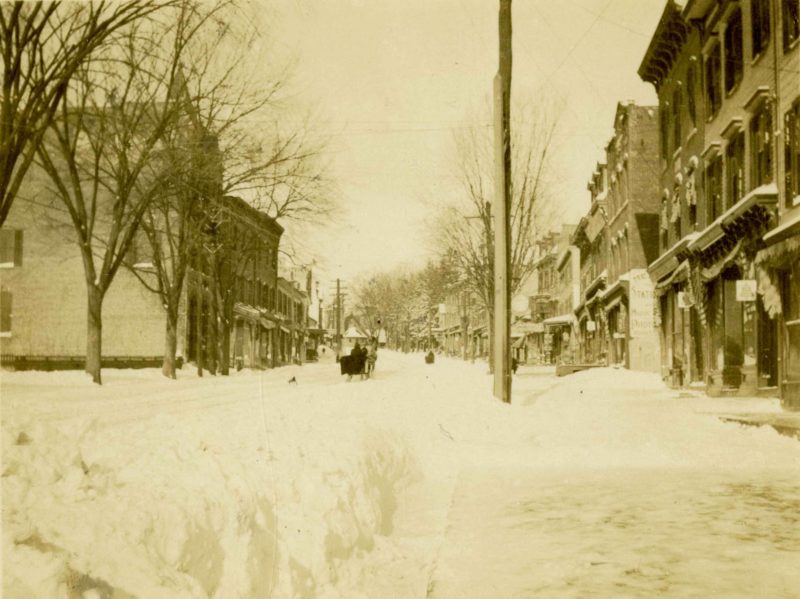
Horse-drawn sleigh headed up Greenwich Avenue in the snow, 1904. Courtesy of Greenwich Historical Society.

Thursday, April 4, 2024

Eugene J. Moye, Sr.: Soldier, Policeman, Teacher

“Undaunted. Relentless. Determined” — words to describe Eugene Moye’s life from 1933 to 1994


Eugene James Moye, Sr. arrived in Greenwich in 1933, at the age of eleven, to join his mother, who was a domestic in the household of Augustus Richards. Moye’s mother had discovered that he was not attending school while living with his cousin in New York City and proceeded to enroll him in Hamilton Avenue School.


Eugene Moye and his wife Jeanette standing between their four children
Photo courtesy of Greenwich Library Oral History Project

There, Moye met Esther Lauridsen, “a very wonderful teacher, everything a good teacher should be… If I’m anything at all, I owe it at least partly to her. I guess I became a teacher because of her… I’ve never forgotten her. I did get back to thank her for what she did for me before she passed on.”

Thus began Eugene Moye’s life in Greenwich and led to his productive careers of soldier, educator, and as the first black policeman in the town. Annette B. Fox of the Oral History Project interviewed him in 1994 as he chronicled his life in Greenwich.

According to Moye, “Very few blacks attended Hamilton Avenue School” in those days. From his Italian friends he learned “the wrong kind of Italian” as one of them told Moye the meaning of the words some other boys were saying to him. Then, “…as soon as someone said something to me, I knew what they were talking about, and I would reply with my fists… After that, we shook hands and that was the end of it.”

A searing memory for Moye occurred at graduation from Hamilton Avenue in 1937, when parents of a white student objected to him being paired with their daughter during the graduation march. Instead, Moye was paired with another girl “who did not mind… I’ll never forget her. She was a perfect lady… Maybe she doesn’t remember that graduation, but I do.”

Moye graduated from Greenwich High School in January 1941. He was not encouraged to apply to college. “Nowadays, guidance is an entirely different thing and I know it quite intimately as to the efforts and lengths they go to encourage students and get them to develop their potential.” However, in his day, “…I do not remember ever having an appointment with the guidance person at all.”

In the fall of 1941, Moye enrolled in a National Youth Administration program in Maine, where he studied sheet metal. Moye went to Port Chester “and got a job tacking floats for anti-submarine nets.” Shortly after, with war being declared, Moye decided to join the army. It was “on a segregated basis… We found ourselves doing the less ‘heroic’ jobs like quartermaster, bread baking, laundry, fixing trucks. I mean, not that it didn’t help – don’t get me wrong – but it was a put-down as far as I was concerned.” Later, “They were allowing them (blacks) to go into combat, which they did, and I have some friends who survived to tell about it.”


Eugene Moye, U.S. Army
Photo courtesy of Greenwich Library Oral History Project

When Moye returned to Greenwich, his mother was still working “and she wanted me to go to college.” Moye enrolled in Teachers College of Connecticut in New Britain, now Central Connecticut State University, graduating in 1950. “…it was pretty rough-going because I had been away from the books. But I was determined to do it.” There, he met a fellow student, Jeanette, who became his wife in 1951. His marriage to a white woman occurred at a time when such unions were prohibited in many other states. Eugene and Jeanette were married for sixty years until Moye’s death in 2011.

Having graduated with honors from college with a degree in history and education, Moye returned to Greenwich in 1951 to apply for a teaching position. At the conclusion of his interview, it was politely suggested that he “go to an Indian reservation and teach.” So, Moye paused his professional teaching direction and took a job in construction where “all they wanted was muscle and a willingness to work” before deciding to apply for a position with the Greenwich Police Department. He was accepted there and “of course, the big question was, what was a man with a college education doing on the Greenwich Police Department? Economics, that’s what it was.” While Moye explained that “most police departments now recommend that you have a college degree…in the thirties they had people that hadn’t even finished grade school.” Most notably, however, was the fact that Moye was “the first black man there.”

Moye went on to obtain a graduate degree in police administration at City College in 1959. “After I got the degree, I said, ‘Oh, boy, I’m on my way now.’ No. In the very next examination, I still got knocked down in the service rating, the subjective evaluation.” Moye concluded that he would not receive a promotion in the department. “So, after that I began to think in terms of something else to do, and I started substitute teaching, and that was a lot of fun.” He continued to sub and do police work for about eight years. During that time, in 1967, he became a member of the first Youth Division of the Greenwich Police Department. “I liked that kind of work. . .. I was inspired with it, I really was.”


Eugene Moye, Greenwich Police ID
Photo courtesy of Greenwich Library Oral History Project

Eventually, Ed Holden, principal of Western Junior High, met Moye “on the field in June 1971 and said that he needed somebody to teach social studies. I said, ‘I am your man.’” Moye resigned from the Police Department and began his career in teaching. “When I walked in for the first teachers’ meeting, it was no great surprise. That’s okay. That’s the way I liked it… It was very professional, very friendly, and the only question was whether you were competent and could do the job… I loved every minute of it.”

 The interview “Soldier, Policeman, Teacher: Overcoming Discrimination” may be read in its entirety or checked out at Greenwich Library and is available for purchase at the OHP office. The OHP is sponsored by Friends of Greenwich Library. Visit the website at glohistory.org. Our narrator’s recollections are personal and have not been subjected to factual scrutiny. Mary Jacobson serves as blog editor.