Friday, March 6, 2026


The Oral History Project – Celebrating America’s 250th: Greenwich Winters Through the Ages
by Mary A. Jacobson

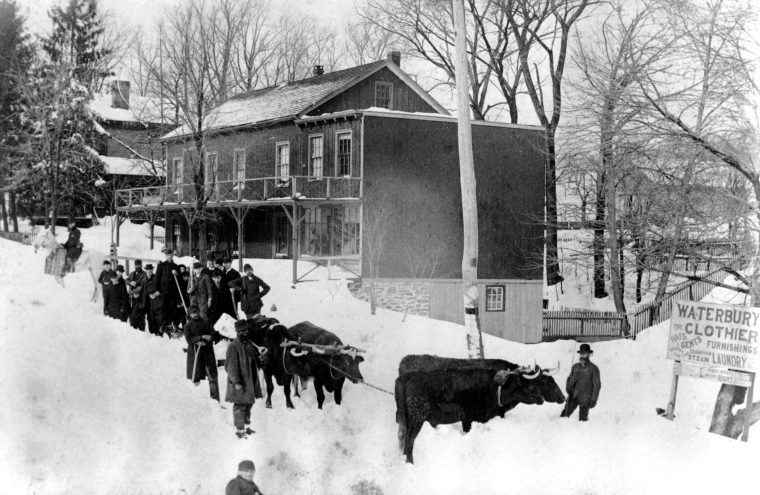
Oxen used to help clear lower Greenwich Avenue, 1888. Courtesy of Greenwich Library.

By Mary A. Jacobson

The winter of 2025-2026 is one of the harshest ones remembered by many Greenwich residents in a very long time. With thermometers reading zero degrees and wind chill temperatures in the negative double-digits, with ice and over a foot of snow lingering seemingly endlessly, it is a winter. With that in mind, it seems fitting to resurrect the remembrances of numerous past Oral History Project narrators who can recount their winter recollections and perhaps give ours a different perspective.

Horace Bassett, a Greenwich dentist born in 1905, was interviewed in 1976 by OHP volunteer Richard W. Howell. He reminisced about the winter of 1918, one of the harshest in his memory. At that time, coal to heat homes “was delivered to Greenwich by barges, not by railroad… Greenwich harbor was completely frozen, so the barges couldn’t get in (to Steamboat Road). The schools were closed because they ran out of fuel… It froze all the way out to the Captain’s Islands.” Horses pulling sleighs traveled on the ice to the stranded barges to transport coal to Maher Brothers, a coal importer on Steamboat Road.

Being young and carefree, Horace and some friends walked over the ice that year to Island Beach to visit its caretaker there, Fred Metzger. Metzger asked the boys to return the next day with his mail from the Post Office and the teens readily agreed. The next day “it must have been towards the end of the cold spell, because the ice was rather weak. My dad happened to be down around Indian Harbor. He saw us out there, met us halfway, and just reprimanded us very severely… Even today I think of what might have been if that ice had caved in.”

Another remarkable year was 1934. William Erdmann, captain of the Island Beach ferry for thirty years, was interviewed in 1975 by OHP volunteer Marge Curtis. As a young man of 24, he recalled that “in 1934 we had a particularly severe winter. It was a combination of real cold weather and no wind, so the Sound was frozen over.” The ice “got real thick at that time. I skated out to the island Ice boating in Greenwich Harbor. Courtesy of Greenwich Library. (Island Beach) to visit the Metzger family who were very low on food supplies. I thought to myself, ‘Boy, I’m a dope for ever being out here on skates all alone.’”

The next time he went to Island Beach, in order to deliver food to the Metzgers, Erdmann put his rowboat on a sled. “I’d pull the boat up on the ice and put the sled underneath it, and I’d walk the rest of the way back in, towing the boat.”

Erdmann had a theory to explain that “awful, heavy ice… That was Depression days, and they just didn’t have much boat traffic, either. So, as long as there was no boat traffic to keep the ice broken up, the ice just got stronger and thicker and thicker and stronger.”

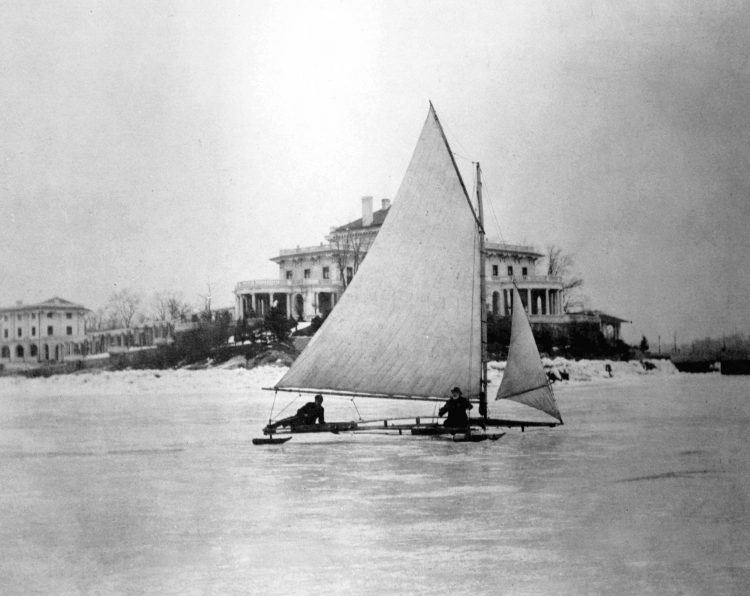
Hugh Dougherty served as dockmaster at Tod’s Point for many years. He was interviewed by Esther H. Smith in 1975 at the age of 72. “We seemed to have much more bitter winters in those days than what you have today, and the Sound would freeze up almost every winter.” He described how, at high tide, along the shore, the ice would “break into cakes and you had what we called ‘cakey.’ Then to get back and forth you had to walk the cakes. I do remember my father being on one and the cake turned over and dumped him in the water… Luckily, we had very few drownings… Old Captain Gardner, who was a very cautious man, warned us if we ever went out to the lighthouse, be sure and take a long sled with us so that if the ice started to get weak at all, you could get on the sled and spread your weight out over a greater area. Then you’d push it along until you got back onto hard ice again.” One of Dougherty’s favorite pastimes was on an iceboat with “a very light frame, with runners on it and a goodsized sail. It did go very fast and it was bitter cold riding on it.”

Cherry Grafton Taylor had somewhat less dramatic, but no less memorable times skating on icy ponds, which she related to OHP volunteer Marjorie Schwier in 1989. “It seemed to me that we had many, many weeks of ice skating and we would take lanterns and skate at night in the moonlight. There’s a pond we used to call Shop Pond where there was an old mill. That was a beautiful place to skate at night when the moon was full and the ice was very thick and black. “Sometimes we would make sails out of an old bedsheet and let the wind take us from one end of the pond to the other.” She, too, had memories of the Blizzard of 1934 “skiing down to Glenville to get milk and eggs.” There was purportedly more than three feet of snow that year in Greenwich and the snowplows couldn’t maneuver. “It was quite a horrendous blizzard.”

Space does not allow us to include the classic nor’easter of 1888 with snowdrifts of twenty feet, or the storm fiftynine years later in 1947, which dumped 25 inches of snow, again stranding residents with dwindling fuel and food. Yet, with these harsh winters and others to follow, the sense of community and the kindness of Greenwich neighbors to one another have remained notable, steadfast, and true.

The Oral History Project is proud to present blogs derived from its collection of recorded interviews as part of the Project’s celebration of “America’s 250th | Greenwich – Greenwich History is American History.” The OHP is sponsored by Friends of Greenwich Library. Visit the website at glohistory.org. Interviews may also be read in their entirety or checked out at the main library. They are also available for purchase by contacting the OHP office. Our narrators’ recollections are personal and have not been subjected to factual scrutiny. Mary Jacobson serves as blog editor.
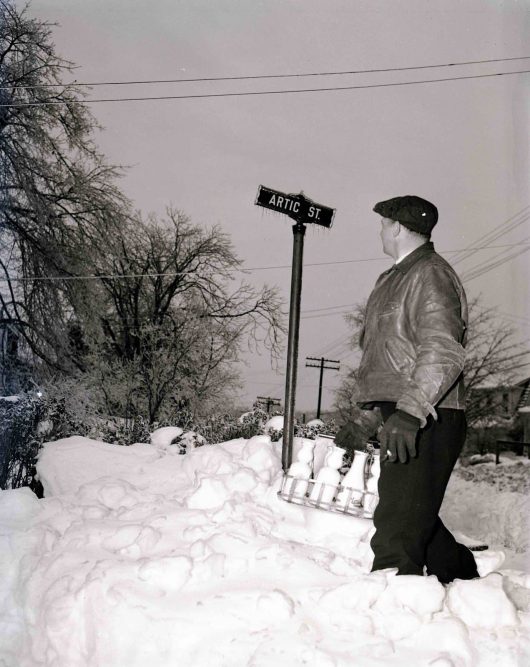
Milkman Francis Connally delivers in the snow to his customers. Courtesy of Greenwich Library.
Ice boating in Greenwich Harbor. Courtesy of Greenwich Library.

Friday, February 6, 2026


The Oral History Project – Celebrating America 250: The Horse and Buggy Man

by Mary A. Jacobson

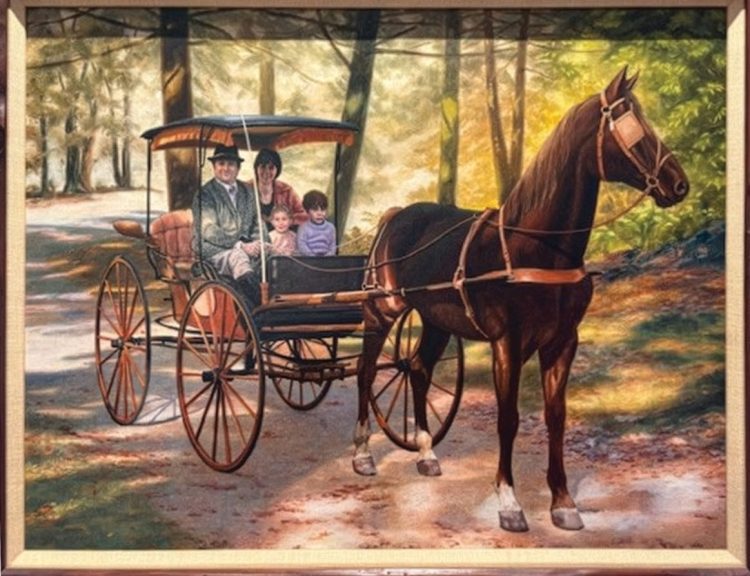
Blaise and Anna Anello with children Andrew and Christiane in a surrey with the fringe on top, pulled by horse Heidi, on Hillcrest Park Road in Old Greenwich, 1977. Courtesy the OHP collection.

For many decades, residents of Greenwich have periodically heard the clop-clop-clopping sound of horse’s hooves, only to turn and see a handsome horse and buggy coming down the road. It’s a reassuring sound, far removed from the screeching sound of tires or the honking of car horns. One might say it is almost meditative. Has the viewer stepped into a time machine and been suddenly transported to a bygone age?

The Oral History Project tasked interviewer Kate Loh with the challenge of finding the answers. She met Greenwich resident Blaise Anello in 2024 who revealed to her the tale of the long and winding road that led him from a boyhood farm in the Tunisian countryside to horse and buggying in Greenwich.

Blaise Anello was born in Tunisia in 1942 “right in the middle of the war. And the war was in North Africa as well as in Europe… Cars at the time were very scarce. My father had a car. And the Italian army came over and they say, ‘We need the car for the war effort.’ And my father had no choice. So (he) went back to horse and buggy like he grew up with.” The bombing in the Tunisian city where they lived caused Anello’s family to relocate to the countryside and rent a farm where they could grow crops. “There was a shortage of everything. There were breadlines.” His dad fashioned a two-wheel cart for his horse made from a car axle with car wheels. “He built a wooden body on it, and he had a way to get to town.”

In 1947, after the war ended, Blaise Anello and his family moved back to the city. However, memories of the farm, and particularly its animals, never left him. “I remember certain things. And the love for horses never left me.” Twelve years later, at the age of 17 in 1959, Anello’s family emigrated to the United States and settled in Yonkers, where he attended high school. There, he met a classmate, Anna, who would later become his wife. After graduation, “We did not see each other for about five years.” However, in 1965, fate intervened on a NYC subway where he noticed Anna. “We recognized each other, and we started dating. And soon after, we decided that we wanted to get married.”

Shortly afterward, Anello obtained a temporary position with an American company in Tunisia, where he and Anna were married. While back in Tunisia, Anello bought a horse. “Just for pleasure. I always wanted to have a horse…This was something I had in my blood all along.” He actually bought two, one for Anna. “And she rode, and I found out later just to please me. It wasn’t in her blood.” Eighteen months later, “when the job was over, I sold the horses.”

Anello returned to the States with Anna and hoped to find a place to live that might also accommodate horses. Purdy’s Farm, on King Street at the time had an apartment there in the barn “and they rented to us. So, once I found that barn, I went to look for a horse.” An ad in the New York Times featured a retired riding mare for two hundred dollars. “Heidi was my first horse in the United States.”

It soon became obvious to Anello that his wife, Anna, “wasn’t crazy about riding. She had fallen off a few times. So, I decided, maybe if I teach the horse to drive, it could pull a carriage. Maybe we can both go on it, and she doesn’t have to ride on a saddle; she can sit right next to me.” Anello obtained his first buggy and harness from Stratford Farms on King Street by trading his talent for electrical work. The owner “had built a new barn and he wanted to put a few lights in there… I said, ‘Tell you what. We could do a trade. I’ll do the electrical work, and you give me that buggy and harness.’”

Anello really had no idea how to train a horse to pull a buggy at the time. “Now, I do this professionally. I train horses to drive… but when I was young and stupid, I knew nothing about it.” At that time, in 1968, Interstate 684 was completed, but not yet open to traffic. “And I taught my horse to drive on 684, a brand new highway between Greenwich and Armonk… One day, a van came by, and it didn’t look like the police, but it was a news crew… here’s a brand new 1960s highway, and here’s a horse and buggy riding on it.”

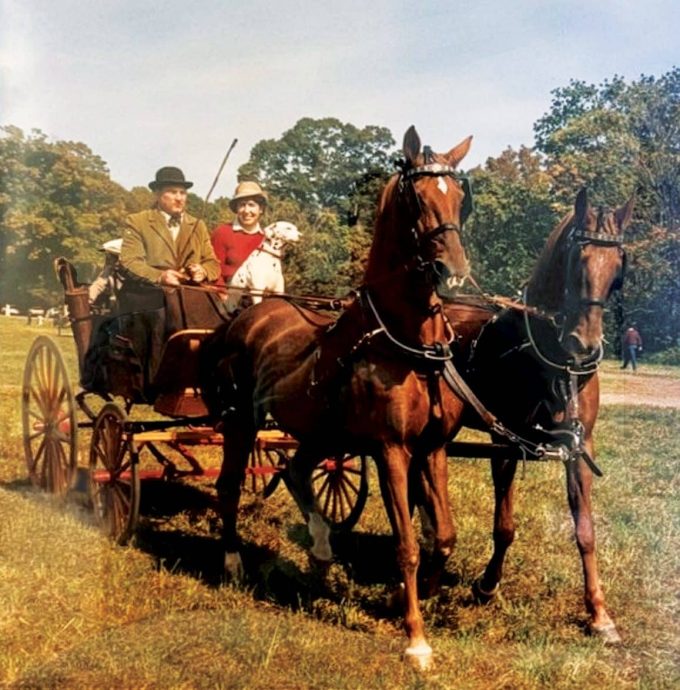
Blaise and Anna Anello with son John and their dog Dutchess in an open carriage, pulled by horses Ginger and Brandy, 1984. Courtesy the OHP collection.

Not long after, Anna found an ad for a house in Hillcrest Park in Old Greenwich with an acre of land, a “fixer upper.” According to Anello, “… the place was pitiful. There was a hole in the ceiling where it was raining in.” However, Anello saw its promise. “The price was reasonable. They said low thirties… and I says, ‘I could do something out of this place.’” At the time, Anna was uncertain but “fifty-six years later, we’re still there. We’re still fixing it.” Three children and eight grandchildren have been added to their family in the ensuing years.

Blaise Anello is a welcome sight with his horse and buggy at Tod’s Point. His twelve-mile route from home is a familiar one, going from Havemeyer Park to Wendle Lane, across Post Road to Laddins Rock Road, and past Perrot Library, and down Sound Beach Avenue to Shore Road. This round-trip ride takes a total of five to six hours from start to finish “but three hours is actually on the road… It’s about forty-five minutes over and back but then I rest and let (the horses) enjoy the view.”

Anello clearly enjoys the pleasure he gives to people who wave and greet him as he passes by. When people ask him how many miles to the gallon he gets, he has a ready answer. “I don’t get any miles to the gallon, but I get a lot of smiles to the mile.”

The Oral History Project is proud to present blogs derived from its collection of recorded interviews as part of the Project’s celebration of America 250 Greenwich – Greenwich History is American History. The OHP is sponsored by Friends of Greenwich Library. Visit the website at glohistory.org. Interviews may also be read in their entirety or checked out at the main library. They are also available for purchase by contacting the OHP office. Our narrator’s recollections are personal and have not been subjected to factual scrutiny. Mary Jacobson serves as blog editor.

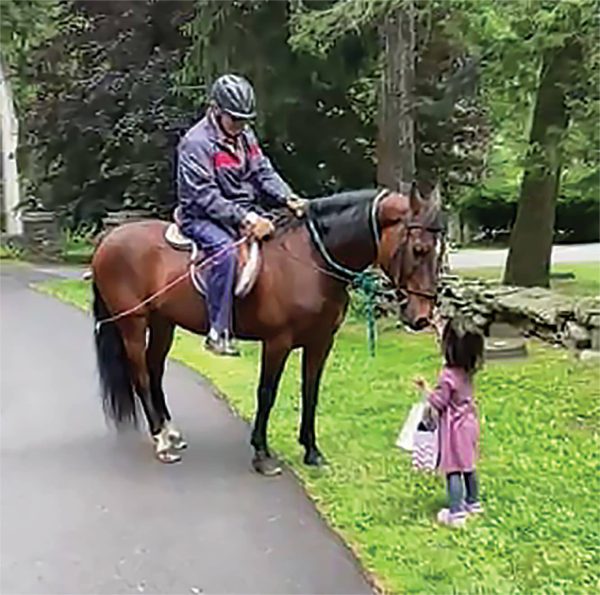
Blaise Anello on his horse Dutch with grandchild Eva. Courtesy the OHP collection.