Friday, March 29, 2024


Olga Zatorsky Hirshhorn – An Immigrant Story
by Mary A. Jacobson

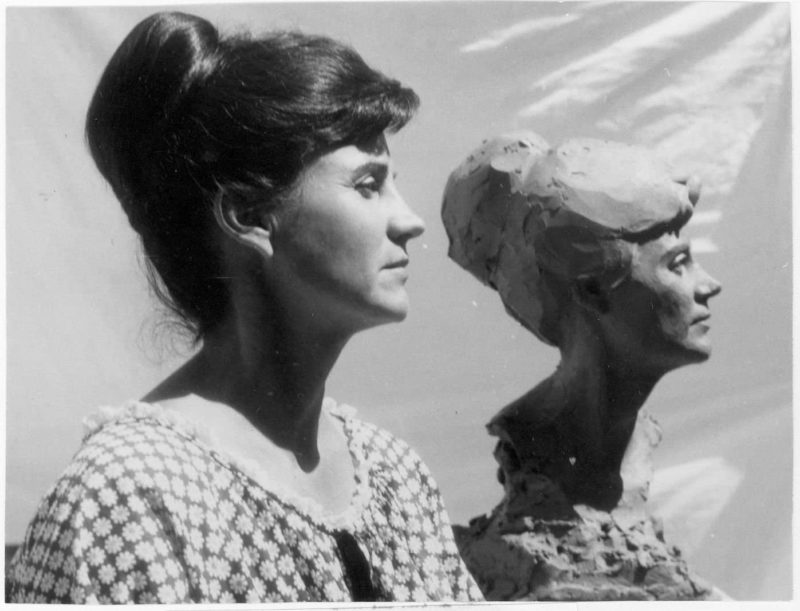
Olga and a bust of her by artist Abel Cretien, 1966. Photo from Collection of Mrs. Hirshhorn.

“I just knew things would get better if you worked hard, and I did work hard. I felt that you get out of life what you put into it.”

Looking back on her life, when interviewed in 1975 by Oral History Project volunteer Penny Bott, Olga Zatorsky Hirshhorn credited her formative years in Greenwich and her work ethic as the building blocks of her character. “Having been born here (in Greenwich) was one of the most important things in my life; and being intelligent enough to take advantage of all the opportunities that were here.”

Olga’s parents were Ukrainian immigrants who arrived in Greenwich in 1916. Working initially as a gardener and a laundress, they provided for their family of three children in a tight-knit community centered on their life on Le Grande Avenue. Olga was born in 1920. “I had a great life as a child here because we were surrounded by fields and woods. The woods are now the Milbrook section; and the Cows Lots, where we had many picnics and campfires and berry-picking periods, are what is now Quarry Knoll.”
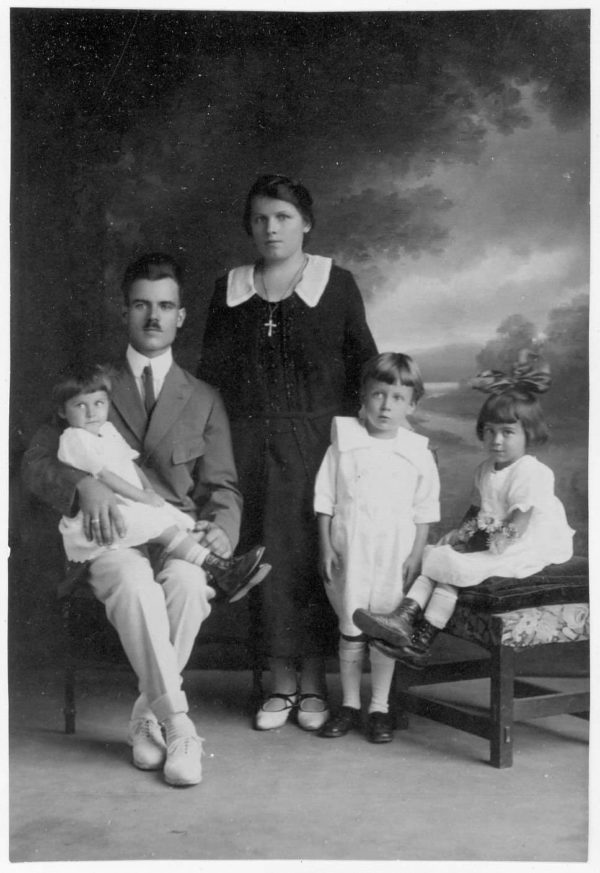
The Zatorsky family (Olga, age one on left), 1921. Photo from Collection of Mrs. Hirshhorn.

Ever enterprising, Olga and her siblings “made extra money by selling to the junkman who came up the street in his horse and wagon. We would hear his bells ringing as he rode up Davis Avenue… and we scrambled around and gathered our saleable items. He gave us a penny a pound for rags and five cents a pound for copper and lead. The copper came from wiring we found in the dump.”

Olga credited her hard-working parents for providing a secure life for the family. Her mother also worked at Electrolux and “as children growing up on Le Grande Avenue, we felt pretty well-off because we always had a car; we always had a telephone; and we always had a real Christmas tree.”

Olga remembered that from a young age “I had to do things for myself.” At the age of nine, she read in the newspaper about a Girl Scout group that was active in Christ Church. “I told my mother that I wanted to be a Girl Scout and she said, ‘That’s all right.’ . . . I walked up there all by myself and just joined. No one knew who I was. No one knew who my parents were… I just loved it. I worked so hard on all those merit badges.”

At Greenwich High School, Olga distinguished herself with her many leadership roles in school activities, including president of the Spanish Club, the G.O. (General Organization), the Girls’ Athletic Association, as well as editor of the school newspaper. Upon graduation, she received the Stanley Finney Award (a scholarship of $25 “which in those days was considered a lot of money”) and the Macy Cup “which made my parents very, very proud.”

One year after graduation, Olga married the English teacher, John Cunningham, who had been the faculty advisor to the school newspaper. “I had three sons with him and was a faculty wife for twenty-three years” before the marriage ended in 1962. In order to supplement her husband’s teaching salary, Olga relied on her independent, entrepreneurial spirit. “I just felt I had to earn money and I had no formal education. I couldn’t really type… and I didn’t want to leave my children.”

An excellent swimmer, Olga started the first learn-to-swim program at Tod’s Point and advertised that she would pick up and return the children. “I just squeezed as many children as I could get in the car.”

Once they moved to a larger house, Olga started a nursery school there. “The day I said the school was opening, I had one child.” Once again, Olga advertised picking up and returning the children. “I remember picking up the child and the mother saying, ‘Where are the other children?’ And I said, ‘Oh, I haven’t picked them up yet.’” By the third week, the “group got so large, I had to stop.”

In the early 1950s “I had decided I had had enough of putting on leggings and boots and winter clothes and wiping noses and decided to start—and it was one of the first, I guess—a babysitting service.” Olga explained, “It was something I could do from home.” Within a short time, clients would call her for recommendations for other needs such as a cleaning woman, a cook, a nursemaid. “And I said yes to everything and went about finding it. . . It was very funny. I’d hang up the phone and say, ‘Now what am I going to do?” Olga would put an ad in the paper for the position, and then “I’d end up with far more cooks or nurses than I needed.” With the additional responses she received, she would advertise in the paper “Cook (or nursemaid) available.”

Eventually, Olga realized that she was inadvertently in the employment agency business. “The phone would ring so early in the morning that I couldn’t get dressed… and so late at night I couldn’t get dinner ready…What I did was all on the phone… I had quite a file of people that were capable of doing many things.” Within the year, she rented office space in downtown Greenwich, hired some employees, and named the business ‘Services Unlimited.’”
One day Olga stopped by the office and picked up the phone to a request for a chauffeur from a Mr. Hirshhorn. After numerous conversations for fulfilling various needs, they developed a rapport on the phone and, eventually, Olga met him at his house when he was sitting for a bust. While talking to the artist, she asked, “Who is this Mr. Hirshhorn anyway?” only to learn that “he’s a famous art collector, and he has the biggest art collection in the world.”

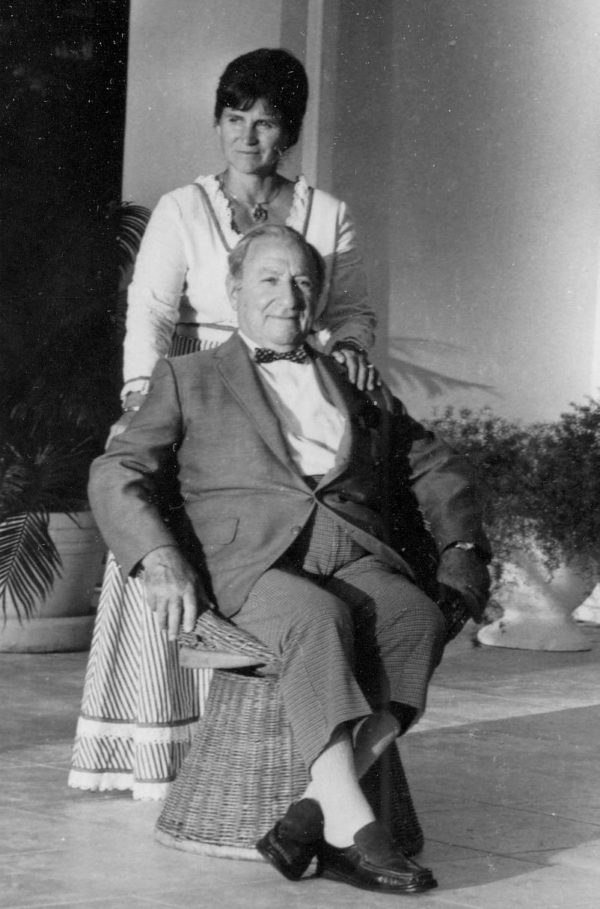
Two and-a-half years later, they were married. Olga sold Services Unlimited to one of her employees and then began a totally new life as she stepped into the role of Mrs. Hirshhorn. During their marriage, The Joseph H. Hirshhorn Museum and Sculpture Garden was conceived and completed as part of the Smithsonian Institution in Washington, D.C.

Married eleven years at the time of her OHP interview in 1975, Olga Zatorsky Hirshhorn reflected, “I thought I had led a very interesting life before I met Joe but, in retrospect, I feel I must have lived in a vacuum because he opened a new world to me – this world of art.”
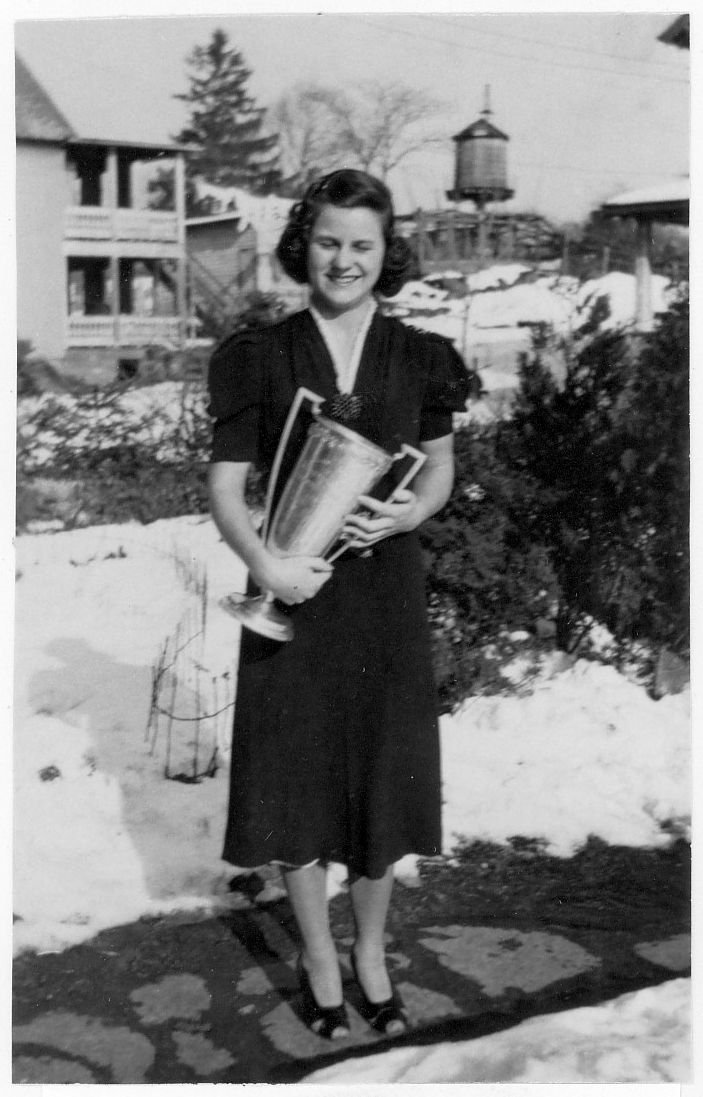
Olga Zatorsky with the Macy Cup awarded at graduation from Greenwich High School, 1938. Photo from Collection of Mrs. Hirshhorn.
Olga and Joseph Hirshhorn, 1975. Photo from Collection of Mrs. Hirshhorn.
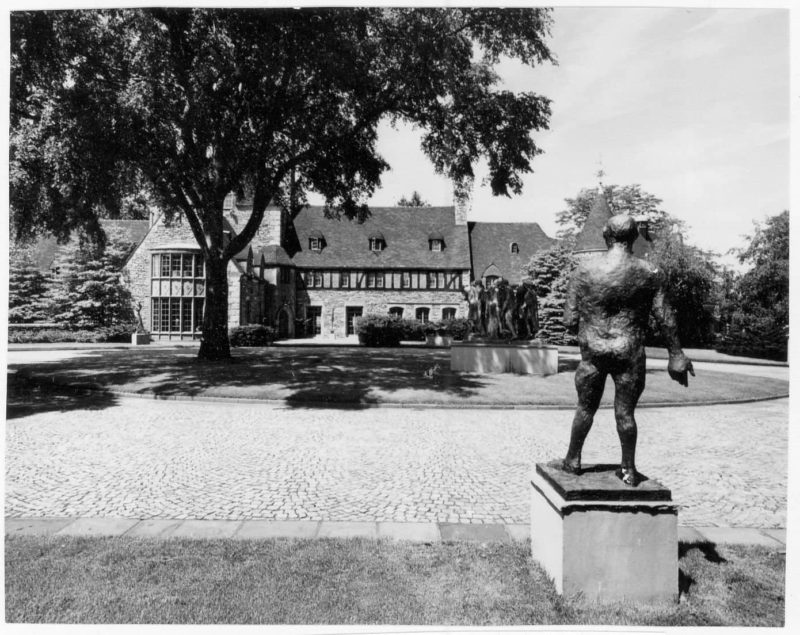
Courtyard of the Hirshhorn estate in Greenwich. Photo from Collection of Mrs. Hirshhorn.


Tuesday, January 30, 2024

Ernest Thompson Seton

In 1902, a few rambunctious, somewhat unruly, children painted the iron gates of a private estate in Cos Cob with “all kinds of things that never should have been put on a gate with paint.” This singular incident may be viewed as the beginning of the formation of the Boy Scouts of America in 1910. 

Ernest Thompson Seton, from "By a Thousand Fires," by Julia Seton.
Copyright 1967 by Julia Seton.
Reproduced by permission of Doubleday & Co., Inc.

The gates were located at the entrance to a 100-acre estate on Orchard Street, known as Wyndygoul, that belonged to Ernest Thompson Seton, who had purchased it two years earlier.  Instead of calling for severe consequences for the young perpetrators, Ernest Thompson Seton must have decided instead that these children didn’t have enough productive ways in which to spend their idle hours. He visited Cos Cob School and spoke to some boys, inviting them to his property for an overnight stay during Easter vacation. One of them was Leonard S. Clark, ten years old at the time, who was interviewed by Oral History Project volunteer Penny Bott in 1975. He proclaimed at the time of his interview, “ . . . honestly and truthfully, I didn’t do it (paint the gates!).” 

Boys by their tepee at Wyndygoul.
Courtesy of Charles A. Clark
 

Leonard had clear memories of that first overnight at Wyndygoul (a Scottish name meaning Windy Gulch). “I remember distinctly that we were told to bring along a blanket, so that we could sleep in a tent that night.”  Mr. Seton’s “tent” was, in reality, “an original Indian teepee that Mr. Seton had bought somewhere from Indians and brought with him to Wyndygoul.” That night, by the light of an open fire, “Mr. Seton told us stories. . . . When he told us stories about the Indians . . . everybody paid attention. Not only paid attention, but we were just entranced with his talking. . . . Nobody ran around, nobody left, nobody turned their heads, nobody spoke. . . . He spoke of the Indians as outstanding individuals.” In addition, the boys were given advice about values, “about fair play, about never lying. He looked down on an individual if you told a falsehood. . . . We were taught always to tell the truth.”


Ernest Thompson Seton teaching archery, from "By a Thousand Fires," by Julia Seton.
Copyright 1967 by Julia Seton.
Reproduced by permission of Doubleday & Co., Inc.

At the close of that first night’s camp experience, Mr. Seton invited the boys to come back in the summer for a longer stay. The boys were to be called Woodcraft Indians and given Indian names. Clark’s name was “Broken Arm.” Their activities were chosen primarily to enhance their knowledge and skills of life in the woods. One involved swimming across the lake, which was about a hundred yards. “We ran races for which we got what he called a ‘coup.’ A coup was a feather that we could put in our hair . . . and, if you did particularly good, on the upper part of the feather was a little white thread that he had put on, and that was a grand coup.” They also raced around the lake “for the hundred yards and then we had the two-twenty races.” 


Ernest Thompson Seton teaching fire-making, from "By a Thousand Fires," by Julia Seton.
Copyright 1967 by Julia Seton.
Reproduced by permission of Doubleday & Co., Inc.

 A favorite game was the “deer hunt” in which one boy was elected to be the deer and given a head start. He would wear shoes onto which iron hoof forms, resembling deer hoofs and made by a blacksmith, were fastened. Off he would go over hills and rocks, trying to elude the “hunters” who followed the tracks until the “deer” was found to great elation. “It was an honor to be the deer, and we all wanted to be the deer, and Mr. Seton would change around so we would all have a chance.”

 The next year, Mr. Seton invited the boys to return “and then it grew, and all the Cos Cob boys came,” eventually including other boys from Greenwich. Ernest Seton taught the boys lessons which resonated with them throughout their lives. “Everything Mr. Seton taught us had something to do with . . . the development of fine young men, in every sense of the word. . . . He was teaching us honesty. . . . He was teaching us to be a team, to play together. He was teaching us of manhood that was to come, and he was teaching us the worth of outdoor life. . . . Everything that you can think of that’s good.” In addition, “There were no harsh words, no swear words. Swearing was one of the things that you just didn’t do. . . . While we were having a good time, in reality he was teaching us the proper things in life.”

 Ernest Thompson Seton was a member of the Camp Fire Club of America and invited that group to come to Wyndygoul to observe the Woodcraft Indians. He also wrote a book entitled “The Birch Bark Roll of the Woodcraft Indians,” which delineated in great detail the rules, goals, games, and activities of the program he created. Sir Robert Baden-Powell of England, who authored “Scouting for Boys” and organized the Boy Scouts in England, was impressed and influenced by Seton. “But where we were called Seton Indians . . . he called them Boy Scouts.”


Leonard S. Clark
Courtesy of Maryanne Gjersvik

 Leonard proudly stated, “So the Boy Scout movement that’s over the world today . . . came from England back to us. . . . And so the first Boy Scouts in the United States were the group in Cos Cob under the leadership of Mr. Seton. . . . I attribute the good health, the fine characters we had . . . to the outstanding training Mr. Seton gave us boys in Cos Cob.” 

 The interview Seton’s Indians” may be read in its entirety or checked out at Greenwich Library and is available for purchase at the OHP office. The OHP is sponsored by Friends of Greenwich Library. Visit the website at glohistory.org. Our narrator’s recollections are personal and have not been subjected to factual scrutiny. Mary Jacobson serves as blog editor.


Tuesday, January 16, 2024

YEARS AGO IN GLENVILLE

“The whole town was like a big
family. We shared each other’s joys and sorrows.” Frances Chmielowiec Geraghty, on three separate occasions in 1975/76,  was interviewed by Katherine Scanlon of the Greenwich Library Oral History Project to capture memories of a lifetime in Glenville. She had much to tell about a life that had its share of hardships and setbacks, but was remembered by the joy and comfort of a loving and large family.

Frances Chmielowiec Geraghty photo by Karl Gleeson
Courtesy of Oral History Project.

Frances was the third of ten children born in 1907 to Polish immigrants.  “They had such large families. Everybody had. I don’t think there was any with less than five.” According to Frances, “We were all Polish-speaking people. . . . There was a great crowd (of immigrants) that came at once; we were all growing up together.”

Glenville was largely a company town. “Almost every house in Glenville was owned by the American Felt Company.” Rent of a dollar a room was paid to the AFC. Families who managed to snare a house with multiple bedrooms would rent them out to boarders for extra cash. “I don’t know anyone in Glenville that started with my mother’s crowd that didn’t end up owning their own home . . . without asking anyone’s help.”


1908 photo of the Chmielowiec family with sisters Mary and Eleanor and adopted son, John. Frances is seated on a cushion on the floor.
Courtesy of Frances Geraghty.

There was a strong sense of community among these young immigrants. Families grew their own vegetables and many owned chickens and pigs. “There was always an exchange. If you didn’t have a good crop of one thing and the other did . . . you just didn’t refuse anyone. . . . People were closely knit in those days.” Frances remembered that her father would be asked by “the people from the country, upper King Street” to help fulfill their needs of a seamstress, a cook, or a milkmaid.   He would then investigate which ships were coming into the Port of New York, hitch up the horse and wagon, and ride down to the docks. As the passengers stepped off the ship, her father would shout, “Who can cook? Who can sew? Who can take care of horses?” Soon he would have a wagon-load of young people who stayed with them until they procured jobs. 

In those early days of her life, Frances remembered that there was no electricity. “Don’t forget there was no water in Glenville either . . . no water till after I was married (in 1930). . . . Every bit of water had to be brought into the house, pumped in. My mother with ten children on wash day was really something.” In addition, “Everybody had an outdoor privy; and you weren’t embarrassed about it because everyone else had one, too.” Proudly, she stated, “Well, we had the best one in town. We had a five-seater.”

The house, owned by the American Felt Company, in which Frances Geraghty was born in 1907. Her father’s general store occupied space in front of the building (not visible). Courtesy of Frances Geraghty.

News traveled in a different way in those days when people did not have telephones. “There was a very unusual way of gathering people.” Someone with “a very fancy bugle with tassels hanging” would stand in the center of town and blow it. “ . . . everybody came running from the hills or they sent the children out. ‘What’s the matter? What’s the matter?’” The bugle was blown when the First World War ended. It also announced when someone had died or if an important meeting was to take place.

As Frances reminisced, she said wistfully, “I don’t think anyone today can visualize or comprehend a life like this. . . . You have to remember the quietness of the town. . . . You heard nothing except the humming of the felt mill, and that would be down toward the river. There were no airplanes, no traffic, no cars. . . . You could hear crickets, locusts, maybe a cow mooing or a rooster crowing. Those were the only sounds we heard. The smells were beautiful. You could smell sweet hay and strawberries.”

Frances remembered making deliveries by horse and wagon with her father from his general store to customers on Porchuck Road, Round Hill Road, and Banksville. In the summer, they would leave at 4:30 in the morning. “I remember coming back home at dark, at night. Sometimes my father would fall asleep and the horse would bring us home.” In the 1930s, the A&P came to Glenville; her dad could not compete with their prices and eventually closed his store.

The onset of the Depression led to difficult and challenging times for Frances and her family. “Bill and I got married at the height of the Depression (1930). There were no jobs. There was nothing; no money. . . . My mother had seventeen people in the home. My father was making a dollar a day for the WPA (Works Progress Administration) building the Glenville School playground. . . . There was nothing to do but go and do domestic work. . . . I had dresses that were somebody else’s and coats that didn’t fit.” Frances and Bill, who was recovering from tuberculosis, lived with her parents for a time. Eventually, Bill got a job as a plumbing apprentice for eleven dollars a week and they were able to rent a tiny house near her parents. “It had no water, no lights, and, of course, no heat.” They preferred to call it their “honeymoon house.” “Yet, somehow,” Frances said, “through all that, you had your garden and you had a few chickens.  You survived. And we had each other which was the main thing.”

Economic circumstances improved for them with the onset of the Second World War when she and Bill obtained jobs with Electrolux in Old Greenwich. At the time of her interview, Frances worked at Town Hall. As she looked back on her life and times, Frances stated, “. . . they were rough times, but they were happy days. . . . Those were the good old days.”

The interview “Years Ago in Glenville – Frances Chmielowiec Geraghty” may be read in its entirety at Greenwich Library and is available for purchase at the OHP office. The OHP is sponsored by Friends of Greenwich Library. Visit the website at glohistory.org. Our narrator’s recollections are personal and have not been subject to factual scrutiny. Mary Jacobson serves as blog editor.