Friday, December 23, 2022

The Legacy of a Community Gem in Old Greenwich
by Mary A. Jacobson

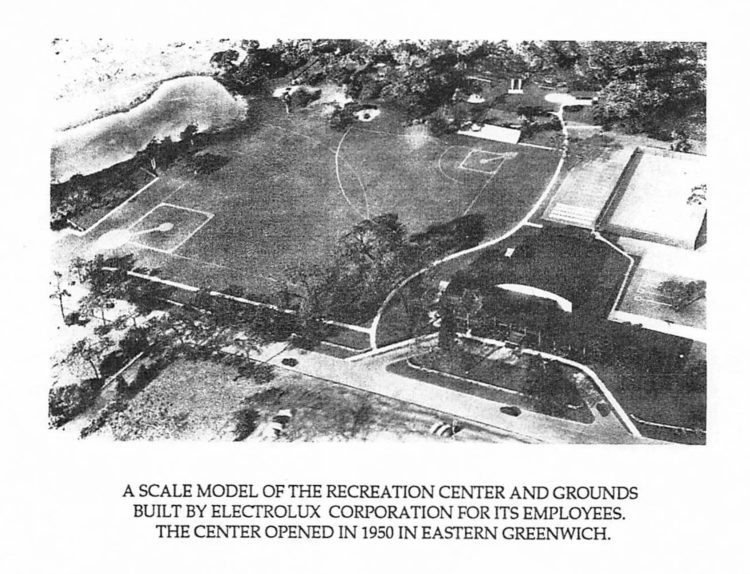
Scale model of the 20-acre recreation complex (Ekman Center) built in Old Greenwich in 1950 for Electrolux employees which became the Greenwich Civic Center in 1967. Courtesy of the Oral History Project.

Seventy-two years ago, in December of 1950, on the grounds of the present construction site of the Cohen Eastern Greenwich Civic Center, the CEO of Electrolux, E.V. Ekman, proudly announced the opening of the Electrolux Recreation Center for the benefit of its employees and their families. In Mr. Ekman’s words, “This is an Electrolux investment…We shall measure the soundness of this investment only in terms of the amount of good that it can be made to generate.”

The Electrolux Company began manufacturing in Old Greenwich in 1933, producing millions of vacuum cleaners by the time it closed in 1985. After World War II, Electrolux acquired a 20-acre tract of land adjoining the plant and set about planning a recreation center and playing fields. In 1948, the task of “converting a swampy waste into a paradise for play for Electrolux folk” began. The completed project afforded workers eight bowling alleys, ball fields, an auditorium/gymnasium, snack bar, and lounges.

John De Forest worked for Electrolux in the 1960s and was interviewed by Penny Haughwout of the Oral History Project in 1986. He described the various activities, parties, entertainment, and dances that were provided for the employees at the then-renamed Ekman Center. De Forest recounted, “At the time it (the Center) served a purpose. But, as the years went on, with all the competition with television and other things, lifestyles changed.” Over time, many employees preferred to go home at the end of the workday and did not stay for recreational activities.

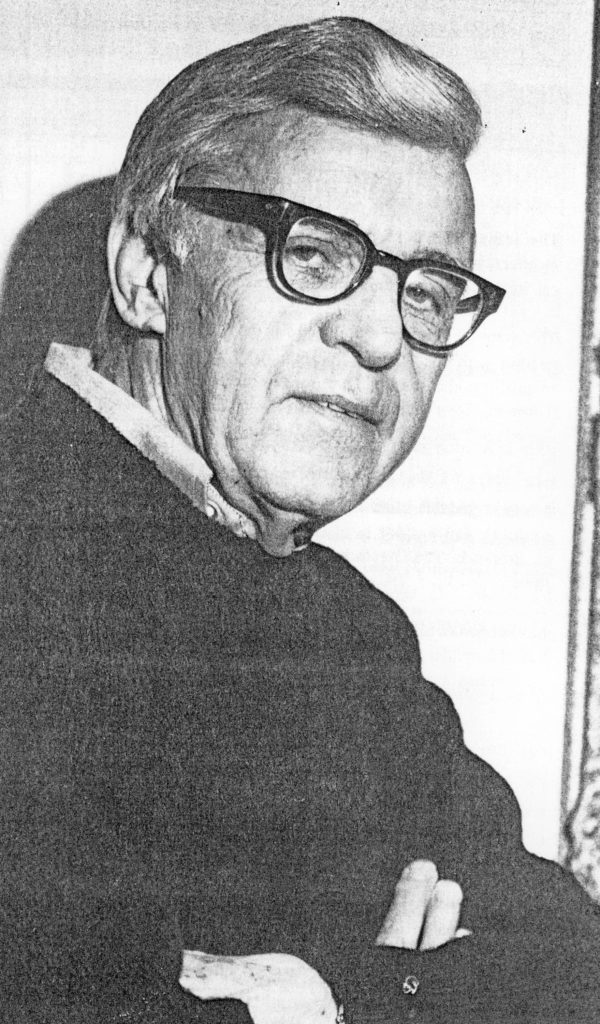
In 1967, the Town of Greenwich purchased the building and grounds for $432,000 and renamed it the Greenwich Civic Center (later the Eastern Greenwich Civic Center). At the time, Lowell Weicker was First Selectman of Greenwich. Charles Henninger was its first director and remained in that position for twenty-five years. In 1992, he was interviewed by Patricia Holch of the Oral History Project. “Four hundred and thirty-two thousand dollars for the building and twenty acres of property…was a very, very good deal for the town.”
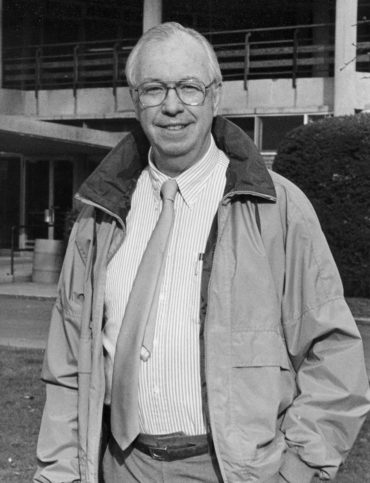
Charles Henninger. Photo by Karl Gleason. Courtesy of the Oral History Project.

According to Henninger, “The early days of the Center were very youth oriented. We had drop-in programs. Dances every other week. The dances were an adventure because, in those days, we cut it off at a thousand…all the regional and local bands that were popular with the kids. Things like the Strawberry Alarm Clock and The Rascals, The Mothers of Invention, Wilson Pickett…All these groups drew lots of people.”

Many celebrities were hosted over the years. “Lionel Hampton’s been here several times. Frank Sinatra Jr., Grand Ole Opry, George Gobel, Jonnie Ray, Myron Cohen…Up with People. Very popular. Big drawing card.” The large outdoor acreage provided for tennis, baseball diamonds, a children’s playground, softball and soccer leagues, company picnics, and much more. The bowling alleys were eventually covered over to provide for more much-needed space.

Senior citizens events included parties at Thanksgiving, St Patrick’s Day, Christmas, and End-of-Season, averaging four to five hundred seniors. For the Thanksgiving event, Henninger needed more people to wait on tables. “So, I just happened to mention at one of the Board of Estimate meetings, ‘Why don’t you guys come out to do it?” Subsequent Thanksgiving gatherings included “three Selectmen, members of the Board of Estimate, the fire chief, the police chief, Department of Social Services, traffic engineer…It’s really become something that people look forward to doing. So, it’s a fun thing. . . We’re very proud of that.”

Popular and unforgettable events in the late sixties and early seventies were the circuses “sponsored by the Friends of the Library.” The first year of the circus, five thousand tickets were sold, and a huge tent covered the outside area. “That was the day of the record rainfall of nine inches…We tied the elephants on the small trees. The elephants uprooted the trees… All the trucks got caught up to their axles in mud. So, we had the elephants pull the trucks out. So, it really looked like a disaster.”

Henninger also recalled accommodating the Darien High School senior prom in the 1970s when it was suddenly displaced because of a fire at their anticipated location. The night before “we had the state collie show here. We were up to our ankles in dog hair.” The students arrived to set up for the prom “and were all upset, but we vacuumed all over and got it ready and it worked out. So, that’s the challenge.”

In 1991 there were 1203 different programs at the EGCC. “We had dances, fashion shows, concerts, dog shows, picnics, antique shows, train shows, athletic leagues, banquets, seminars, bridal showers, baby showers, roller skating programs, senior citizen programs, Weight Watchers, square dancing…We don’t have a free weekend…When Governor Weicker was here maybe three months ago, he stuck his head in the door and said, ‘I thought this place was a white elephant. I can’t find a place to park out there.’ He’s always very proud that he pushed to get the place.”

As of this writing, the EGCC is currently an active construction site as it undergoes a transformation within its existing footprint. The original building has been demolished and will reopen as the Cohen Eastern Greenwich Civic Center, after Steven and Alexandra Cohen donated five million dollars to the project, in a public/private partnership with the Town of Greenwich.

May the seventy-two-year investment in this site continue, in the words of Mr. Ekman of Electrolux in 1950, “to provide an abundant return in terms of human values.”

The interviews entitled “Electrolux” and “Greenwich Civic Center” may be read in their entirety at Greenwich Library and are available for purchase at the Oral History Project office. The OHP is sponsored by Friends of Greenwich Library. Visit the website at glohistory.org. Mary Jacobson serves as blog editor.
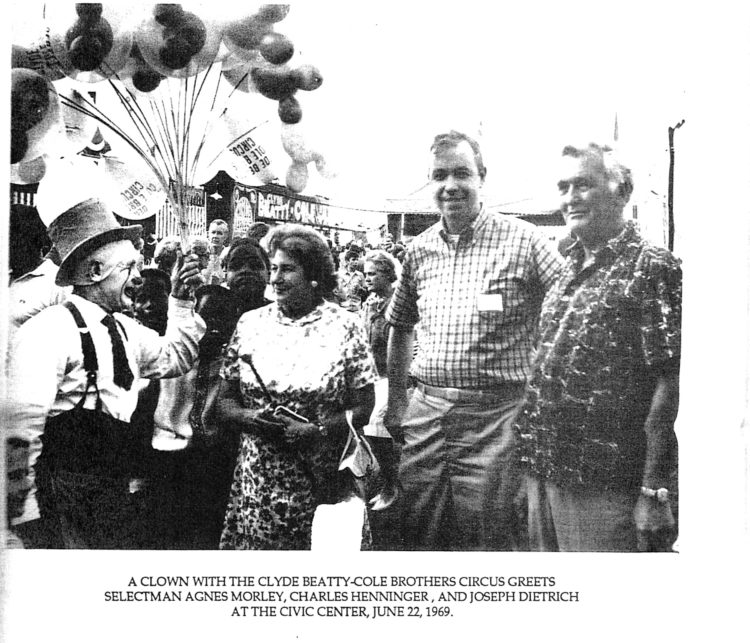
A clown with the Clyde Beatty-Cole Brothers Circus greets Selectman Agnes Morley, Charles Henninger, and Joseph Dietrich at the GCC, 1969. Photo by Cal Hood. Courtesy of the Oral History Project.


Friday, November 25, 2022

Conyers Farm Then and Now

by Mary A. Jacobson

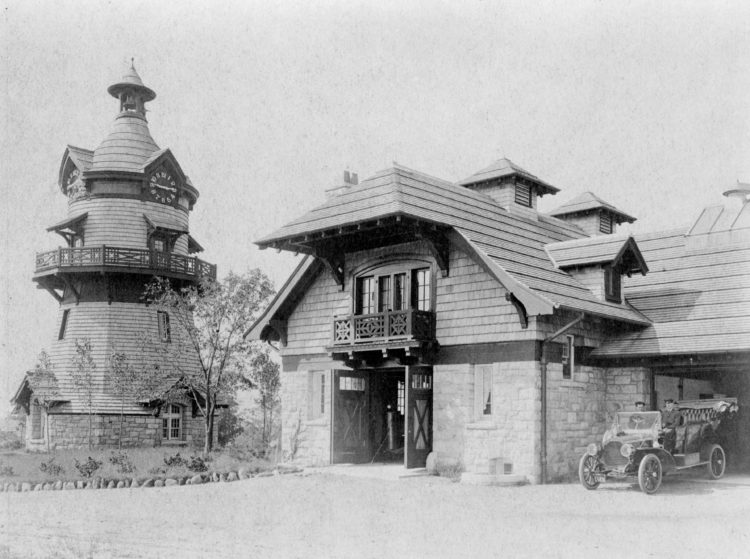
Clock tower and part of garage of Converse estate. Courtesy of Frances Benjamin Johnston Photograph Collection, Library of Congress (Reproduction #LC-USZ62-110482).


In 1977, the land that now comprises the 78 luxury homes of Conyers Farm, was described as “desolate and overgrown…I have no desire to see the place in its present state of neglect.” These words were spoken to interviewer Penny Bott of the Oral History Project by narrator Eleanor Enright as she decried the condition of the once-beautiful estate where she had worked from 1934 to 1950.

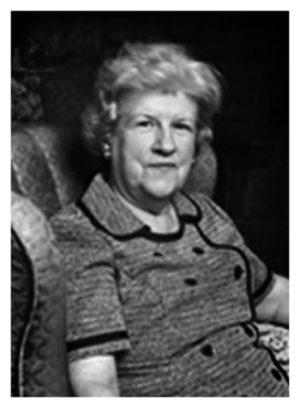
Eleanor Enright worked as a secretary to Carlyle Gowdy, manager at Conyers Farm. Her mother, Grace Sullivan, preceded her years before in the same position for then-manager, George Drew. Eleanor shared vivid memories of the history and times of the original estate, which comprised over 1,400 acres. In her words, “I am glad to have experienced this life cycle of a place.”

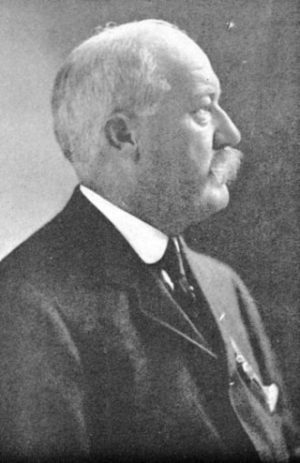
Greenwich at the turn of the twentieth century was a farming community. By 1904, Edmund Cogswell Converse, steel industrialist and first president of Bankers Trust Company, assembled his estate by purchasing and consolidating approximately 20 farms in North Greenwich and the neighboring town of North Castle, NY. He then began work on converting the property into Conyers Manor. (“Conyers” was purportedly an Old English spelling of “Converse.”)

Edmund Converse. Courtesy of Greenwich News and Graphic, September 22, 1916.

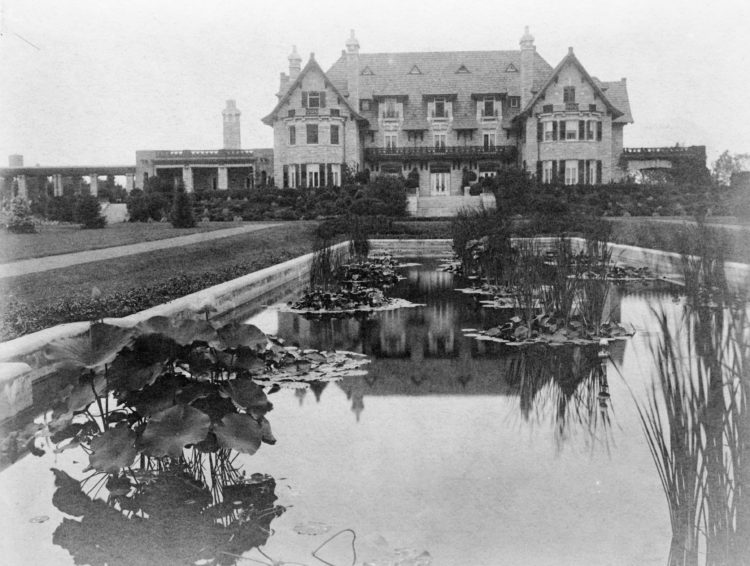
According to Eleanor, “They used hundreds of workmen . . . artisans of every type. At that time horses were still in use, and many teams hauled the materials from the (railroad) station…It was like the building of a village.” The original gatehouse was on the corner of Lower Cross Road and North Street. A mile-long driveway led to the 52-room manor house, which was situated on the highest point of land, “with a perfect view of the surrounding countryside and Long Island Sound.” Along the driveway were specimen trees “planted in every variety you could imagine…There were all kinds of bulbs and flowers and flowering shrubs blooming in spring and summer.”

There were approximately 40 structures on the estate, many designed by Donn Barber, a well-known architect. Buildings included the stone manor stables that housed Converse’s own horses and carriages. Other structures included a farm garage with a fire engine. There were also eight greenhouses. “One was a palm house, a large round glass building like the one at the Botanical Garden in New York, where they grew nectarine, palm trees, orange trees, and flowers of all description.” In addition, there was the blacksmith shop, a boarding house for a number of the workers, a one-room schoolhouse, an icehouse, a boathouse, a 30,000-gallon water tank, and a cold storage building with a capacity for “at least forty or fifty thousand bushels.”

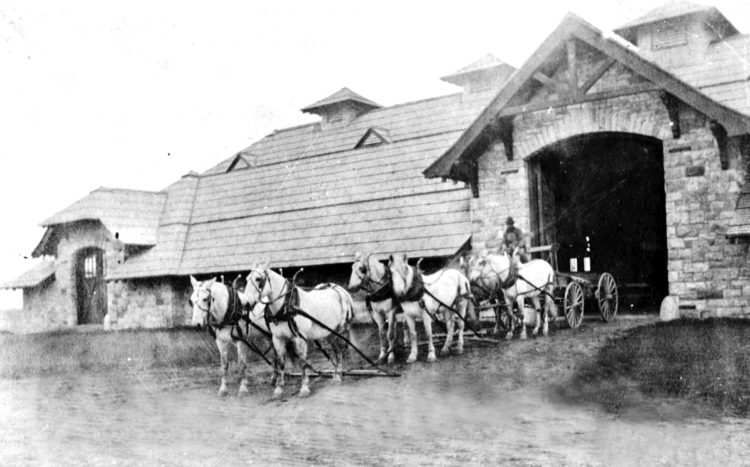
The farm barn had stone walls and a steeply pitched shingled roof. Its wings housed the cow barn and the horse barn; in the center were the wagons. Guernsey cows grazed in the fields. “The milk was so good…You could see that the cream filled at least half the bottle.” In addition to the farm barn, there was an overflow barn “used to store all of the extra hay and farm equipment, and so forth. Also, they had a poultry department where fresh eggs and chickens were produced.”

One of the signature structures on the property was the clock tower. “It was absolutely beautiful. It would remind you of a windmill.” At approximately forty feet tall, one could see the Empire State Building from the balcony under the face of the clock. “There was a bell in the tower, and the bell would ring the hour and the half hour…It just sounded all over the countryside, like a fire bell. In fact, that was the bell they used as a fire alarm and that bell would sound all over the Stanwich area.”

A number of the original farmhouses that comprised the estate were maintained by house employees. Many of the homes were referred to by the names of the families who had once lived in them. “We always spoke of the McCann Cottage, the Powers Cottage, the Buckout Cottage, the Albert Close and Gilbert Close houses, and the Mead Farm.”

Approximately four hundred acres of the property were developed into orchards. “Conyers Farm apples, pears, and peaches became known throughout the East coast. People used to drive out on Sundays from New York…We shipped pears and apples many times across the country to customers and to our boys in the service.”

Edmund Converse died in 1921. The property was unoccupied until it was purchased in 1936 by Lewis Rosenstiel, founder of Schenley Corporation. His hopes to reduce the zoning regulation from four acres per lot to half-acre lots for 83 acres was rebuffed by the town. The proposal of office buildings on the property was also denied. Over the years, few improvements were made to the neglected estate and a number of buildings were ravaged by fire.

When Eleanor Enright was interviewed in 1977, Conyers Farm had not yet been purchased by Peter Brandt and developed into the minimum 10-acre residential properties, arts center (repurposed from the original cold storage stone barn), and polo fields we know today. At the time of her interview, Eleanor’s closing remarks were, “And so what will the future hold for this wonderful place? I hope I live to see a bright future for it.”

Eleanor Enright. Courtesy of Miss Enright.

The book “Conyers Farm” may be read at Greenwich Library and is available for purchase at the Oral History Project office. The OHP is sponsored by the Friends of Greenwich Library. Visit the website at glohistory.org. Mary Jacobson, OHP blog editor.

Home of Edmund Converse. Courtesy of Frances Benjamin Johnston Photograph Collection, Library of Congress (Reproduction #LC-USZ62-110479).
Horses and wagon exiting the cold storage barn. Courtesy of the Greenwich Library, John Gotch Photo Collection.

Monday, October 3, 2022

Greenwich Symphony Orchestra

by Mary A. Jacobson

Mary and Dick Radcliffe, 2007 photograph from Mary Radcliffe personal collection.

Music! Music! Music! How wonderful to have the Greenwich Symphony Orchestra resume its performance schedule on September 10, 2022, after its programming was interrupted by the pandemic. Its inaugural concert was played to an appreciative audience at the Performing Arts Center at Greenwich High School. The concert also introduced the orchestra’s new conductor, Stuart Malina.

In 2011, the Oral History Project published “The Greenwich Symphony Orchestra: 53 Years of Superb Performances,” a compilation of several interviews of board presidents dating from 1976 to 2011.

The history of the Greenwich Symphony Orchestra dates back to 1958, when a local orchestral group became the Greenwich Philharmonia, conducted by Ken Wendrich, head of the music department of Greenwich High School. A board of directors was formed with Catherine Felding (Mrs. Allen Converse at the time) as its first president who served until 1967. The orchestra held three concerts a year.

The year 1967 is considered a watershed year for the GSO by many, the year the orchestra transitioned into a fully professional one with growing prestige. That was the year that a search for a new conductor led to a young man, John Nelson, “straight out of Juilliard, who had been highly recommended,” according to Marianne Jeffrey, board president at the time. John Nelson was the first of twelve applicants to audition. “Each conductor was to take the orchestra, first rehearsing a piece they had once performed, and then work on something they had never performed…His rehearsal technique was even then really remarkable, how he brought out more than they thought they could do… A survey was taken from all the orchestra members, which showed the orchestra also felt how marvelous he was, how very fine a musician he was, but they were also a little worried whether they could live up to such a conductor.” No more interviews were conducted. “We gave up after that first night because it wasn’t needed anymore.”

Mary Radcliffe, who began her thirty-seven-year tenure as president of the board in 1975, stated that John Nelson “was with us for seven years, and he made the orchestra a professional orchestra. Everybody was now being paid. He also had a lot of contacts with Juilliard. He got wonderful soloists…That was a turning point for the orchestra. Also, he enlarged the orchestra’s string section. So, it became a real symphony orchestra.” In 1975, the orchestra changed its name to the Greenwich Symphony Orchestra. That year it also welcomed David Gilbert as its conductor and music director. He remained in that position for the next 45 years.

One aspect of the orchestra of which its musicians and the board are particularly proud is that there is no paid management. According to Mary Radcliffe, aside from the librarian, personnel and concert managers, and the musicians, “the orchestra has never had an executive manager or a paid manager…Every other orchestra in the American Symphony Orchestra League, every other orchestra with this budget size has a person like that, but we have a symphony board, which is a volunteer board, that manages the orchestra.”

The Chamber Players of the Greenwich Symphony, in existence since 1971, is an independent ensemble, whose musicians are drawn primarily from the principals of the GSO. They present four sets of subscription concerts each season. “It’s really a wonderful program. They do all kinds of chamber music. Not only strings –woodwinds, harp…they program that… we advertise each other,” explained Mary Radcliffe.

The Young People’s Concerts have been a source of pride for the GSO. In collaboration with the community’s music educators, children in the Greenwich public and private schools are provided with a unique musical experience which includes a pre- and post-concert curriculum. “We present professional orchestra concerts to every child in this town, grades two through seven…This is not an outing for these kids…they come absolutely fully prepared,” explained Mary Radcliffe.

The pandemic had a disruptive effect on the programs and concerts normally performed by the GSO, from the spring of 2020 until this month’s inaugural concert. The Oral History Project has embarked on a “COVID Project” to document the effects of COVID-19 on the people and institutions of Greenwich. Volunteers of OHP have conducted more than sixty interviews in this endeavor. Daniel Miller, personnel manager of GSO, was interviewed by Connie Gibb, and described the impact of the pandemic on the orchestra. In his words, “Everything stopped. I mean, it was astonishing. And that’s really a big shift…Our whole organism, our whole life is geared up towards spending these hours in the evening being at our top form and performing. Our days are kind of balanced around that. And so that kind of performance…that was just taken away.”


Now that the music and performances of the GSO have resumed, the Greenwich community can once again appreciate and support this community gem. As Danny Miller expressed, “… music is kind of like time travel. You can go places, you can visit other centuries, other settings through music. And to do that together in this community is precious. And I think that’s something that’s transcendent, and I think that’s what the audience wants, as well as the performers. It is a communal experience, which is very important. And I think people long for it.”

The book of interviews entitled “The Greenwich Symphony Orchestra: 53 Years of Superb Performances” may be read in its entirety at Greenwich Library and is available for purchase at the Oral History Project office. The OHP is sponsored by Friends of Greenwich Library. Visit the website at glohistory.org. Mary Jacobson serves as blog editor.
Monday, August 15, 2022

The Hurricane of 1938

The unnamed hurricane of 1938 is purported to be the first major hurricane to strike New England since 1869. It was one of the most powerful and destructive hurricanes of the twentieth century.

Moving at 47 miles-per-hour, its center made landfall at the time of an astronomical high tide and fueled storm tides of fourteen to eighteen feet across the Connecticut coast. In addition, in 1938 there were no advanced meteorological technologies such as radar, radio buoys, or satellite imaging to warn residents of an oncoming hurricane.

Paul Palmer after he joined the 
U.S. Navy in 1942. Photo lent by 
the Palmer family to the Oral 
History Project.
Paul Palmer, aged fourteen and living on Willowmere Avenue at the time, experienced this storm first-hand. His vivid recollections were recounted to Barbara Ornstein of the Oral History Project in 1975.

On September 21, 1938, Paul and his classmates were dismissed from school at noon as heavy rain had been continuously falling for several days. “I remember coming home and how hard that wind was blowing. I can see the trees going over, you know, but there was no mention of a hurricane.” Once home, Paul and his friend, John [Buster] Clarke, helped Paul’s dad pump out the flooded cellar. Paul recounted, “Then I remember it started raining again that afternoon. The tide was due to come in at night. It was an afternoon tide. I’d say around five o’clock…That wind was blowing; man alive, that wind was blowing. And then, all of a sudden, the rain had let up. I guess the eye had come through, you see, and we thought everything was all over…And that’s when we all took off.”

Paul and Buster heard police and fire engine sirens coming down the street; they ran out to follow them and saw a boat aground on Great Island. “And so, Buster and I said, ‘Well, gee, we can get closer than this. Let’s walk the wall around’… and we crossed over to Quigley’s Island [then part of the Martin J. Quigley property]. We went out on the end out there, and we were watching them try to get the boat off and get the people off the boat.” By this time, the rain and howling wind resumed as the back end of the hurricane was coming around. The boys decided they had better return home.

They crossed back over the bridge connecting the Quigley property to the mainland and realized the water was to the top of the wall. One of their neighbors, Mr. Pitcher, called to them saying, “Boys, you better come in here for a minute. This tide is coming in awful fast.” Paul agreed to go into the house, but Buster decided to run home. “He ran around the corner of the house, and the water came up over the wall, and I heard him holler and his feet went out from underneath him, and he went down the wall with the wave… He went down alongside the house, and he grabbed ahold of that telephone pole stay out there when he went by it, on the side of the driveway.”

Flood waters on Arch Street during the 
September 1938 hurricane. Courtesy of the  
Greenwich Library Local History Collection.

Paul’s training as a Boy Scout helped prepare him for this emergency situation as he waded into the garage. “I found a barrel and some line. So, I tied the line to the barrel. And I went over to the side of the house, and I threw it out in the current, and let it float down to the telephone pole. Buster grabbed a hold of it, and I said, ‘All right now, I’ll tie it to the car, and you pull yourself in the lee of the house.’” Unfortunately, at that point, the car started to float out of the garage.

Destruction caused by the hurricane in the
Island Beach area. Courtesy of the
Greenwich Historical Society.
With help from other adults in the house, Buster was pulled into the relative safety of the Pitcher home in which the water was waist high. “I remember the [dining] table was floating around. The candles were lit on the table and the table was floating around with all the candles lit on it.” A neighbor, Doc Roper’s son Edward, came over in a rowboat and “we all got out of the kitchen window into the rowboat… We were scared to death to go home. We said, ‘Oh, boy, are we gonna get it.’”

Like any parent, Mrs. Palmer was beside herself with worry. “…and man alive, did we get it! My mother was having a fit. She didn’t know where we were, where we had gone.”

The hurricane of 1938 and Mr. Pitcher’s 1921 Sears and Roebuck house on Willowmere Circle in Riverside played a significant role in Paul Palmer’s life. Paul had always admired the home, and after Paul returned from naval service in World War II, Mr. Pitcher “put in his will that if he died before he could sell me the house, that I would get it through his estate at the assessed valuation. It was to be sold to me. I pretty near flipped.”

Eventually, Paul purchased the home and proudly described the many improvements he had made to it, most notably, putting the furnace and the washer and dryer on the second floor. In addition, “I rewired everything overhead. You see where the base plugs are? [waist-high] Well, I know how deep it can get!”

The book “The 1938 Hurricane in Willowmere” may be read at Greenwich Library and is available for purchase at the Oral History Project office. The OHP is sponsored by the Friends of the Greenwich Library. Visit the website at glohistory.org. Mary A. Jacobson, OHP blog editor.

By Mary Jacobson, OHP Blog Editor

Friday, June 24, 2022

The Mianus River Bridge Collapse

by Mary A. Jacobson

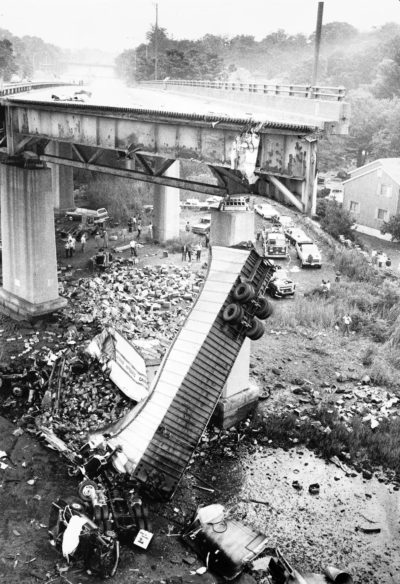
Remnants of the truck which fell when the Mianus River Bridge portion of Interstate 95 collapsed. Photo courtesy of Greenwich Historical Society.

On June 28, 1983, at approximately 1:30 a.m., a 100-foot portion of the Mianus River Bridge on Interstate 95 in Greenwich suddenly collapsed and fell into the river. Nine years later, the Oral History Project compiled or conducted interviews of twenty-two persons who remembered that momentous tragedy.

It is interesting to note that in 1970 the Greenwich Audubon Society conducted a winter bird count of starlings flying into the Mianus River Bridge roost under I-95. Joseph Zeranski, vice president of the Greenwich Audubon Society, reported that approximately 100,000 birds were counted flying in on one evening, not atypical for that time of year. “They roosted there as it was protected from rain and other inclement weather…it was one of the major roosting areas in this region.” By the 1980s there were none. “We went there each year and just shook our heads and were amazed that no birds were present.”

At 1:15 a.m. on June 28, 1983, Margot Cardozo, whose home was situated on a cove under the Mianus River Bridge, couldn’t sleep. She decided to have some milk and chocolate chip cookies in her kitchen. Approximately fifteen minutes later, a huge noise shook the house. She thought maybe a truck had jack-knifed on the bridge.

On the Mianus River Bridge, at that same early morning time, David Pace was driving a truck northbound on I-95 with his sleeping wife, Helen, beside him. Suddenly, “there was nothing under the truck, and that was it…All this happened so quick. I was on the bridge when it collapsed…I heard CRACK, like a bolt of lightning. “

Under the Mianus River Bridge, at a dock on the Cos Cob side, Werner Albrecht had been working late on his boat. At 1:25 a.m., he reached over to turn out the light when he heard “a very deep roar and a thump, like a bass drum, and a screech of tires. I looked out the window and I saw lights cascading down off the Mianus Bridge.” Werner grabbed his flashlight and “found a truck in the water with a couple (the Paces) on top of their cab calling for help…Just about that time I heard sirens from the police and fire departments and state police arriving… Several boats arrived from people who were either working or staying on their boats and they effected the rescue of that couple.”

In all, four vehicles, two trucks and two cars, fell into the river that night from a 100-foot section of I-95 that had suddenly collapsed into the river below. Three victims perished and three survived.

Greenwich first responders who arrived quickly on the scene had a chaotic and challenging task before them. They needed to deal with the traffic on the highway; to lead cars off the road before they would drive near the fallen portion of the bridge. There was a strong smell of fuel around the site in the river, which led to concerns of fire. And, of course, they needed to search for and rescue survivors as well as recover those who had perished.

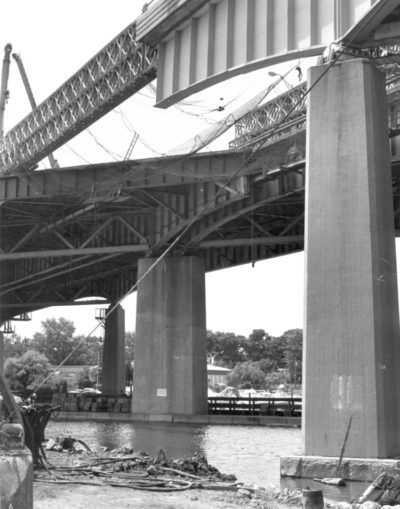
Looking up at the missing span of the Mianus River Bridge. Photo courtesy of Greenwich Historical Society.

Divers arrived, including Tom Brown, a state trooper and a diver. Their search was impeded by the fact that it was dark and that one of the two trucks that had fallen into the river was transporting meat. According to Brown, “You couldn’t see into the water… and, as you reach underneath, you don’t know if you have a body or a side of beef. And we kept pulling up hunks of beef. Fortunately, it was beef.”

Despite an initial estimate of eighteen months to repair the bridge, the highway reopened to traffic the following September. However, until that date arrived, the daily lives of many Greenwich residents were completely disrupted. Within nine days of the bridge collapse, the state of Connecticut determined that ramps would be built to enable cars and trucks to exit I95 to make their way alternatively through Cos Cob to the Post Road. That meant that over 90,000 vehicles were directed to the Post Road each day with the concomitant noise, pollution, disruption to residents and businesses, and safety concerns that would ensue.

Residents of Cos Cob, particularly the 300 families who lived in the “Diesel Triangle” of River Road, Strickland Road, and Post Road, were particularly negatively affected during that time. They stated that there was no communication beforehand of the impending ramps to be built. David Donald, Cos Cob resident, remarked, “It was probably the quickest road paving job that’s ever been done in the state, I’m sure, because they . . . had those ramps up in less than two weeks’ time… Oh, it was just horrendous. It was a nightmare. So, this was the shortest route. There’s no question about it. But it was awful for us who lived here.”

Five years of litigation followed to determine compensation for victims and to decide whether faulty bridge design or faulty maintenance led to its collapse. A determination was made that the bridge was held up by less steel than was originally designed because of undetected forces of rust and corrosion causing fracture and pieces to fall off, not because of design flaws. Blame was cast on the inadequate bridge inspections which did not detect these flaws. According to William Rush, defending attorney for the engineering firm, “. . . even the birds knew enough to get off the bridge.”

As Michael O’Connor, a first responder, remarked in 1992, “Sometimes it’s strange when you go across and you look and you say, ‘There’s the piece.’ And you go over it. But, knowing what that bridge has been through, it’s the safest bridge in the whole world now. I have no qualms about going over the top.”

The interviews and “The Mianus River Bridge Collapse” book may be read at Greenwich Library. The Oral History Project is sponsored by Friends of Greenwich Library. Visit the website at glohistory.org. Mary A. Jacobson, OHP blog editor.


Saturday, May 28, 2022

 Oystering in Greenwich

by Mary A. Jacobson


Oystering in Greenwich has a long and storied history that is indelibly intertwined with that of the Chard family of Greenwich. In 1976, Suzanne Kowalski of the Oral History Project interviewed Clarence Chard to learn about his family and its contributions to the history of oystering in our town.

Clarence Chard’s grandfather, Samuel Chard, began oystering off the Greenwich coastline in the 1870s. According to Clarence, “He had a shanty, they called it, on Brush Island (west of Mead’s Point), where he lived through the week. Then the boys would come down weekends with the horse and wagon and take him back up home to Cognewaugh (Road).”


By the turn of the century shellfishing had become a lucrative business for local fishermen. Clarence’s father, William, born in 1868 in Cos Cob, oystered there until he retired in the late 1920s. Clarence, aged 18 in 1918, joined his father and his Uncle Stanley in the oystering business after graduation from Greenwich High School. “At that time the market boats came up from New York and we loaded them…In the early days, before my time, the oyster sloops (or scows, as they were called) used to go down…most people would call them barges, but we called them scows. They had the house on them; and they opened or shucked oysters right there.”

New England was especially known for the richness of its oyster industry. Chard explained that oysters secrete their spawn from June to September. “When the temperature of the water gets right, they secrete that spawn in the water and it swims around for a dozen or so days. Then it settles to the bottom and attaches itself to the shells and pebbles…the oysters settle on the shells there and grow…It’s because they had good natural settling ground. Connecticut seed (young transplantable oysters) used to be shipped all the way down to Chincoteague, Virginia in schooners. Some of the vessels would carry five thousand bushels of seed.”

Clarence vividly recalled growing up on Indian Harbor Drive watching the oyster sloops. Of the thirty-odd there, he began to name a number of them. “Well, there was the Ann Gertrude, the Florence T., the F.E. Webster, the Fannie S., the Piano, the Emma Jane, the Sarah Lucinda, and, of course, the Susie C. and the Samuel Chard—that was my father’s sloop (built in 1900).”

Clarence and his brother Bill bought the Susie C. from his Uncle Stanley in 1932 and would sail it to Bridgeport to oyster there. “There were over three hundred boats up there, years ago. When the fleet landed up in Bridgeport, why, there were some hot old times…the tricks they used to play on each other. Put things down their smoke pipes so the smoke would come out in the cabin, and things like that.”

The Chard family oyster beds were off Field Point, outside of Captain’s Island, and outside Greenwich Point “in the neighborhood of four hundred acres.” Chard recalled that “the best price we ever got (for oysters) was four dollars a bushel…I did sell a few, in later years, for sixteen dollars a bushel.” In his father’s time, when times were lean, “They raked clams out of a rowboat, and he had clam market enough to pay his men…There were a good many years we never made anything.”


In the 1920s oystering in New York State was condemned and Connecticut was restricted. As a result, “the whole west end of the Sound was a breeding place for stars (starfish),” the nemesis of oysters. “They’ll move in like a blanket sometimes, the stars will. Just cover the bottom…There were a couple of years that there were so many stars that, when we had a nice bed of oysters coming, we took them up and sold them before they were really of marketable size. We ran them over to Oyster Bay and sold them.”

The last boat the family built, utilizing both sail and power, was the Hope, built on Brush Island and launched in 1948. “But we didn’t have any oysters, so then we started dredging clams by power.” Nevertheless, Clarence remained hopeful for the future of oystering: “We know that things come in cycles with both fish and shellfish…I think that perhaps the oysters are liable to spawn again someday and live; and if they do, why there’ll be a rebirth of oystering.”

Today, oystering in Greenwich Harbor has had a rebirth. The Greenwich Shellfish Commission, begun in 1986, is considered an example for the State. Its mission to is “manage, protect, propagate and conserve the shellfish beds for both recreational and commercial use.” Local waters are tested sixteen times a year in thirty-six locations. Roger Bowgen, chairman of the GSC, states that there are now thirty million oysters in Greenwich waters.

Clarence Chard would be pleased.

The interview entitled “Oystering” may be read in its entirety at Greenwich Library and is available for purchase at the Oral History Project office. The OHP is sponsored by Friends of Greenwich Library. Visit the website at glohistory.org. Mary A. Jacobson, blog editor.


Friday, March 25, 2022

Pioneering Mother and Daughter Flyers of Greenwich

by Jean P. Moore

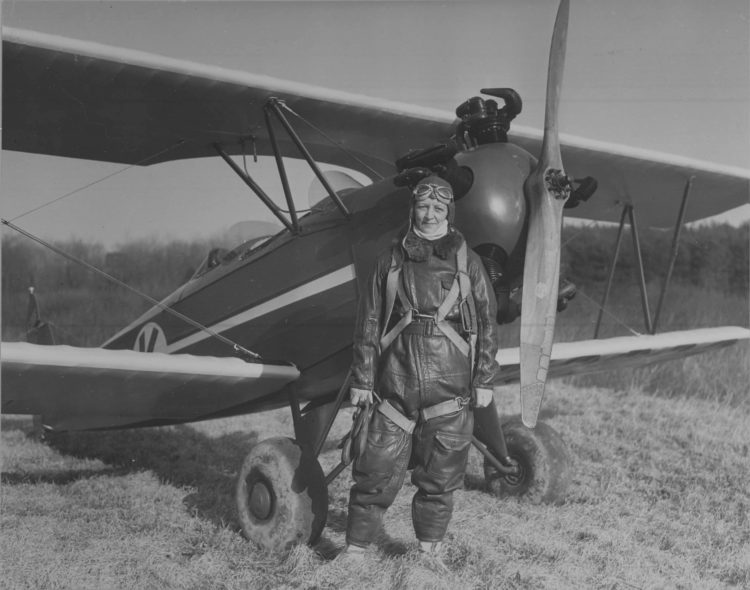
Marian Cummings suited up to fly her plane, 1934. Courtesy of the Oral History Project

What could be more appropriate for Women’s History Month than to celebrate two female aviation pioneers who achieved many of their flying feats right here in Greenwich in the 1930s?

The two remarkable women are Molly Cummings Minot Cook and her mother, Marian Engle Cummings, who died in 1984 at the age of 93. Together with Molly’s brother, Wilbur (“Billy”) Love Cummings, Jr., also a pilot, they won the nickname, “The Flying Family of Greenwich.” Molly was interviewed by Oral History Project volunteer Suzanne Seton in 2012. She died at the age of 102 in April 2020.

In her youth, Marian Cummings was a force of nature. She proved such a challenge to her parents that she was sent east from her home in Seattle to be made a “lady”- a not entirely successful venture. From sliding down spiral staircases at her finishing school in Middlebury, Connecticut, to illegally harboring kittens in her room, she was a handful for the headmistress, who nevertheless appreciated her spunk.
After graduating with honors and returning to Seattle, Marian met Wilbur Love Cummings, a young lawyer out west on assignment. Young and in love, their romance culminated in marriage on the eve of World War I. Subsequently, they traveled to New York, where Mr. Cummings would resume his work. This trip occurred at the height of the Spanish flu epidemic. Marian, Wilbur, and their two young children, Billy and Molly, wore facemasks and stayed in their cabin.

The family settled in Greenwich and bought an old farmhouse on John Street. However, life in Greenwich may have been too uneventful for Marian Cummings. To feed her love for adventure, she began taking flying lessons at North Beach, now LaGuardia airport, earning her pilot’s license in 1932 at the age of 40. Mr. Cummings congratulated his wife on her accomplishments and asked if she would like an airplane. And so Marian Cummings acquired her first Stinson Reliant. Before long, Marian and her son and daughter were all flying at Armonk Airport. According to her daughter, Molly Cook, Armonk was not a proper airport. It was called the Westchester Pasture for Select Flying Machines and was actually a potato field off Route 22 just long enough for landing small planes.

While Molly and Billy were earning their wings, their mother Marian was busy racking up firsts and awards. She was the first woman to make a parachute jump and the first woman to hold a commercial license. She then proceeded to put her training to use by flying her husband to various destinations where he had legal dealings, traveling around the States and in Central America.

Marian Cummings was a powerful influence on her two children. Following in their mother’s footsteps, they were accomplished and daring pilots. Daughter Molly Cummings Minot Cook, born in 1917, was also a flying marvel, earning her pilot’s license in 1935 when she turned 18. Soon thereafter, Molly and her brother Billy bought a small plane, a Luscombe, and began competing in meets. While still in college, they became popular at “stunting” meets at airfields in Armonk, Hartford, and Long Island, among others. Molly Cook describes one maneuver in which a roll of toilet paper would be thrown out of the plane at three or four thousand feet creating a streamer effect. “The trick was how long it took you to cut that strip twice, with your plane.”

During World War II, Molly and her mother joined the Civil Air Patrol. While her mother ferried pilots between destinations stateside, Molly taught Morse code and aerial navigation. Her brother Billy joined the Navy Air Corps as a transport pilot, flying new planes from factories in the U.S. to England, where they were deployed in the war. Tragically, it was on one of those trips that young Billy Cummings crashed on takeoff, killing this cherished son and brother.

In time, Molly Cook went on to marry and have a family of her own. She continued flying and engaging in many other interests, from teaching art, to ranching, and to conservation, making substantial donations to the Land Trust. However, flying was never far from her heart.
As she relates, “I loved stunting. In the summer…I would be in my white flying suit and helmet and goggles – oh, I was just the big cheese – and get into my little Fleet plane. All these people on Sunday, that was the thing to do in those days, that people would drive to Armonk to watch the planes, sort of a – what would you call it – a bullfight feeling. Is the matador going to make it or – I’d go up and do a spin or a loop and a something, and then come down. Then we’d sit, and then somebody said, ‘Well, I think I’ll go up and amuse them a little bit.’ It was fun on a Sunday.”

This blog was written by OHP volunteer Jean Moore from the interview, “Mother and Daughter Flyers.” The transcript of the interview may be read at Greenwich Library and is available for purchase at the Oral History Project office. The OHP is sponsored by Friends of Greenwich Library. Visit the website at glohistory.org. Mary A. Jacobson, OHP blog editor.


Saturday, February 26, 2022


Havemeyer Park – A Unique Community

by Anne W. Semmes

Gene Tunney and Arthur M. Starck reviewing construction plans for Havemeyer Park. Photo courtesy of the Greenwich Historical Society.


What does a sugar cane magnate, a professional boxer, and World War II veterans have in common? The answer, of course, is Havemeyer Park, a planned community in Old Greenwich, just to the west of the town line with Stamford, that has thrived since the 1940s. Oral History Project volunteers Carol Ashwell and Janet McDonald interviewed early residents of Havemeyer Park in the 1990s to gain an understanding of this place with its unique culture and history.

One can trace the history of Havemeyer Park to its initial incarnation, that of a 200-acre homestead, just north of Boston Post Road, where Henry Osbourne Havemeyer built a family country retreat in 1880, named Hilltop. Havemeyer, president of the American Sugar Refining Company, enjoyed the bucolic setting of Hilltop with its mansion, barn, three greenhouses, farm animals, and extensive plantings. Havemeyer died in 1907. The home was demolished after his wife, Louisine, died in 1929.

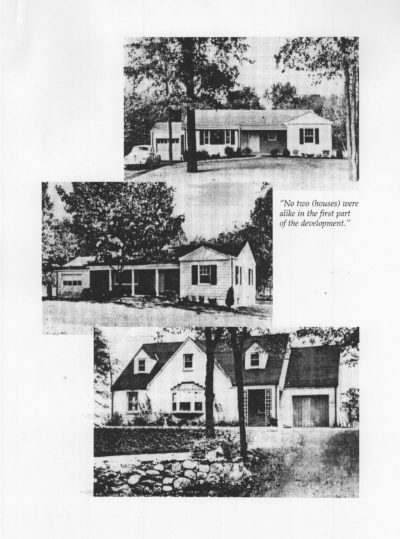
Gene Tunney, known primarily as the world heavyweight champion from 1926 to 1928, married socialite Polly Lauder of Greenwich in 1928. In 1946, he purchased the property from the Havemeyer estate for $178,000. Tunney, a former Marine, envisioned the land, now named Havemeyer Park, as a housing development for returning WWII veterans. He and Arthur M. Starck formed the Stamford Building Company. The Cape Cod-style homes were built on one-quarter acre lots. The first units were completed by 1947; eventually 360 of them were constructed. A $1,000 loan from the bank could procure a home priced at $10,000. It is no surprise that the neighborhood boasts street names like McArthur Drive, Halsey Drive, and Nimitz Place.


Ginny Ridenour, a former resident, recounted a story about Mr. Tunney. “I heard that in the early years he used to come along and check out the site; and if people would come out and say, ‘Mr. Tunney, I don’t have enough room for my garage’ or whatever, he would try to accommodate the wishes of the residents. And the builder finally told him, ‘You have to stay off the site because we can’t make all these changes.’”

Russell Vernet lived in Havemeyer Park from 1950 to 1996. When he moved in “practically everybody was a veteran…We had a Cape Cod, and it was a two-story, but the second floor was never finished; and the basement, of course, wasn’t finished. But, over a period of time I completely finished the upstairs into two bedrooms and a bath and made a playroom in the basement…Almost everybody who moved in was a hands-on handyman.” Vernet describes some of the streets as dirt roads “for a long time after we moved in…So there was a lot of roadwork that had to be done.”


Havemeyer Park’s population consisted mostly of young families. It was amusingly dubbed “Have a Baby Park” for the many children in the neighborhood. Ginny Ridenour remembered the first day she moved there in 1959. “My next door neighbor came over and she said, ‘Do you have children?’ and I said, ‘Yes, we have one.’ And she said, ‘Oh, I’m so glad because we have three.’ And from that moment on we began a beautiful experience in Havemeyer Park.”
Within the community there were many organized and impromptu social activities. From Boy Scout and Girl Scout troops to picnics, a garden club, costume parties, Valentine’s Dances and more. “We really had a whole social life right within our own area. Nobody joined the Newcomers or anything like that. They never felt they needed to,” according to Ridenour.

“No two (houses) were alike in the first part of the development.” Photo courtesy of the Greenwich Historical Society.


Russell Vernet described a Christmas tradition where a neighbor “used to put up a big screen in front of his house; and he had a projector and would project the words of the Christmas carols onto that screen. Then he’d play the accordion, and we’d all stand around and sing.”

The Havemeyer Park Owners Association, begun in 1948, grew out of concern for roads and traffic. In those days, according to Gerald Porricelli, past president of the homeowners’ association, “… we were speaking at Planning and Zoning Commission hearings, writing letters particularly about traffic, the density of traffic coming onto Havemeyer Lane and arranging for access out on Palmer Hill Road.” Over time, Porricelli commented, the population of Havemeyer Park has become more transient in nature and the number of neighborhood activities has diminished from its early days. “You see a lot of turnovers…we have working families with not a whole lot of time to give to these kinds of events.”

Ginny Ridenour reflected on her early days in Havemeyer Park saying, “It was a very positive period of our life, and I think this is what we’ve all come away thinking about it…I don’t know what the magic was, but we really did all have such fun…It was truly a unique place to start your life in Greenwich.”

The transcript of the interview, “Havemeyer Park.” may be read at Greenwich Library and is available for purchase at the Oral History Project Office. The OHP is sponsored by Friends of Greenwich Library. Visit the website at glohistory.org. Mary A. Jacobson, OHP blog editor.


Wednesday, February 2, 2022

Life on Lewis Street in the 1920s

by Mary A. Jacobson


In 1974, Frank Nicholson was interviewed by Olwen M. Jones of the Oral History Project. Nicholson, born in 1915, lived at 52 Lewis Street, between Greenwich Avenue and Mason Street in the 1920s. “Lewis Street in itself at that time, as I look back at it, was more like the beginning of the twentieth century than the beginning of the 1920s.”

Frank Nicholson, photograph by Agnew Fisher

His home “which was not a new house” had a shop in its front. “At that time it was Doc Fowler’s vulcanizing shop, where they vulcanized automobile tires…And the roar that these machines made and the smell of the rubber was pretty repulsive. But that didn’t remain for too long that I remember; around 1922 it was replaced by a battery shop for automobiles.”

On the south side of the street was Cole’s Automobile Agency that sold Wills Sainte Claires, classic cars that were manufactured between 1921 and 1927. Next door was Clark’s garage where you could fuel, repair, wash and store your car. There was one gasoline pump “that you turned by hand and measured out a gallon of gas. Then you turned it back and measured out another gallon of gas…Everybody who had a car took care of it, I guess because there weren’t many at that time.” Between Nicholson’s house and Clark’s garage was “this great big open field and a tremendous big hay and feed barn, which was Timothy Loughlin’s’ Feed and Grain Store.” In the early 1920s, goods like milk, bread, ice and coal were still delivered by horse and wagon.

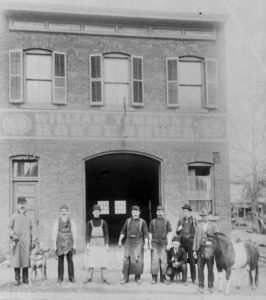
There were many diversions on Lewis Street to keep a young boy’s interest and imagination active. On the north side of Lewis Street were two blacksmith shops, William Timmons’ and Seth Mead’s. In between, was Kirhoffer’s ironwork shop which serviced carriages. Nearby, was the shoemaker Tony Ginto.

“We learned an awful lot of things as kids because you always could go into the blacksmith’s shop and you could stand around and watch…You’d see them shoeing horses and glad to have you there and watch the sparks flying…Or you could go into the shoemaker’s and sit down and watch him cut the leather to make a sole on a shoe and sew it and glue it…We could go in the battery shop and watch them. You could go in the garage and watch them tear apart a car, and you could watch them vulcanize a tire…You were in things. You were never at a loss for something to do.”

The 1920s ushered in the age of prohibition and Lewis Street was “where the action was.” Number 25 Lewis Street housed Hassett’s Saloon. “I remember the day that they padlocked the saloon and all of these men standing out in front of Hassett’s Saloon bewailing the fact that there would be no more booze.” However, although the front door was closed, the back door was open. Nicholson remembers “rushing the growler” (taking a can to get it filled with beer) for his father. “I’d go to the back window at Hassett’s Saloon and have them fill it and I’d usually get a bottle of soda as a bonus because I was, I guess, small for rushing the growler.” Nicholson recounted stories about bootleg liquor, homemade “hooch,” and speakeasies, but as he would say, “I’m telling you this as recollections of a child…This is not factual; this is things that I remember.”

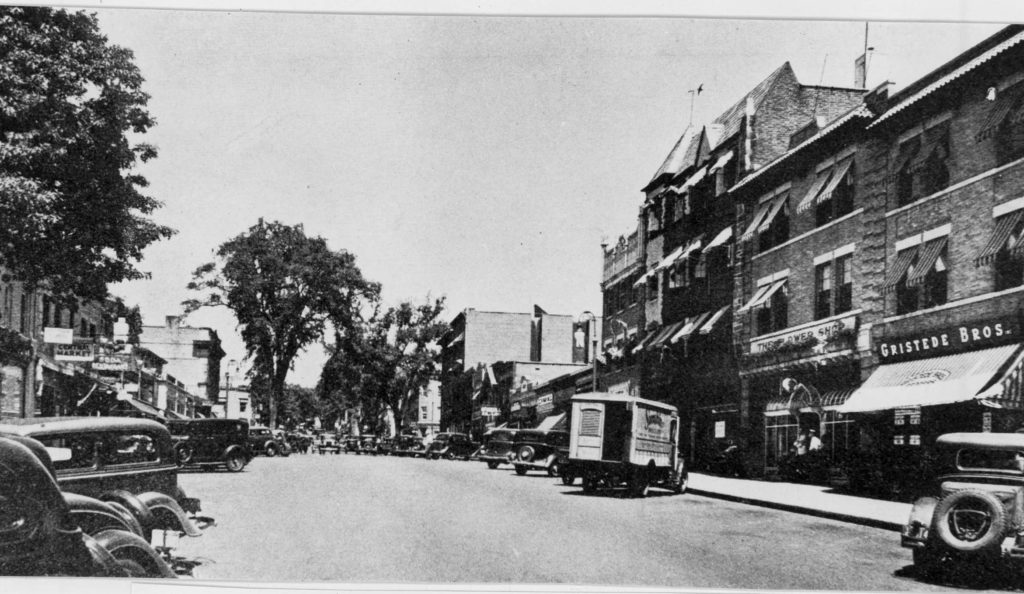
Looking north on Greenwich Avenue, courtesy of Agnew Fisher

One of Nicholson’s favorite childhood amusements was going to the silent movies at the Greenwich theater. There were two organists who would play during the film, one of whom, Russell Green, was also the organist at St. Mary Church. “If it was Rudolph Valentino in Blood and Sand, there was a score that went with that, and it fit in with the action.”

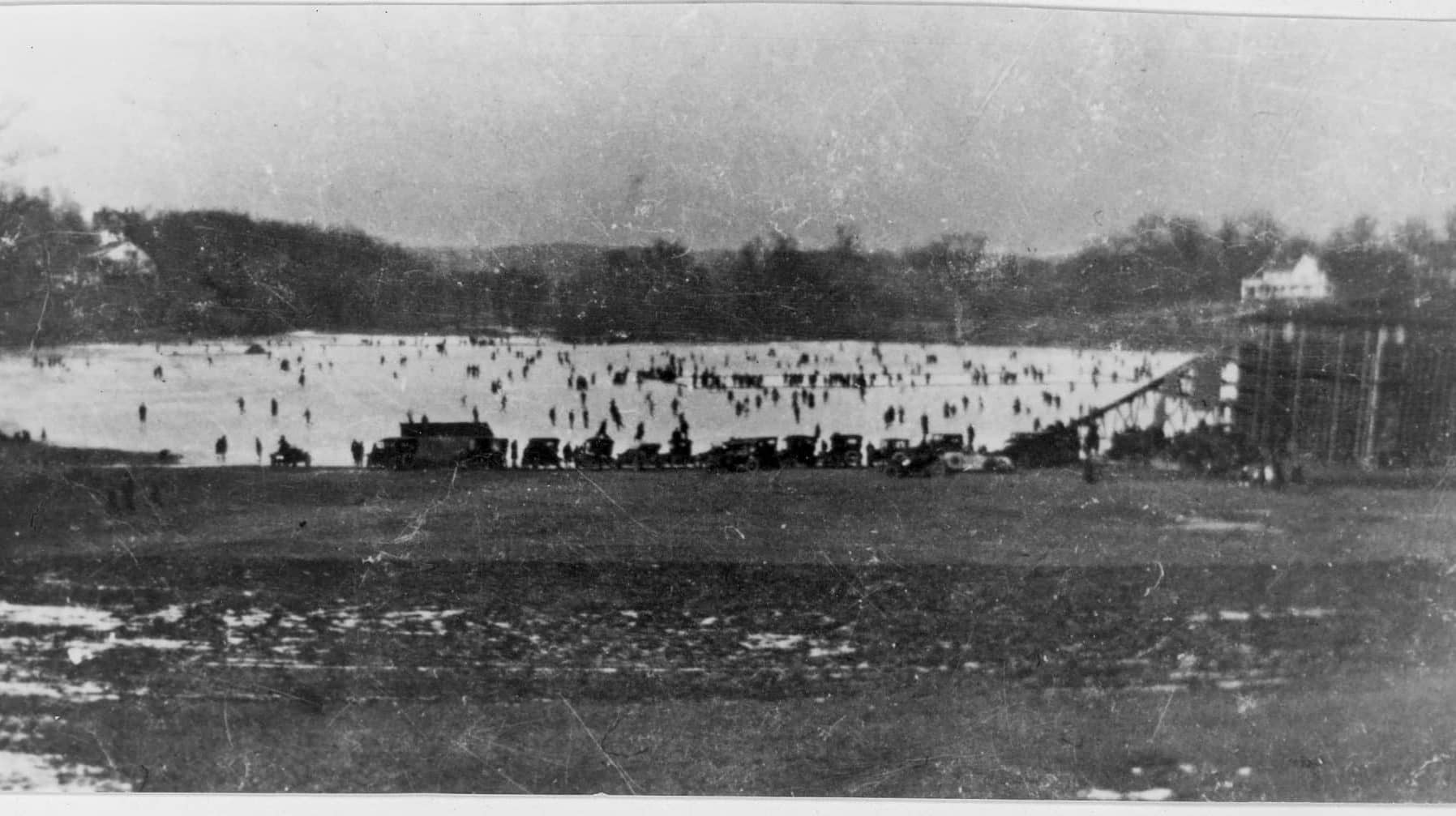
Skating at Ten Acres, now the Greenwich High School football field, courtesy of Greenwich Historical Society

There were also simple games like putting pennies on the trolley tracks before the trolley crushed them into different shapes. “And stickball, all you needed was an old broomstick and a saw…You sawed off one piece about six inches and that was your ball. At night we’d play cops and robbers and hide and seek. Hide and seek was a good way to get away from the front door… I can remember as a kid, my mother saying, ‘Don’t go away from that door,’ and I didn’t. I’d just stay right there on the curb and that’s where I saw the world go by. Great, great entertainment.”

Timmons’s Blacksmith, courtesy of Greenwich Historical Society


After graduating from Greenwich High School, Nicholson attended Middlebury College, the University of Grenoble and, as a Fulbright Scholar, the Sorbonne at the University of Paris. He began teaching French at Greenwich Country Day School in 1956.


The transcript of the interview, “Growing Up on Lewis Street in the 1920s” may be read at Greenwich Library and is available for purchase at the Oral History Project Office. The OHP is sponsored by Friends of Greenwich Library. Visit the website at glohistory.org.

Mary A. Jacobson, OHP blog editor.