by Mary A. Jacobson
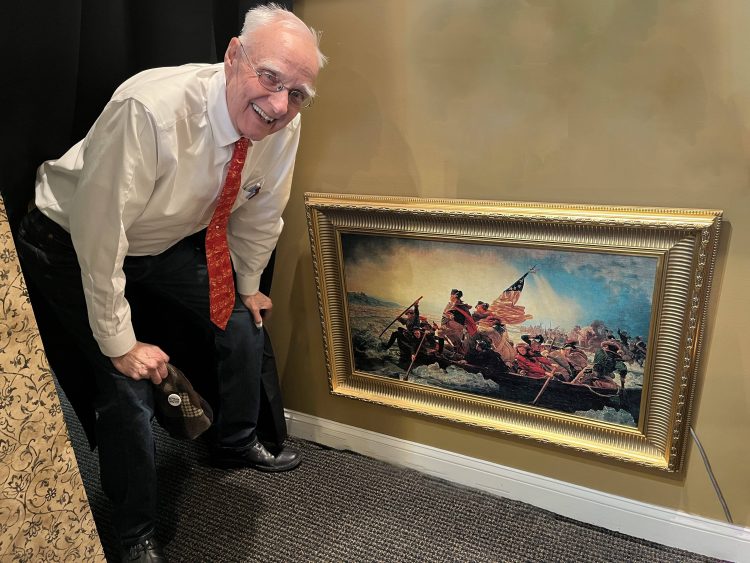
Wyatt Bennett with a
painting by Emanuel Leutze visualizing Washington Crossing the Delaware.
Photo
by Anne W. Semmes
George Washington – patriot, soldier, president, Father of
our Country – a man for the times who helped shape our country at a critical
period in its history.
Wyatt Bennett has had a fascination with George Washington
for fifty years. This year, at eighty-three years of age, he shared his
knowledge and admiration of Washington with Mary Ellen LeBien of the Oral
History Project, co-chair of the America 250th|Greenwich Community Partners
Committee. Bennett was interviewed at Bennett Jewelers, his family store in Old
Greenwich.
“Without Washington and without the French help that we got,
it could very well have been an extended period before we achieved our freedom.
Or it might never have occurred, and we might have had a situation like Canada
has, where they peacefully separated from England, and there was no war to
speak of… we just don’t know.”
According to Bennett, Washington “was a wonderful soldier in
the Seven Years War (1756-1763), and the British were very haughty about how
they treated colonials… probably that helped his decision to… become head
of the Continental Army” in 1775. Washington, a Virginian, was considered a
good choice. “A lot of the disruption that was occurring at this time, in the
1770s was in New England. So, the Second Continental Congress, I think, said,
‘Look, we have to get a Southern man in here who can do the job.’ And he was a
very good choice.”
Washington did not experience only victorious outcomes in
battles. “I think he might have been involved in seven battles during the
Revolutionary War, five of which he lost.” According to Bennett, Washington was
determined “to keep the army together... because, if the army dissolved, there
would be nobody to oppose the British… That’s why many of those losses were
more tactical retreats than anything. In 1776, he was chased across New Jersey
into Philadelphia. And he just kept a step ahead of the British at that time,
keeping the colonials together.”
At that point, as Bennett described, Washington made a brave
and risky decision. He would have his troops cross the Delaware River in
the middle of a brutal winter in a raging storm, and make the attack on
Trenton, New Jersey. “The night was terrible. He lost a couple of his men
through freezing to death. But during the battle, he lost nobody… Normally
soldiers in the eighteenth century took a break in the winter and started
fighting in the spring… Twenty-four hundred soldiers, I think, he put together
to cross the Delaware.”
Once the garrison crossed the river, they then had to march
nine miles to get to Trenton. Two supporting contingents of soldiers that were
supposed to meet them were unable to, so “Washington had to do it on his own…
They (the Hessians) were completely surprised by it (the attack). The Hessians
were busy celebrating Christmas. This was the day after Christmas, actually the
26th … And he (Washington) took nine hundred prisoners and killed thirty or
forty of them.” A week later, “he went up to Princeton and won a battle there
also.” These battles in 1777 with exceptional outcomes were pivotal for the
troops and the War effort which did not end until 1781 at the Battle of
Yorktown, led by Washington with support from the Marquis de Lafayette and
French army troops.
From 1781 “we had a set of rules that we were going to abide
by (the Articles of Confederation)” but “the big thing at that time also was
keeping the thirteen colonies together, not having them balkanize and each
state fighting another state. It was very important to Washington… He believed
in a strong federal government.” The drafting of our constitution was completed
at the Constitutional Convention at Independence Hall in Philadelphia in 1787.
“So, the representatives were sent back to the various states to get their
approval… nine was the number you had to have to have full approval.”
In 1789, George Washington was elected president of the
United States with unanimous support from each participating state. A national
hero and favorite son of Virginia, the largest state at the time, he had been
president of the Constitutional Convention and Commander-in-Chief of the
Continental Army. “I think he would have preferred not being president. He
loved Mount Vernon and his mules and his crops and he would rather have done
that as a private citizen, but he was highly respected and trusted… The things
he decided to do on his own set precedents for many years to come… The fact
that he was so highly respected made a big difference to how we got off to a
fairly good start as a country.”
As to what Bennett thinks young people should know about
Washington? “I think it varies depending on the age of the student…. Early on
emphasizing patriotism is rather a good thing… and then work from there. As you
get older, you become critical of what you’ve been told…. you have to be
careful how you treat things that were not so good back then by our standards….
You have to look through the eyes of an eighteenth-century politician, when
they were making their decisions, not through the eyes of a twenty-first
century one… As I say, in the long run, I think our constitution is set up
pretty well; it’s aspirational. We’re trying to make it better all the time,
which is encouraging, I hope.”
A truly historic event for America 250th|Greenwich will
occur at Greenwich Library on June 20. On that day, the George Washington
Inaugural Bible will be displayed there from 11 a.m. until 3 p.m. This Bible
was supplied to Washington when it was discovered that there was none for him
to lay his hand upon as he was about to be sworn in as president in 1789. The
Bible has been kept under guard at the Masonic Lodge in lower Manhattan; its
safe keeping will continue to be monitored as it travels to Greenwich.
The Oral History Project is proud to present blogs
derived from its collection of recorded interviews as part of the Project’s
celebration of “America’s 250th|Greenwich – Greenwich History is American
History.” The OHP is sponsored by Friends of Greenwich Library. Visit the
website at glohistory.org. Interviews may also be read in their entirety or
checked out at the main library. They are also available for purchase by
contacting the OHP office. Our narrator’s recollections are personal and have
not been subjected to factual scrutiny. Mary Jacobson serves as blog editor.
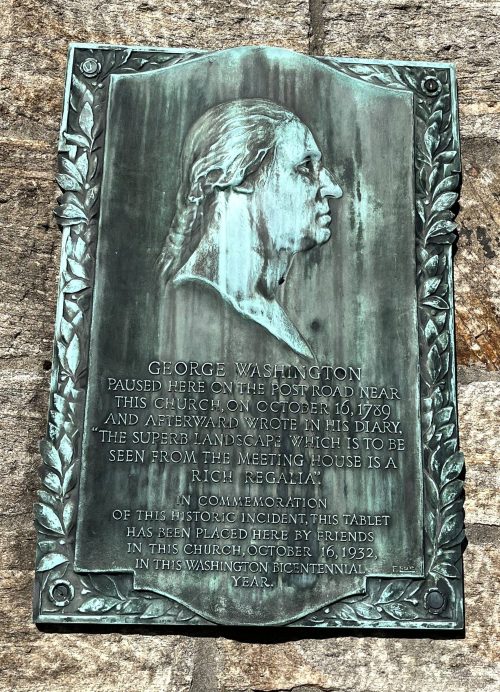
A plaque from 1932, located on exterior of Second Congregational Church,
commemorating 143rd anniversary of day George Washington stopped to admire
scenery from nearby Post Road in 1789. Photo by Anne W. Semmes.
A visualization entitled
“Washington’s Crossing” on a Durham boat with men and cannons by Mort Kunstler,
painted in 2011.
Photo by Anne W. Semmes.

