Friday, May 29, 2026

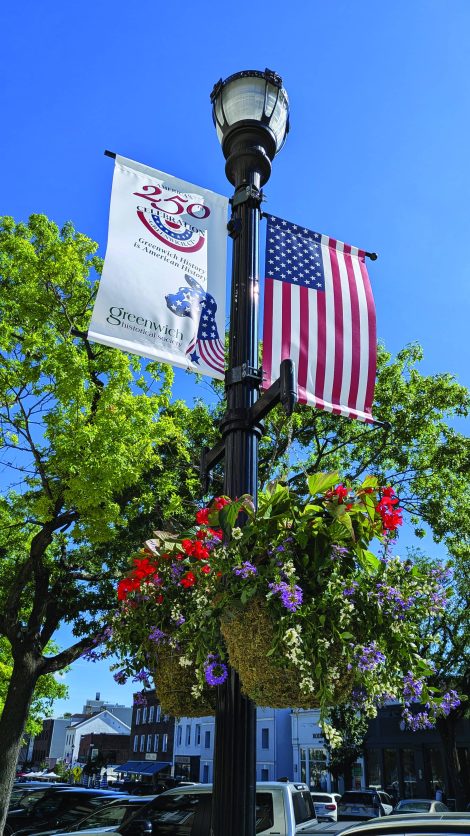
On George Washington: Father of Our Country – Celebrating America’s 250th

by Mary A. Jacobson


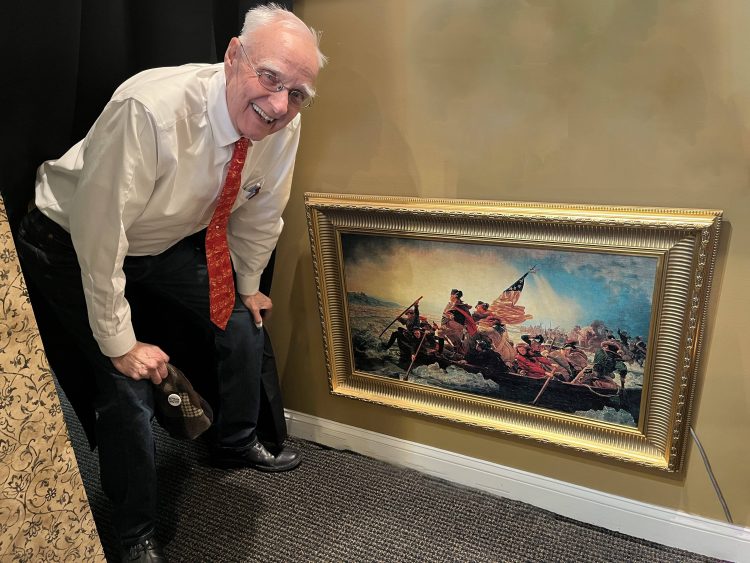
Wyatt Bennett with a painting by Emanuel Leutze visualizing Washington Crossing the Delaware.
Photo by Anne W. Semmes

George Washington – patriot, soldier, president, Father of our Country – a man for the times who helped shape our country at a critical period in its history.

Wyatt Bennett has had a fascination with George Washington for fifty years. This year, at eighty-three years of age, he shared his knowledge and admiration of Washington with Mary Ellen LeBien of the Oral History Project, co-chair of the America 250th|Greenwich Community Partners Committee. Bennett was interviewed at Bennett Jewelers, his family store in Old Greenwich.

“Without Washington and without the French help that we got, it could very well have been an extended period before we achieved our freedom. Or it might never have occurred, and we might have had a situation like Canada has, where they peacefully separated from England, and there was no war to speak of… we just don’t know.”

According to Bennett, Washington “was a wonderful soldier in the Seven Years War (1756-1763), and the British were very haughty about how they treated colonials… probably that helped his decision to… become head of the Continental Army” in 1775. Washington, a Virginian, was considered a good choice. “A lot of the disruption that was occurring at this time, in the 1770s was in New England. So, the Second Continental Congress, I think, said, ‘Look, we have to get a Southern man in here who can do the job.’ And he was a very good choice.”

Washington did not experience only victorious outcomes in battles. “I think he might have been involved in seven battles during the Revolutionary War, five of which he lost.” According to Bennett, Washington was determined “to keep the army together... because, if the army dissolved, there would be nobody to oppose the British… That’s why many of those losses were more tactical retreats than anything. In 1776, he was chased across New Jersey into Philadelphia. And he just kept a step ahead of the British at that time, keeping the colonials together.”

At that point, as Bennett described, Washington made a brave and risky decision. He would have his troops cross the Delaware River in the middle of a brutal winter in a raging storm, and make the attack on Trenton, New Jersey. “The night was terrible. He lost a couple of his men through freezing to death. But during the battle, he lost nobody… Normally soldiers in the eighteenth century took a break in the winter and started fighting in the spring… Twenty-four hundred soldiers, I think, he put together to cross the Delaware.”

Once the garrison crossed the river, they then had to march nine miles to get to Trenton. Two supporting contingents of soldiers that were supposed to meet them were unable to, so “Washington had to do it on his own… They (the Hessians) were completely surprised by it (the attack). The Hessians were busy celebrating Christmas. This was the day after Christmas, actually the 26th … And he (Washington) took nine hundred prisoners and killed thirty or forty of them.” A week later, “he went up to Princeton and won a battle there also.” These battles in 1777 with exceptional outcomes were pivotal for the troops and the War effort which did not end until 1781 at the Battle of Yorktown, led by Washington with support from the Marquis de Lafayette and French army troops.

From 1781 “we had a set of rules that we were going to abide by (the Articles of Confederation)” but “the big thing at that time also was keeping the thirteen colonies together, not having them balkanize and each state fighting another state. It was very important to Washington… He believed in a strong federal government.” The drafting of our constitution was completed at the Constitutional Convention at Independence Hall in Philadelphia in 1787. “So, the representatives were sent back to the various states to get their approval… nine was the number you had to have to have full approval.”

In 1789, George Washington was elected president of the United States with unanimous support from each participating state. A national hero and favorite son of Virginia, the largest state at the time, he had been president of the Constitutional Convention and Commander-in-Chief of the Continental Army. “I think he would have preferred not being president. He loved Mount Vernon and his mules and his crops and he would rather have done that as a private citizen, but he was highly respected and trusted… The things he decided to do on his own set precedents for many years to come… The fact that he was so highly respected made a big difference to how we got off to a fairly good start as a country.”

As to what Bennett thinks young people should know about Washington? “I think it varies depending on the age of the student…. Early on emphasizing patriotism is rather a good thing… and then work from there. As you get older, you become critical of what you’ve been told…. you have to be careful how you treat things that were not so good back then by our standards…. You have to look through the eyes of an eighteenth-century politician, when they were making their decisions, not through the eyes of a twenty-first century one… As I say, in the long run, I think our constitution is set up pretty well; it’s aspirational. We’re trying to make it better all the time, which is encouraging, I hope.”

A truly historic event for America 250th|Greenwich will occur at Greenwich Library on June 20. On that day, the George Washington Inaugural Bible will be displayed there from 11 a.m. until 3 p.m. This Bible was supplied to Washington when it was discovered that there was none for him to lay his hand upon as he was about to be sworn in as president in 1789. The Bible has been kept under guard at the Masonic Lodge in lower Manhattan; its safe keeping will continue to be monitored as it travels to Greenwich.

The Oral History Project is proud to present blogs derived from its collection of recorded interviews as part of the Project’s celebration of “America’s 250th|Greenwich – Greenwich History is American History.” The OHP is sponsored by Friends of Greenwich Library. Visit the website at glohistory.org. Interviews may also be read in their entirety or checked out at the main library. They are also available for purchase by contacting the OHP office. Our narrator’s recollections are personal and have not been subjected to factual scrutiny. Mary Jacobson serves as blog editor.
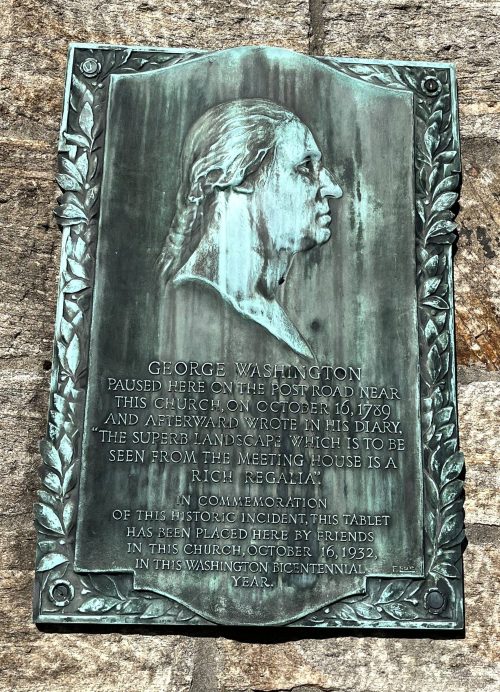
A plaque from 1932, located on exterior of Second Congregational Church, commemorating 143rd anniversary of day George Washington stopped to admire scenery from nearby Post Road in 1789. Photo by Anne W. Semmes.

 
A visualization entitled “Washington’s Crossing” on a Durham boat with men and cannons by Mort Kunstler, painted in 2011.
Photo by Anne W. Semmes.


Friday, April 24, 2026

Missy Wolfe: Greenwich Historian -- Celebrating America 250

 By Mary A. Jacobson

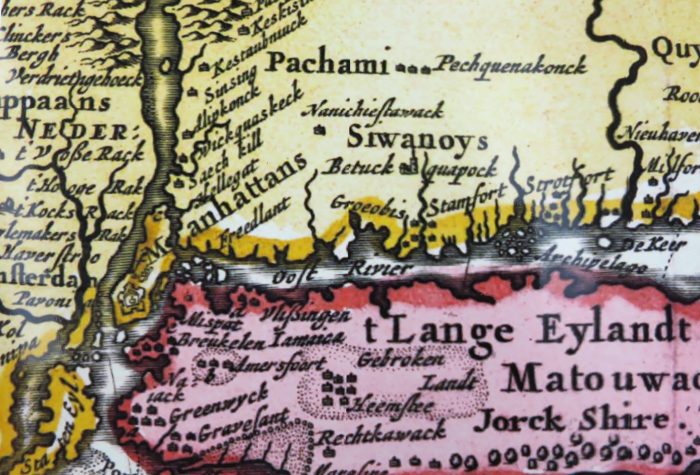
A 1649 Dutch Visscher map showing Greenwich (Groeobis) and Stamford (Stamfort). The misspelled Dutch name for Greenwich should be Groenwits. Greenwich was a Dutch territory, a part of New Netherlands for its first sixteen years. Courtesy of Missy Wolfe.


Historian: “a scholar who studies and writes about the past and is regarded as an authority on it. Historians are concerned with the continuous, methodical narrative and research of past events.” (Wikipedia)

What, one may wonder, are the qualities and influences which might propel a person to make the study of history a life’s passion? Curiosity? The joy of discovery? Perseverance? Inspiration?

Missy Wolfe, a Greenwich resident, is considered a preeminent Greenwich historian. In 2024, Oral History Project volunteer Caroline Atkins interviewed her to enlighten us about the person behind her work.

Missy Wolfe’s family moved to Greenwich from Louisville, Kentucky, when she was of middle-school age and was enrolled at Central Middle School. “I loved reading and always did; I love nonfiction and biography… I always found nonfiction far more fascinating than fiction because you can’t make this stuff up; it really happened. And that it really happened was intriguing to me.”

After receiving her undergraduate degree in economics and psychology at Indiana University, Wolfe joined her dad, who had a career in advertising, in developing a marketing strategy consulting firm. Their focus was on the concept of creativity, and how their uniquely developed materials could enable consumers of goods or services to create what they wanted to buy. “The creativity process we sold became very successful…Our clients, the companies, would then ask their manufacturers to create our recommendations and their advertising agency to relay our findings.” Missy credits that experience with developing her writing skills. “How do you take a large amount of information, sort it, organize it, structure it, make conclusions about it, and report it in a very efficient way?… So, I guess that really established my ability to organize a lot of data.”

Missy also credits several writers as being major influences on her. They include Antonia Fraser, “famous for her non-fiction histories of female European royalty and the geopolitical games they played and why;” Alison Weir, author of numerous historical biographies of British royalty and personages; and Barbara Tuchman, local author, historian, and Pulitzer Prize winner. “And those were my inspirations… I was always reading them.”

Over the next twelve or so intervening years, Missy obtained an MBA from Columbia Business School, was employed by Ogilvy and Mathers, married, worked additional years with her dad, and had three children. Her husband, an orthopedic surgeon, was also an academic writer. “He taught me the importance of publishing in academic journals to present important discoveries… He is the one who pushed me to write my first academic article on the original Dutch jurisdiction of Greenwich… So that jelled with my love of nonfiction that requires a lot of citation. My great interest in genealogy links with this too.”

Missy’s hypothesis was that, in its first years, Greenwich was a Dutch territory, that it was not founded by the New Haven Colony. “It was a myth that we were English originally.” She presented her theory to Debra Mecky, then Executive Director and CEO of Greenwich Historical Society. Mecky’s response was, “’Well, do your research and present your proposition,’ which I did.”

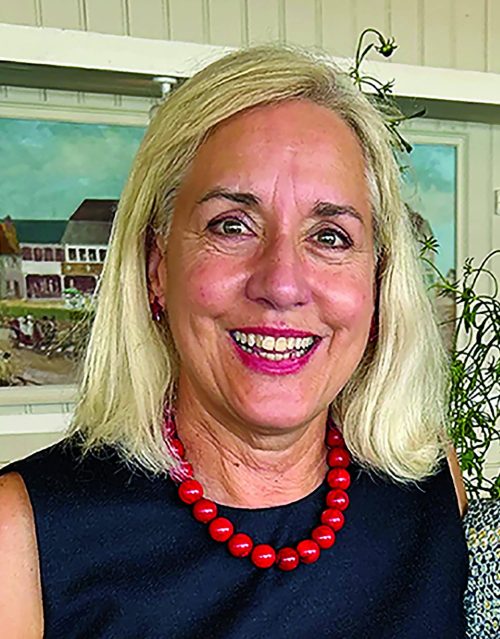
Missy Wolfe portrait. Courtesy of Missy Wolfe.

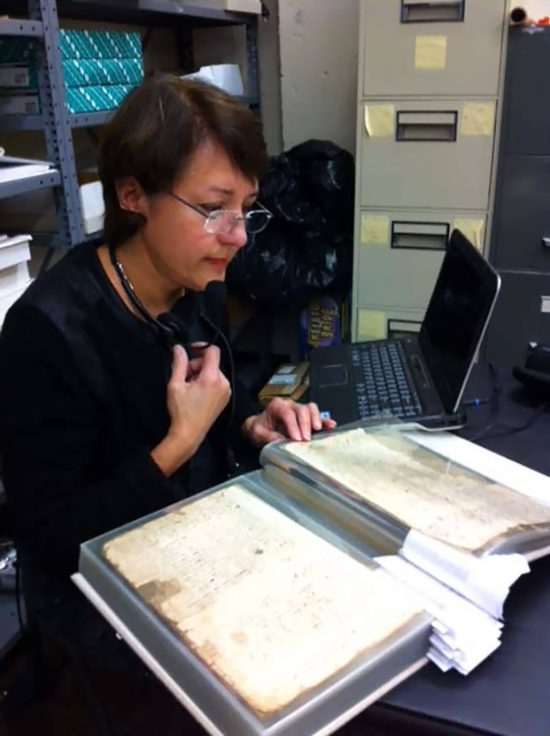
Missy Wolfe’s research took her to the New York State Library in Albany, New York, which “has many of the earliest records concerning Greenwich because of this original (Dutch) jurisdiction; another reason we didn’t know our earliest history very well…These records sat on ships during the American Revolution. They put them on ships because they didn’t want the Dutch or British to burn them. . . getting moldier and wet. It’s amazing they survived.” Later, in the 1800s, the records were retrieved from The Hague, where they had been stored, and were brought back to New York State. Luckily, one man transcribed some records and created an index for most of them, storing them in the New York State Library. Unfortunately, in 1911, a fire damaged or destroyed much of these old 1600s records. “All the original documents that have been transcribed to this day, up there at New Netherland project, all the original documents are burned around the edges.”

In the 1970s these records were conserved and cleaned by Josephine Conboy, founder of the Greenwich Preservation Trust in 2008. “Fifty years after Jo Conboy’s prescient work, I had the technology to digitize them, and in this way, they could be restored to chronological order once again after three hundred and fifty years… It is also amazing that our town archives of Greenwich, that live down in our town hall, that we have them at all is a truly wonderful thing!”

In 2015, Missy’s article The First Dutch Jurisdiction of Greenwich was published in the Connecticut History Review. “So now it is accepted by all of academia that that is true. We were (initially) a part of New Netherland; a part of Dutch New York.” Missy further stated, “People were upset because they had invested in the English heritage of Greenwich… Everything I’ve written is cited. You can refer to the original source document where this information comes from.”

Missy Wolfe’s publications include Insubordinate Spirit, chronicling the history of early settlers Elizabeth Feake Winthrop Hallett and family when Greenwich was still part of New Netherland; The Hidden History of Colonial Greenwich, describing the creation of the community of Greenwich in early American colonial times; and The Great Ledger Records of the Town of Greenwich, Connecticut 1640-1742, a two-volume “transcription of town hall records… a very large project of photographing, transcribing, ordering, and indexing hundreds and hundreds of colonial records.” Missy is now working on volume three and is up to 1768. The factual information and historical revelations presented in these books have added immeasurably to the knowledge that we now have about our local history.

For Missy Wolfe, the fascination of Greenwich is of “the lost Greenwich, the Greenwich that we never knew, radically different from today.” And the inner propulsion to uncover its history? “I can’t explain it. It’s like an obsession that just came over me. It was like I was teed up because of my life experiences to be the person to do this work.”

The Oral History Project is proud to present blogs derived from its collection of recorded interviews as part of the Project’s celebration “America’s 250th|Greenwich – Greenwich History is American History.” Visit the website at glohistory.org. Interviews may also be read in their entirety or checked out at the main library. They are also available for purchase by contacting the OHP office. Our narrator’s recollections are personal and have not been subjected to factual scrutiny. Mary Jacobson serves as blog editor.
Dictating the 1600s records in Greenwich Town Hall Vital Records Vault in 2015. Courtesy of Missy Wolfe.

Friday, March 27, 2026

WWII Veterans and Tod’s Point -- Celebrating America 250

By Mary A. Jacobson

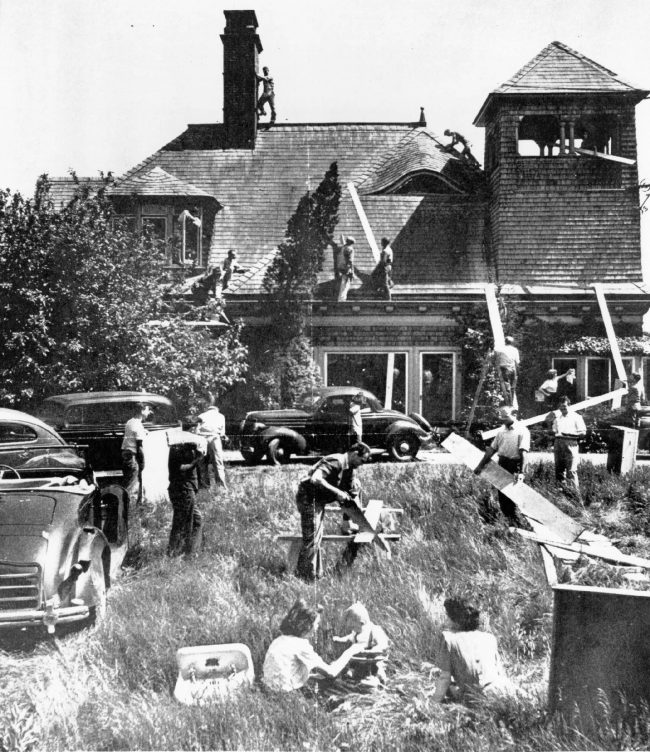
Veteran tenant families renovating the mansion to accommodate thirteen families. Courtesy of Life Magazine, June 17, 1946.

While thousands of people enjoy the beauty and sanctuary of Tod’s Point, known now as Greenwich Point, few are aware of its connection to our WWII veterans. The longtime owners of Tod’s Point were Mr. and Mrs. J. Kennedy Tod. From 1946 to 1961, their former mansion served as a residence for WWII veterans and their families.

To preserve the history of Tod’s Point for present and future generations, the Oral History Project interviewed 67 narrators and published its book Tod’s’ Point, An Oral History in 1981. It is from this rich trove that the stories of the WWII veterans are excerpted.

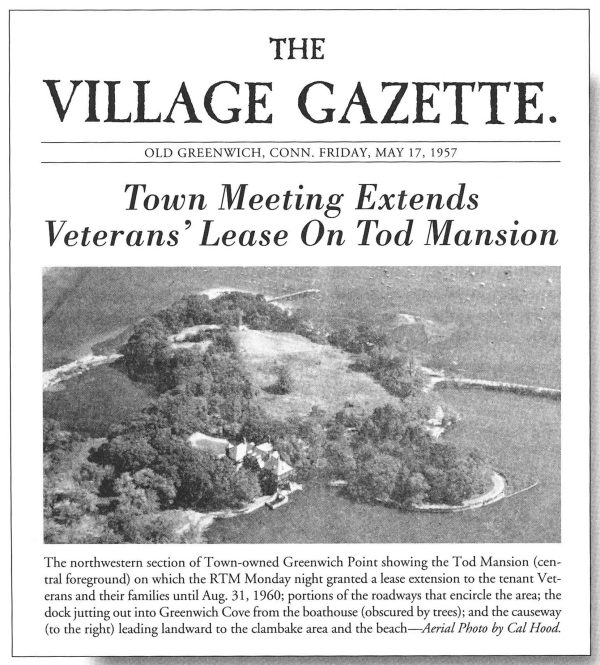
In 1945 the Town of Greenwich purchased the 148acre property of Tod’s Point from Presbyterian Hospital, to whom it had been bequeathed upon J. Kennedy Tod’s death, for the sum of $550,000. The mansion on the property had not been used as a residence since 1939. Concurrently, with the end of WWII, veterans were returning home to Greenwich to a severe housing shortage. Approval was given by the Town of Greenwich to lease the mansion to thirteen veteran families for one dollar a year.

Before these families could move into the mansion in 1946, its thirty-nine rooms needed to be converted into thirteen apartments. The veterans formed an independent nonprofit corporation called Vetaptco (Veterans’ Apartment Corporation) and each family floated a $1,000 loan from The Greenwich Trust Company. According to resident Thiel Ficker, “We paid (monthly) rent to our own corporation. I think forty dollars was the cheapest and seventy dollars was the most expensive. Of that, twentynine dollars went to the bank. The balance went into our Vetaptco account, and from that we paid for our oil, our heat, our electric, and so forth.”

The original Tod home was beautifully appointed. “You would find lovely casement windows in certain areas with just lovely hardware, the kind that would be very, very expensive; leaded glass, that sort of thing.” To ready the apartments for thirteen families, Ficker continued, “This contractor (Peter Danziger) did the basic work and we did all the finishing work. We did all the painting and some of the plastering and a lot of the carpentry.” When the job was done, “and everybody’s apartment was finally fixed up, we decided we ought to have an open house because people all over town were curious about this… Hordes of people came down and walked through the whole place… and were quite astounded at what had been done.”

Thiel Ficker reminisced, “Because practically every woman in the place was pregnant, we called it “Stork Point” for a while… None of us would ever choose to go back to that time again, of course, but for that particular time -we were all young, just out of the army – it was fun. It was sort of communal living in a way. We kept the integrity and privacy of each individual family.”

Wintertime living at Tod’s Point had its challenges. The Town agreed to only plow snow to the entrance of the Point. On December 26, 1947, one of the worst blizzards occurred in Greenwich with 26.5 inches of snow. Ficker recalled, “Well, we didn’t have any snow shovels… so we took these sheets of aluminum and cut them up and made long wooden handles, and nailed these rectangular pieces of aluminum to the wooden handles and made about thirteen shovels…We shoveled all day long, and at six o’clock at night, we finally broke through to Shore Road where they had plowed it.”

Another emergency requiring a communal response was the inadequate septic system that gave out on Thanksgiving Day, 1946. As Ficker described it, “There was a poor old septic tank, and it just couldn’t take it any longer.” That day the men dug a whole dry field. “We dug trenches through that. We honeycombed that whole field, laid tiles, filled in gravel, and connected it in with the septic tank which was across the road. All that on Thanksgiving Day. We worked up an appetite for turkey. Although some of us didn’t have much of an appetite.”

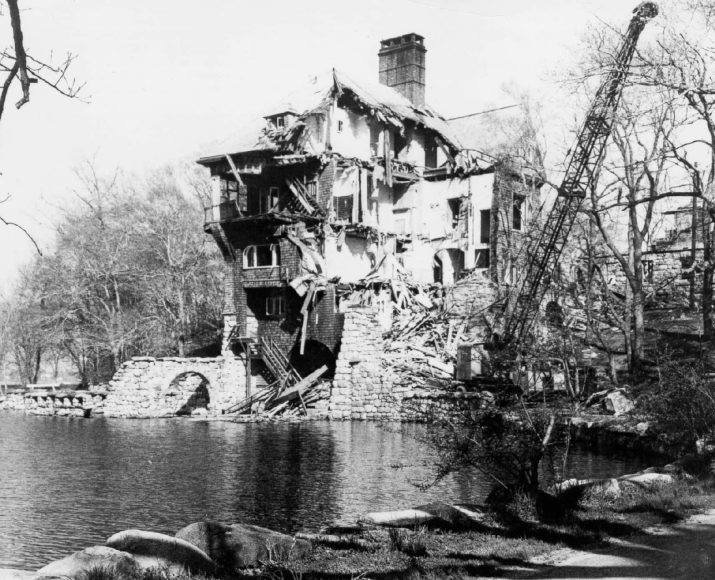
Demolition of the mansion, 1961. Courtesy of the Oral History Project.

Summertime was a busy time. “You can imagine it was like living on Coney Island on a Sunday. On a nice day in July, it was a steady stream of cars, and people used to drive up the driveway and right around the big circle there. So, we were happy when fall came and they closed the beach. Then it was peaceful and quiet.” Joseph Callachan remembered fondly the flock of snowy white egrets that would return to Tod’s Point in the fall. “Of course, Tod’s Point is, and was then, a sort of paradise for bird watchers.” Thiel Ficker remembered Sunday mornings down at the pond with his two sons. “We had a big net on the end of a long pole and we’d catch blue crabs Oh, boy! Blue crabs were all over the place!”

By 1961, the last family moved out. According to Ficker, “I think it ended simply because time had run out on it… The Town had said they wouldn’t renew the lease, and there was good reason… It was really starting to get run down. It would have taken a tremendous amount of money to put it into any shape at all… And then there was the decision to demolish the house. Of course, we were sad to see it go.” Joseph Callachan heartily agreed. “It was just a simply marvelous experience.”

On May 9, as part of the celebration of “America’s 250th|Greenwich,” Seaside Gardens at Greenwich Point will be the site of a festival of handbell choirs, featuring a commissioned work by Jonathan Vaughn entitled “Let Freedom Ring!” One might muse of the connection from the theme of this music to the brave American WWII veterans who moved to Greenwich Point eighty years ago, after their years of dedicated service in the defense of freedom.

The Oral History Project is proud to present blogs derived from its collection of recorded interviews as part of the Project’s celebration of “America’s 250th|Greenwich – Greenwich History is American History.” The OHP is sponsored by Friends of Greenwich Library. Visit the website at glohistory.org. Interviews may also be read in their entirety or checked out at the main library. They are also available for purchase by contacting the OHP office.

Recollections are personal and have not been subjected to factual scrutiny. Mary Jacobson serves as blog editor.
Lease extension granted by RTM in 1957. Aerial photo of by Cal Hood. Courtesy of The Village Gazette.

Friday, March 6, 2026

Greenwich Winters Through the Ages -- Celebrating America 250

by Mary A. Jacobson

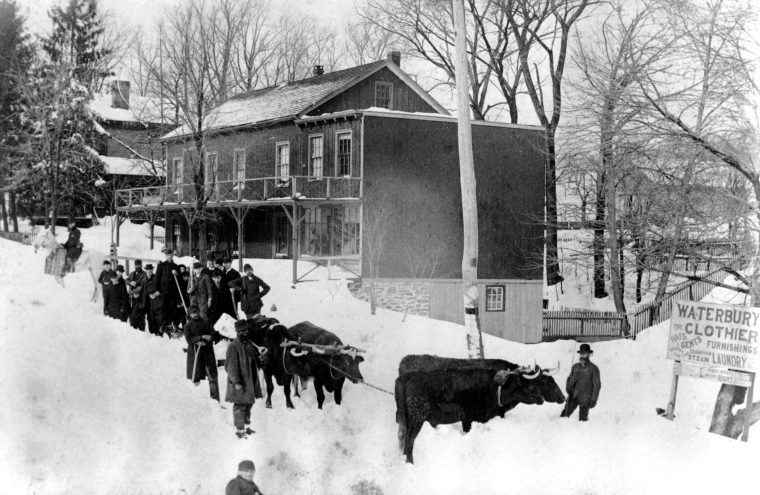
Oxen used to help clear lower Greenwich Avenue, 1888. Courtesy of Greenwich Library.

By Mary A. Jacobson

The winter of 2025-2026 is one of the harshest ones remembered by many Greenwich residents in a very long time. With thermometers reading zero degrees and wind chill temperatures in the negative double-digits, with ice and over a foot of snow lingering seemingly endlessly, it is a winter. With that in mind, it seems fitting to resurrect the remembrances of numerous past Oral History Project narrators who can recount their winter recollections and perhaps give ours a different perspective.

Horace Bassett, a Greenwich dentist born in 1905, was interviewed in 1976 by OHP volunteer Richard W. Howell. He reminisced about the winter of 1918, one of the harshest in his memory. At that time, coal to heat homes “was delivered to Greenwich by barges, not by railroad… Greenwich harbor was completely frozen, so the barges couldn’t get in (to Steamboat Road). The schools were closed because they ran out of fuel… It froze all the way out to the Captain’s Islands.” Horses pulling sleighs traveled on the ice to the stranded barges to transport coal to Maher Brothers, a coal importer on Steamboat Road.

Being young and carefree, Horace and some friends walked over the ice that year to Island Beach to visit its caretaker there, Fred Metzger. Metzger asked the boys to return the next day with his mail from the Post Office and the teens readily agreed. The next day “it must have been towards the end of the cold spell, because the ice was rather weak. My dad happened to be down around Indian Harbor. He saw us out there, met us halfway, and just reprimanded us very severely… Even today I think of what might have been if that ice had caved in.”

Another remarkable year was 1934. William Erdmann, captain of the Island Beach ferry for thirty years, was interviewed in 1975 by OHP volunteer Marge Curtis. As a young man of 24, he recalled that “in 1934 we had a particularly severe winter. It was a combination of real cold weather and no wind, so the Sound was frozen over.” The ice “got real thick at that time. I skated out to the island Ice boating in Greenwich Harbor. Courtesy of Greenwich Library. (Island Beach) to visit the Metzger family who were very low on food supplies. I thought to myself, ‘Boy, I’m a dope for ever being out here on skates all alone.’”

The next time he went to Island Beach, in order to deliver food to the Metzgers, Erdmann put his rowboat on a sled. “I’d pull the boat up on the ice and put the sled underneath it, and I’d walk the rest of the way back in, towing the boat.”

Erdmann had a theory to explain that “awful, heavy ice… That was Depression days, and they just didn’t have much boat traffic, either. So, as long as there was no boat traffic to keep the ice broken up, the ice just got stronger and thicker and thicker and stronger.”

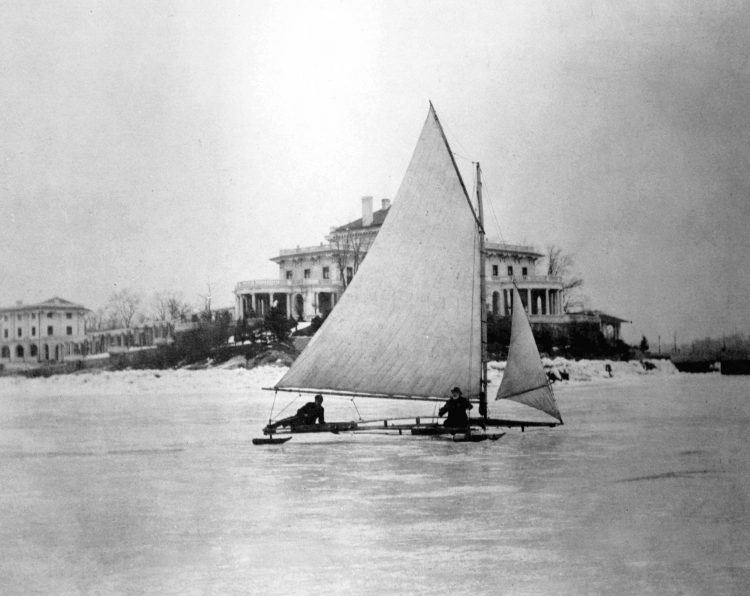
Hugh Dougherty served as dockmaster at Tod’s Point for many years. He was interviewed by Esther H. Smith in 1975 at the age of 72. “We seemed to have much more bitter winters in those days than what you have today, and the Sound would freeze up almost every winter.” He described how, at high tide, along the shore, the ice would “break into cakes and you had what we called ‘cakey.’ Then to get back and forth you had to walk the cakes. I do remember my father being on one and the cake turned over and dumped him in the water… Luckily, we had very few drownings… Old Captain Gardner, who was a very cautious man, warned us if we ever went out to the lighthouse, be sure and take a long sled with us so that if the ice started to get weak at all, you could get on the sled and spread your weight out over a greater area. Then you’d push it along until you got back onto hard ice again.” One of Dougherty’s favorite pastimes was on an iceboat with “a very light frame, with runners on it and a goodsized sail. It did go very fast and it was bitter cold riding on it.”

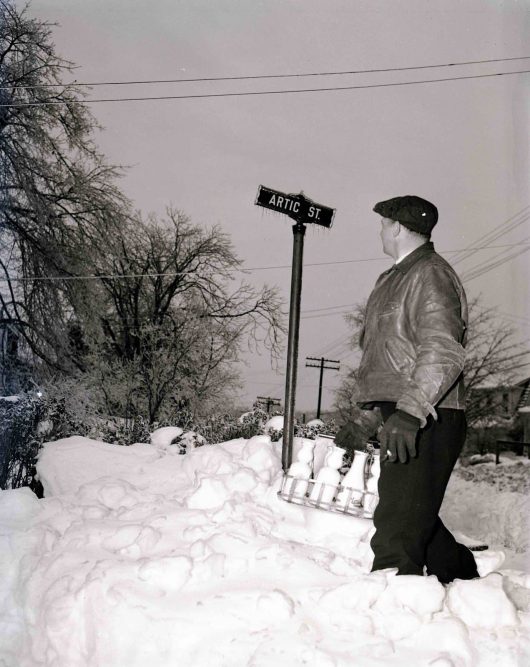
Cherry Grafton Taylor had somewhat less dramatic, but no less memorable times skating on icy ponds, which she related to OHP volunteer Marjorie Schwier in 1989. “It seemed to me that we had many, many weeks of ice skating and we would take lanterns and skate at night in the moonlight. There’s a pond we used to call Shop Pond where there was an old mill. That was a beautiful place to skate at night when the moon was full and the ice was very thick and black. “Sometimes we would make sails out of an old bedsheet and let the wind take us from one end of the pond to the other.” She, too, had memories of the Blizzard of 1934 “skiing down to Glenville to get milk and eggs.” There was purportedly more than three feet of snow that year in Greenwich and the snowplows couldn’t maneuver. “It was quite a horrendous blizzard.”

Space does not allow us to include the classic nor’easter of 1888 with snowdrifts of twenty feet, or the storm fiftynine years later in 1947, which dumped 25 inches of snow, again stranding residents with dwindling fuel and food. Yet, with these harsh winters and others to follow, the sense of community and the kindness of Greenwich neighbors to one another have remained notable, steadfast, and true.

The Oral History Project is proud to present blogs derived from its collection of recorded interviews as part of the Project’s celebration of “America’s 250th | Greenwich – Greenwich History is American History.” The OHP is sponsored by Friends of Greenwich Library. Visit the website at glohistory.org. Interviews may also be read in their entirety or checked out at the main library. They are also available for purchase by contacting the OHP office. Our narrators’ recollections are personal and have not been subjected to factual scrutiny. Mary Jacobson serves as blog editor.
Milkman Francis Connally delivers in the snow to his customers. Courtesy of Greenwich Library.
Ice boating in Greenwich Harbor. Courtesy of Greenwich Library.

Friday, February 6, 2026


The Horse and Buggy Man -- Celebrating America 250

by Mary A. Jacobson

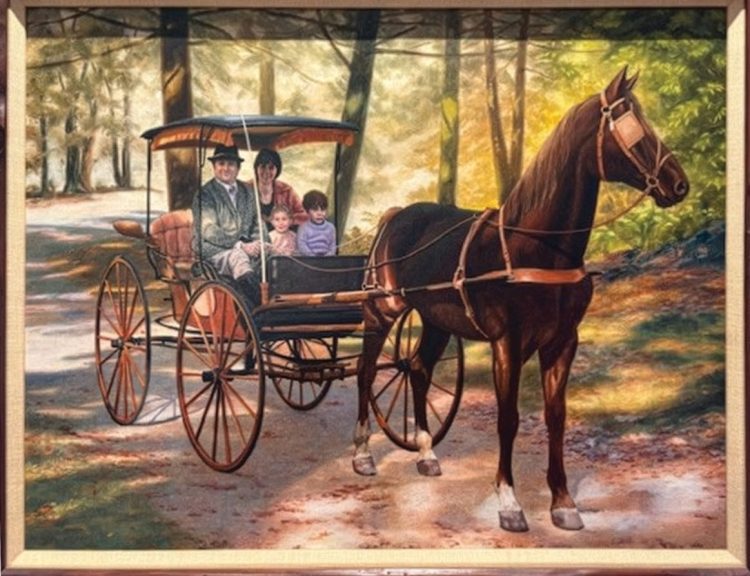
Blaise and Anna Anello with children Andrew and Christiane in a surrey with the fringe on top, pulled by horse Heidi, on Hillcrest Park Road in Old Greenwich, 1977. Courtesy the OHP collection.

For many decades, residents of Greenwich have periodically heard the clop-clop-clopping sound of horse’s hooves, only to turn and see a handsome horse and buggy coming down the road. It’s a reassuring sound, far removed from the screeching sound of tires or the honking of car horns. One might say it is almost meditative. Has the viewer stepped into a time machine and been suddenly transported to a bygone age?

The Oral History Project tasked interviewer Kate Loh with the challenge of finding the answers. She met Greenwich resident Blaise Anello in 2024 who revealed to her the tale of the long and winding road that led him from a boyhood farm in the Tunisian countryside to horse and buggying in Greenwich.

Blaise Anello was born in Tunisia in 1942 “right in the middle of the war. And the war was in North Africa as well as in Europe… Cars at the time were very scarce. My father had a car. And the Italian army came over and they say, ‘We need the car for the war effort.’ And my father had no choice. So (he) went back to horse and buggy like he grew up with.” The bombing in the Tunisian city where they lived caused Anello’s family to relocate to the countryside and rent a farm where they could grow crops. “There was a shortage of everything. There were breadlines.” His dad fashioned a two-wheel cart for his horse made from a car axle with car wheels. “He built a wooden body on it, and he had a way to get to town.”

In 1947, after the war ended, Blaise Anello and his family moved back to the city. However, memories of the farm, and particularly its animals, never left him. “I remember certain things. And the love for horses never left me.” Twelve years later, at the age of 17 in 1959, Anello’s family emigrated to the United States and settled in Yonkers, where he attended high school. There, he met a classmate, Anna, who would later become his wife. After graduation, “We did not see each other for about five years.” However, in 1965, fate intervened on a NYC subway where he noticed Anna. “We recognized each other, and we started dating. And soon after, we decided that we wanted to get married.”

Shortly afterward, Anello obtained a temporary position with an American company in Tunisia, where he and Anna were married. While back in Tunisia, Anello bought a horse. “Just for pleasure. I always wanted to have a horse…This was something I had in my blood all along.” He actually bought two, one for Anna. “And she rode, and I found out later just to please me. It wasn’t in her blood.” Eighteen months later, “when the job was over, I sold the horses.”

Anello returned to the States with Anna and hoped to find a place to live that might also accommodate horses. Purdy’s Farm, on King Street at the time had an apartment there in the barn “and they rented to us. So, once I found that barn, I went to look for a horse.” An ad in the New York Times featured a retired riding mare for two hundred dollars. “Heidi was my first horse in the United States.”

It soon became obvious to Anello that his wife, Anna, “wasn’t crazy about riding. She had fallen off a few times. So, I decided, maybe if I teach the horse to drive, it could pull a carriage. Maybe we can both go on it, and she doesn’t have to ride on a saddle; she can sit right next to me.” Anello obtained his first buggy and harness from Stratford Farms on King Street by trading his talent for electrical work. The owner “had built a new barn and he wanted to put a few lights in there… I said, ‘Tell you what. We could do a trade. I’ll do the electrical work, and you give me that buggy and harness.’”

Anello really had no idea how to train a horse to pull a buggy at the time. “Now, I do this professionally. I train horses to drive… but when I was young and stupid, I knew nothing about it.” At that time, in 1968, Interstate 684 was completed, but not yet open to traffic. “And I taught my horse to drive on 684, a brand new highway between Greenwich and Armonk… One day, a van came by, and it didn’t look like the police, but it was a news crew… here’s a brand new 1960s highway, and here’s a horse and buggy riding on it.”

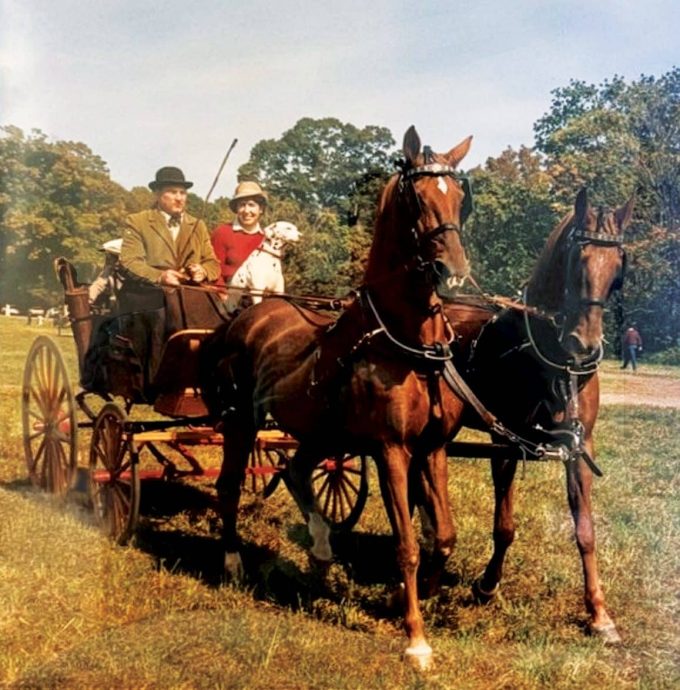
Blaise and Anna Anello with son John and their dog Dutchess in an open carriage, pulled by horses Ginger and Brandy, 1984. Courtesy the OHP collection.

Not long after, Anna found an ad for a house in Hillcrest Park in Old Greenwich with an acre of land, a “fixer upper.” According to Anello, “… the place was pitiful. There was a hole in the ceiling where it was raining in.” However, Anello saw its promise. “The price was reasonable. They said low thirties… and I says, ‘I could do something out of this place.’” At the time, Anna was uncertain but “fifty-six years later, we’re still there. We’re still fixing it.” Three children and eight grandchildren have been added to their family in the ensuing years.

Blaise Anello is a welcome sight with his horse and buggy at Tod’s Point. His twelve-mile route from home is a familiar one, going from Havemeyer Park to Wendle Lane, across Post Road to Laddins Rock Road, and past Perrot Library, and down Sound Beach Avenue to Shore Road. This round-trip ride takes a total of five to six hours from start to finish “but three hours is actually on the road… It’s about forty-five minutes over and back but then I rest and let (the horses) enjoy the view.”

Anello clearly enjoys the pleasure he gives to people who wave and greet him as he passes by. When people ask him how many miles to the gallon he gets, he has a ready answer. “I don’t get any miles to the gallon, but I get a lot of smiles to the mile.”

The Oral History Project is proud to present blogs derived from its collection of recorded interviews as part of the Project’s celebration of America 250 Greenwich – Greenwich History is American History. The OHP is sponsored by Friends of Greenwich Library. Visit the website at glohistory.org. Interviews may also be read in their entirety or checked out at the main library. They are also available for purchase by contacting the OHP office. Our narrator’s recollections are personal and have not been subjected to factual scrutiny. Mary Jacobson serves as blog editor.
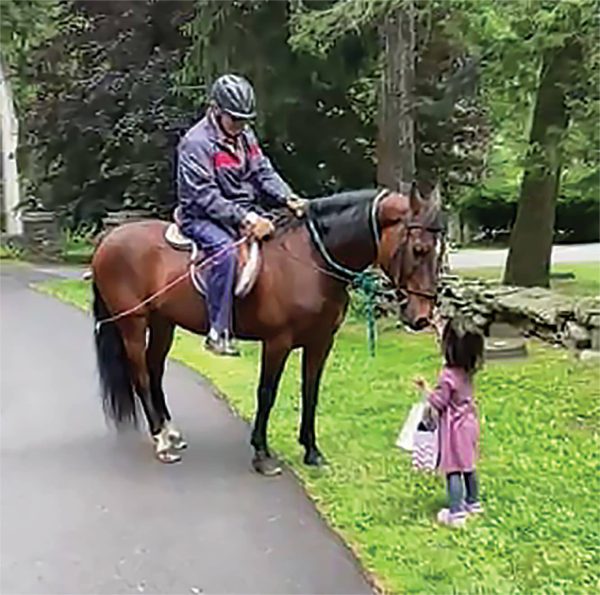
Blaise Anello on his horse Dutch with grandchild Eva. Courtesy the OHP collection.

Friday, November 14, 2025

Edward Vick: Proud American -- Celebrating America 250

by Mary A. Jacobson
Ed Vick speaking on Memorial Day. Photo by Andy Volcom.

Edward Vick’s family has proudly served in the United States military for generations. In his 2024 Oral History Project interview with Mary Magnusson in 2024, he reviewed both his and his family’s military history.

Vick’s great-great-grandfather, Joshua Vick, led a company of the 7th North Carolina Regiment in Gettysburg. Wounded, captured, and later released, “he was one of the lead elements of Pickett’s Charge.” His grandfather participated in the First World War. “He went to France as a motorcycle dispatch rider.” Vick’s Uncle George, “who I was very close to… ran away from home when he was sixteen and went up to Canada and joined the Royal Canadian Air Force and flew Mosquito bombers in Europe” during World War II.

Vick’s dad had the greatest influence on him. A medical doctor, he was made a junior officer in the Navy and a medical officer. “He was in the Battle of Okinawa on a ship, and he was treating the wounded on an open deck while the kamikazes were crashing all around him… He received the Bronze Star for that.”

With that legacy of military service in his family, it is no wonder that Vick also wanted to serve his country by joining the military. A graduate of the University of North Carolina at Chapel Hill, “I joined the Navy because my dad had been in the Navy.” Vick was twenty-two in 1966 and the Vietnam War was raging. Vick was initially assigned to a ship in Boston Harbor. “I didn’t want to do that. I felt like I really wanted to be in Vietnam. I suppose my feelings changed later on, but I really believed in the war at the time.” After a year, he asked his commanding officer if he knew “anybody in the River Patrol Force of the swift boats or anything like that?… So next thing I knew, the orders got changed and I was off to San Francisco to train for riverine warfare.”

Vick’s four-month training program involved small boat tactics, “daytime and nighttime, up in Vallejo, California, in the northern side of San Francisco Bay,” survival school, and Vietnamese language school. “And then I was sent to Vietnam right before Christmas in 1968” at age 24. Upon arrival, Vick learned that he would replace another junior officer who had been killed. “I was told that I was going to be assigned to River Division 534, which was up on an operation called GIANT SLINGSHOT, northwest of Saigon and it was a really difficult operation.”

Vick found this first foray upriver to be “quite an eye-opening experience. Nothing was like what they taught you.” These were not the big rivers upon which he had been trained. “They wanted to get more up into where the Viet Cong and the North Vietnamese really hung out. So, we had to go into more narrow rivers which were much more dangerous… the Viet Cong would line up along the riverbanks. They’d build bunkers… and they’d wait for you to come by and they’d open fire… My very first gun fight, my boat was hit by a rocket below the water line, and we sank.” Fortunately for Vick, “All patrols moved in pairs because they were so vulnerable. They’re just plastic with no armor… So, my cover boat behind me saw that we’d been hit and were going down.” Fortunately, they all survived.

Other times, with a starlight scope – like a night vision goggle, Vick’s platoon would wait in silence to ambush an expected Viet Cong crossing of the river. “We’d tie our boat up to the bank and we’d turn all the radios and everything off. We wouldn’t talk. We’d just lie there and wait all night long. No smoking. No nothing… And then you could see them crossing. And they wouldn’t see you. So, we would catch them sometimes crossing late at night… And that’s what you were trained to do.”

All in all, Vick commanded about a hundred patrols in the area of the Mekong Delta and was awarded two Bronze Star medals. “One of the things I’m most proud of is we were awarded the Presidential Unit Citation for our actions in GIANT SLINGSHOT, the highest award that a combat unit can receive for its actions in combat.”

When Vick returned from his tour in Vietnam, he enrolled at Northwestern for a master’s degree in journalism, a small program of about thirty students. “I hadn’t been home for three years basically. And when I came back, the attitude towards the war had completely changed and vets were completely ostracized.” One university experience at that time was seared in his memory. On the first day of class, the professor asked everyone in the program to tell something about themselves. “So, everybody goes around and it comes to my turn. So, I said, ‘Well, I’m from Philadelphia and blah, blah, blah. And I went to the University of North Carolina.’ And that’s all I said. And the dean said, ‘Wait a minute. Wait a minute. You forgot the most important part.’ The dean was a reserve naval officer. So, he was proud of the fact that I was a naval officer in Vietnam. And for the next two months, nobody spoke to me. Didn’t say anything to me. No, didn’t say a word.”

During that time, Vick started to write his book entitled “Slingshot.” He was “beginning to turn against the war… It’s basically good guys caught up in the web of the system and the bureaucracy. And it doesn’t come out well… The American population blamed the war on the warriors, not on the politicians.”

Vick’s professional life in the years that followed saw him rise to be CEO of the firm Young and Rubicam. His personal philanthropy centered on causes that benefitted veterans. While Mayor of New York, Ed Koch appointed him to the board of the New York Vietnam Veterans Memorial Commission. “That was quite an honor.” A jobs program for veterans was initiated. In addition, a book entitled “Dear America: Letters Home from Vietnam” was published and later turned into an Academy Award-nominated film. “It was a book of nothing but letters home from Vietnam. No editorial comment or anything like that. Just letters.”

Vick was also on the board of an organization called “Give an Hour” which pairs those in need of psychological help with a psychiatrist or psychologist for an hour a week free. “And we have seven thousand psychiatrists. So, it’s really quite a good program.” He is also often seen on the parade route of the Greenwich Veterans Day parade or as a speaker at the annual Memorial Day ceremony at Indian Harbor Yacht Club.

Looking back at his accomplishments, Vick surmised, “I learned hard work in the Navy, and I learned responsibility. I learned leadership. I just learned a lot of things in the Navy. It stood me in good stead.”

The Oral History Project is proud to present blogs derived from its collection of recorded interviews as part of the Project’s celebration of America 250 Greenwich – Greenwich History is American History. The OHP is sponsored by Friends of Greenwich Library. Visit the website at glohistory.org. Interviews may also be read in their entirety or checked out at the main library. They are also available for purchase by contacting the OHP office. Our narrator’s recollections are personal and have not been subjected to factual scrutiny. Mary Jacobson serves as blog editor.
Book jacket of “Slingshot” based on Vietnam wartime experiences.
Ed Vick in 2024 with Oral History Project interviewer Mary Magnusson. Courtesy of Oral History Project.

Wednesday, November 5, 2025


A 1695 Greenwich Landmark Tells America’s Story
by Mary A. Jacobson

Thomas Lyon farmhouse, circa 1900. Courtesy of Greenwich Historical Society.


The Thomas Lyon House, built by Thomas Lyon the 2nd in 1695, is the second oldest house in Greenwich and bears witness to the statement: “Greenwich History is American History.” The house may easily be overlooked by the thousands of cars that drive by it each day, crossing from Port Chester to Greenwich. On one side of the road, there’s a sign that reads “Greenwich CT Gateway to New England.” Directly opposite, on the corner of Byram Road and West Putnam Avenue, stands a small, brown-shingled house. Hung across the front of it is a large, faded white banner. Ironically, the only words that can easily be deciphered are “This House… Help Us.”

Despite its current condition, the history of the Thomas Lyon House is a proud one. Julie Grey Pollock, a ninth-generation Lyon descendant, was interviewed by Oral History Project volunteer Richard M. Blair in 2010. She had traveled to Greenwich from her home in Alaska at the time, eager to join other family members on a day which was proclaimed Lyon Family Day by Peter Tesei, then First Selectman.

Julie Grey Pollock was anxious to share her knowledge of the Lyon family, and the history of the Thomas Lyon House. “This area was for most of its life a working farm. The lands that the Lyon family worked on were from as many as three hundred acres, to ninety-five acres in my great-grandfather’s (Underhill Lyon) time, to a final piece of eight acres. They had orchards; they raised livestock; they grew crops; they grew hay; they did a lot of trading in apples and making of cider and vinegar, which they traded to New York.”

The Thomas Lyon House was a participant in the American Revolution. As Pollock stated, “I have the (British) cannonball that hit this house during the Revolutionary War…. Most of that generation… were joining the Americans and fighting the British. But their father, Gilbert, was a Tory… So, I think that whole issue of the sons being for the Revolution, and the father being for the British Crown, had to be rather interesting in this house at that time.” As a child, “I thought everyone had a cannonball by their fireplace.”

Pollock elaborated on the Revolutionary War history of the house at a talk she gave at the Bruce Museum for the Greenwich Preservation Trust in 2012 and kindly sent the transcript to the Oral History Project for its records. In her words, “The neighborhood around the Lyon home at Byram Bridge was a highly strategic location between the advances of the British into New England and the Americans’ repeated attempts in 1779 to repel them… The British forces and Continental Army met up and fought several times along this border zone… Repeated forays of the British, including the destruction of homes, barns, crops, ships and churches along the coast disrupted normal life for many months.” Pollock’s grandmother, Julia Lyon Saunders, told her that family lore that included stories of “redcoats hiding behind the rocks across the road from the house.”

Thomas Lyon House moved across the street in 1927 because of widening of Boston Post Road. Courtesy of Greenwich Historical Society.

Pollock and her family members have preserved many of the artifacts that were essential to life in those times. “We have the spinning wheels that they used for both flax and for wool… We have utensils, we have implements… so that we would have something really solid to contribute to the overall knowledge of the place,” including documents that tell the economic story of the family from “about 1800 until after the Civil War.” Pollock was particularly proud of a desk she possessed called “Uncle Seth’s desk,” belonging to Seth Lyon, born in 1790. He lived in the house, “a prominent person in his time” and was acclaimed for “working with the African Americans who were in a lot of struggles during that period for freedom.”

In the 1920s, a road-widening project of Boston Post Road nearly resulted in the destruction of the house. Funds were raised, “almost $12,000 which was a lot of money in 1926,” to save it by moving it across the road where it now stands. Pollock’s grandparents moved out that year and gave the historic house to the Rotary and Lions clubs in the hopes that “a handsome visitor center and museum to be known as ‘The Gateway to New England’ would be created.”

With the Depression of 1929 and World War II, those hopeful plans for the Thomas Lyon House did not materialize. “My grandmother, I think, felt very down about what had happened to the house. It became a private rental, and it never became the Gateway to New England” as she had hoped. Instead, it became “a maintenance nightmare and a money sink.” In 2007, the Lions Club gave the home to the Town of Greenwich.

The Thomas Lyon House was listed on the National Register of Historic Places in 1977. The Greenwich Preservation Trust, headed by Andrew Melillo, is now seeking to lease the site from the Town of Greenwich. “Hopefully, we will have the lease signed with RTM approval as well as Planning and Zoning approval by December.” With its eventual maintenance and accessibility plan secured, it is hoped that the story of this historic Greenwich home may be preserved and shared with present and future generations. To quote Julie Grey Pollock, “Like old stone walls, old homes have a story to tell.”

The Oral History Project is proud to present blogs derived from its collection of recorded interviews as part of the Project’s celebration of America 250 Greenwich – Greenwich History is American History. The OHP is sponsored by Friends of Greenwich Library. Visit the website at glohistory.org. Interviews may also be read in their entirety or checked out at the main library.

They are also available for purchase by contacting the OHP office. Our narrator’s recollections are personal and have not been subjected to factual scrutiny. Mary Jacobson serves as blog editor.

Thomas Lyon House interior room with fireplace as seen today. Photo by Mary A. Jacobson.

Monday, September 29, 2025

Andrew Bella 

From Byram Boy to High School Principal

by Mary A. Jacobson

There aren’t too many residents of Greenwich who can trace their ties to the Greenwich Public Schools from their earliest childhood years at New Lebanon School to their retirement after a career spanning forty years. Such a man was Andrew Bella for whom Bella House at GHS is proudly named.

Andrew Bella.
Courtesy of the Oral History Project.

Andrew Bella was interviewed for the Oral History Project in the 1970s by Margaret F. French and Brooks Lushington. Born in 1907, Bella’s memories of his early life in Byram are vivid in his mind. “Byram was more or less a self-contained community . . . called East Port Chester in those days because without cars people did their shopping in Port Chester.” He was born into the German Lutheran Church - a “P.K.” or “Preacher’s Kid” - as he said. Most of his dad’s parishioners were immigrants who worked at Abendroth’s, the foundry in Port Chester. “. . . as kids we could look in there, and you could watch the red-hot molten metal being poured.” His dad would advise his immigrant newcomers, “Go to church, get your citizenship papers, and buy a home.” According to Bella, “Many of the homes on Mead Avenue in Byram . . . are still owned by the sons and daughters and grandsons and granddaughters of those people who came here at the turn of the century.”
 
Bella’s description of his early school days at New Lebanon were far different from those experienced today. “We had a crowded school even when I was here, and we had to use the church on William Street for some of the classes.” Bella’s favorite game of baseball was played on a field where the ashes from the school furnace were disposed. “The playground actually was just the open field with stones for bases and ashes in the outfield . . . We passed the hat and made enough to buy the balls and bats and the equipment we needed. So that was the Recreation and Parks Department!” As Bella recounted, “No one had a car. My dad didn’t have a car till I was sixteen (in 1923). Cars and airplanes were a novelty. If you’d see a plane, everybody would look up.”
 
From New Lebanon School, Bella went to Greenwich High School, which was located on Havemeyer Place. However, for Bella, there was “no gym, no yard, no nothing.” For physical education, the students would do calisthenics in the third-floor hallway. “Weather permitting, we would run around the block.” There was also no auditorium. For assemblies, Mr. Folsom, the principal affectionately known as “Pop,” would climb on a platform in the corridor “and we would stand around him, and we’d have our assemblies there.” The year Bella graduated in 1925, however, construction began on the new high school on Field Point Road (now Town Hall).

Havemeyer School, on Havemeyer Place, eight years after its opening in 1892.
Site of the first Greenwich High School graduation in 1895.
Courtesy of Greenwich Library.

Despite the lack of facilities, “we managed, and I think we had an excellent faculty.” In particular, Bella extolled the science department. “We did have an excellent science department.” Bella excelled in physics and chemistry and enrolled at Yale, graduating as a physicist. However, “By then the Depression had struck, and no one knew what a physicist was, let along hire one.” His luck changed through a chance meeting with Pop Folsom. “I came home one vacation from graduate work at Yale and I met Pop Folsom who said ‘We have an opening in the physics department. Would you be interested?’ . . . So that’s the way I came back to Greenwich High School (in 1929 at age 22), by meeting Pop Folsom on the street one day.”
 
By 1940, with a master’s degree in educational administration from Columbia, Bella was named principal of Greenwich High School. During his tenure, until his retirement in 1969, the high school experienced much growth and development. “The athletic program evolved from football, baseball, and basketball into the complete spectrum of sports we have today (1977 at the time of interview), including lacrosse, tennis, and soccer . . . We developed ice hockey when the rink was built in Playland . . . We were the only out-of-state school that skated in Playland. Many times we were champs of the Westchester County Hockey League.”
 
Bella also supported increasing school services for students who had learning difficulties or were academically challenged. “The whole guidance movement developed during my tenure at the high school.” Bella was also particularly proud of a program developed in the aftermath of World War II. “Boys who had not finished their high school education were allowed to come back as veterans . . . they were the best students; they knew what they wanted to do.”
 
As the post-World War II baby-boom generation moved through the school, its facilities became cramped with some classes held in the auditorium and gymnasium. “Toward the end of my career at Field Point (now Town Hall), our proms were so large that we had to have two orchestras. We had one inside the girls’ gym and we had a tent on the front lawn, so there was continuous music inside and outside.” “Afterglows” (post-prom gatherings) were held at The Clam Box in Cos Cob so the students would have a place to go after the prom.
 
Bella fondly recalled an incident in which he was summoned to the second floor because there was a car in the hallway. “A crowd of maybe a hundred students followed me up and, sure enough, there in the corridor was this Volkswagen completely assembled . . . What they had done is, during the night, under blankets with flashlights, taken this car apart, and hoisted it up to the second floor . . . no gasoline . . . no scratches . . . They did it and they were fine students.”
 
Bella had definitive views about the value of discipline. “I think that discipline, if it’s fair . . . is something that students want . . . If they don’t have it, they’re going to look for it, and they’re going to look for it by doing something that demands discipline . . . Youngsters want to know what the lines are.”

Greenwich High School on Field Point Road in 1960.
Opened in 1925.
Now serves as Greenwich Town Hall.
Courtesy of Greenwich Library.

Bella’s tenure extended from the World War II era to that of the Vietnam War and the turmoil of the sixties. Through those years, he led with a steady hand. The present high school on Hillside Avenue opened in 1970, the year after he retired. Bella had championed for a new school to accommodate the swelling student population. A clandestine petition, signed by hundreds of students, requested that one of the houses in the new school be named Bella House after him, a recognition in which he took great pride. “I go to about three reunions a year and you get this outpouring of affection for the school . . . And that’s where you begin to feel the real quality and value of what went on at that time.”
 
The interview entitled “From Byram Boy to High School Principal” may be read in its entirety or checked out at the main library. It is also available for purchase at the Oral History Project office. The OHP is sponsored by Friends of Greenwich Library. Visit the website at glohistory.org. Mary Jacobson serves as blog editor.