Monday, October 3, 2022

Greenwich Symphony Orchestra
by Mary A. Jacobson

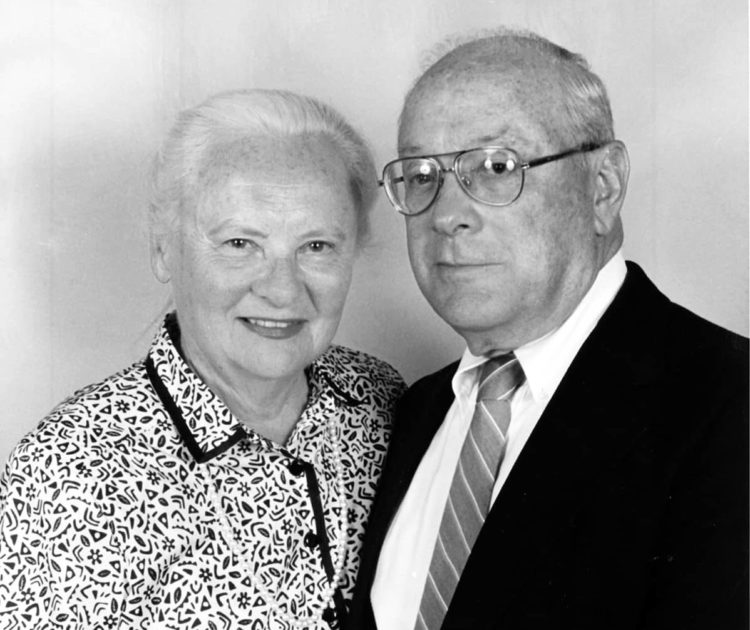
Mary and Dick Radcliffe, 2007 photograph from Mary Radcliffe personal collection.

Music! Music! Music! How wonderful to have the Greenwich Symphony Orchestra resume its performance schedule on September 10, 2022, after its programming was interrupted by the pandemic. Its inaugural concert was played to an appreciative audience at the Performing Arts Center at Greenwich High School. The concert also introduced the orchestra’s new conductor, Stuart Malina.

In 2011, the Oral History Project published “The Greenwich Symphony Orchestra: 53 Years of Superb Performances,” a compilation of several interviews of board presidents dating from 1976 to 2011.

The history of the Greenwich Symphony Orchestra dates back to 1958, when a local orchestral group became the Greenwich Philharmonia, conducted by Ken Wendrich, head of the music department of Greenwich High School. A board of directors was formed with Catherine Felding (Mrs. Allen Converse at the time) as its first president who served until 1967. The orchestra held three concerts a year.

The year 1967 is considered a watershed year for the GSO by many, the year the orchestra transitioned into a fully professional one with growing prestige. That was the year that a search for a new conductor led to a young man, John Nelson, “straight out of Juilliard, who had been highly recommended,” according to Marianne Jeffrey, board president at the time. John Nelson was the first of twelve applicants to audition. “Each conductor was to take the orchestra, first rehearsing a piece they had once performed, and then work on something they had never performed…His rehearsal technique was even then really remarkable, how he brought out more than they thought they could do… A survey was taken from all the orchestra members, which showed the orchestra also felt how marvelous he was, how very fine a musician he was, but they were also a little worried whether they could live up to such a conductor.” No more interviews were conducted. “We gave up after that first night because it wasn’t needed anymore.”

Mary Radcliffe, who began her thirty-seven-year tenure as president of the board in 1975, stated that John Nelson “was with us for seven years, and he made the orchestra a professional orchestra. Everybody was now being paid. He also had a lot of contacts with Juilliard. He got wonderful soloists…That was a turning point for the orchestra. Also, he enlarged the orchestra’s string section. So, it became a real symphony orchestra.” In 1975, the orchestra changed its name to the Greenwich Symphony Orchestra. That year it also welcomed David Gilbert as its conductor and music director. He remained in that position for the next 45 years.

One aspect of the orchestra of which its musicians and the board are particularly proud is that there is no paid management. According to Mary Radcliffe, aside from the librarian, personnel and concert managers, and the musicians, “the orchestra has never had an executive manager or a paid manager…Every other orchestra in the American Symphony Orchestra League, every other orchestra with this budget size has a person like that, but we have a symphony board, which is a volunteer board, that manages the orchestra.”

The Chamber Players of the Greenwich Symphony, in existence since 1971, is an independent ensemble, whose musicians are drawn primarily from the principals of the GSO. They present four sets of subscription concerts each season. “It’s really a wonderful program. They do all kinds of chamber music. Not only strings –woodwinds, harp…they program that… we advertise each other,” explained Mary Radcliffe.

The Young People’s Concerts have been a source of pride for the GSO. In collaboration with the community’s music educators, children in the Greenwich public and private schools are provided with a unique musical experience which includes a pre- and post-concert curriculum. “We present professional orchestra concerts to every child in this town, grades two through seven…This is not an outing for these kids…they come absolutely fully prepared,” explained Mary Radcliffe.

The pandemic had a disruptive effect on the programs and concerts normally performed by the GSO, from the spring of 2020 until this month’s inaugural concert. The Oral History Project has embarked on a “COVID Project” to document the effects of COVID-19 on the people and institutions of Greenwich. Volunteers of OHP have conducted more than sixty interviews in this endeavor. Daniel Miller, personnel manager of GSO, was interviewed by Connie Gibb, and described the impact of the pandemic on the orchestra. In his words, “Everything stopped. I mean, it was astonishing. And that’s really a big shift…Our whole organism, our whole life is geared up towards spending these hours in the evening being at our top form and performing. Our days are kind of balanced around that. And so that kind of performance…that was just taken away.”


Now that the music and performances of the GSO have resumed, the Greenwich community can once again appreciate and support this community gem. As Danny Miller expressed, “… music is kind of like time travel. You can go places, you can visit other centuries, other settings through music. And to do that together in this community is precious. And I think that’s something that’s transcendent, and I think that’s what the audience wants, as well as the performers. It is a communal experience, which is very important. And I think people long for it.”

The book of interviews entitled “The Greenwich Symphony Orchestra: 53 Years of Superb Performances” may be read in its entirety at Greenwich Library and is available for purchase at the Oral History Project office. The OHP is sponsored by Friends of Greenwich Library. Visit the website at glohistory.org. Mary Jacobson serves as blog editor.

Monday, August 15, 2022

The Hurricane of 1938

The unnamed hurricane of 1938 is purported to be the first major hurricane to strike New England since 1869. It was one of the most powerful and destructive hurricanes of the twentieth century.

Moving at 47 miles-per-hour, its center made landfall at the time of an astronomical high tide and fueled storm tides of fourteen to eighteen feet across the Connecticut coast. In addition, in 1938 there were no advanced meteorological technologies such as radar, radio buoys, or satellite imaging to warn residents of an oncoming hurricane.

Paul Palmer after he joined the 
U.S. Navy in 1942. Photo lent by 
the Palmer family to the Oral 
History Project.
Paul Palmer, aged fourteen and living on Willowmere Avenue at the time, experienced this storm first-hand. His vivid recollections were recounted to Barbara Ornstein of the Oral History Project in 1975.

On September 21, 1938, Paul and his classmates were dismissed from school at noon as heavy rain had been continuously falling for several days. “I remember coming home and how hard that wind was blowing. I can see the trees going over, you know, but there was no mention of a hurricane.” Once home, Paul and his friend, John [Buster] Clarke, helped Paul’s dad pump out the flooded cellar. Paul recounted, “Then I remember it started raining again that afternoon. The tide was due to come in at night. It was an afternoon tide. I’d say around five o’clock…That wind was blowing; man alive, that wind was blowing. And then, all of a sudden, the rain had let up. I guess the eye had come through, you see, and we thought everything was all over…And that’s when we all took off.”

Paul and Buster heard police and fire engine sirens coming down the street; they ran out to follow them and saw a boat aground on Great Island. “And so, Buster and I said, ‘Well, gee, we can get closer than this. Let’s walk the wall around’… and we crossed over to Quigley’s Island [then part of the Martin J. Quigley property]. We went out on the end out there, and we were watching them try to get the boat off and get the people off the boat.” By this time, the rain and howling wind resumed as the back end of the hurricane was coming around. The boys decided they had better return home.

They crossed back over the bridge connecting the Quigley property to the mainland and realized the water was to the top of the wall. One of their neighbors, Mr. Pitcher, called to them saying, “Boys, you better come in here for a minute. This tide is coming in awful fast.” Paul agreed to go into the house, but Buster decided to run home. “He ran around the corner of the house, and the water came up over the wall, and I heard him holler and his feet went out from underneath him, and he went down the wall with the wave… He went down alongside the house, and he grabbed ahold of that telephone pole stay out there when he went by it, on the side of the driveway.”

Flood waters on Arch Street during the 
September 1938 hurricane. Courtesy of the  
Greenwich Library Local History Collection.

Paul’s training as a Boy Scout helped prepare him for this emergency situation as he waded into the garage. “I found a barrel and some line. So, I tied the line to the barrel. And I went over to the side of the house, and I threw it out in the current, and let it float down to the telephone pole. Buster grabbed a hold of it, and I said, ‘All right now, I’ll tie it to the car, and you pull yourself in the lee of the house.’” Unfortunately, at that point, the car started to float out of the garage.

Destruction caused by the hurricane in the
Island Beach area. Courtesy of the
Greenwich Historical Society.
With help from other adults in the house, Buster was pulled into the relative safety of the Pitcher home in which the water was waist high. “I remember the [dining] table was floating around. The candles were lit on the table and the table was floating around with all the candles lit on it.” A neighbor, Doc Roper’s son Edward, came over in a rowboat and “we all got out of the kitchen window into the rowboat… We were scared to death to go home. We said, ‘Oh, boy, are we gonna get it.’”

Like any parent, Mrs. Palmer was beside herself with worry. “…and man alive, did we get it! My mother was having a fit. She didn’t know where we were, where we had gone.”

The hurricane of 1938 and Mr. Pitcher’s 1921 Sears and Roebuck house on Willowmere Circle in Riverside played a significant role in Paul Palmer’s life. Paul had always admired the home, and after Paul returned from naval service in World War II, Mr. Pitcher “put in his will that if he died before he could sell me the house, that I would get it through his estate at the assessed valuation. It was to be sold to me. I pretty near flipped.”

Eventually, Paul purchased the home and proudly described the many improvements he had made to it, most notably, putting the furnace and the washer and dryer on the second floor. In addition, “I rewired everything overhead. You see where the base plugs are? [waist-high] Well, I know how deep it can get!”

The book “The 1938 Hurricane in Willowmere” may be read at Greenwich Library and is available for purchase at the Oral History Project office. The OHP is sponsored by the Friends of the Greenwich Library. Visit the website at glohistory.org. Mary A. Jacobson, OHP blog editor.

By Mary Jacobson, OHP Blog Editor

Friday, June 24, 2022

The Mianus River Bridge Collapse

by Mary A. Jacobson

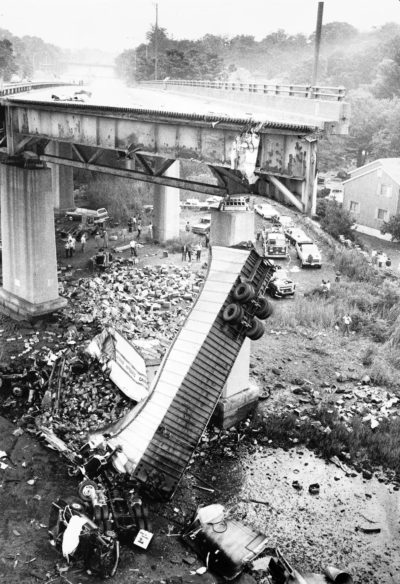
Remnants of the truck which fell when the Mianus River Bridge portion of Interstate 95 collapsed. Photo courtesy of Greenwich Historical Society.

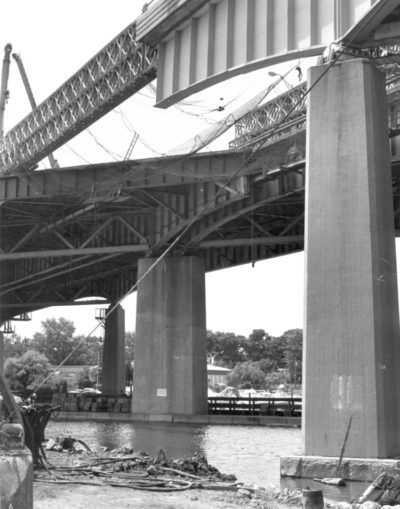
On June 28, 1983, at approximately 1:30 a.m., a 100-foot portion of the Mianus River Bridge on Interstate 95 in Greenwich suddenly collapsed and fell into the river. Nine years later, the Oral History Project compiled or conducted interviews of twenty-two persons who remembered that momentous tragedy.

It is interesting to note that in 1970 the Greenwich Audubon Society conducted a winter bird count of starlings flying into the Mianus River Bridge roost under I-95. Joseph Zeranski, vice president of the Greenwich Audubon Society, reported that approximately 100,000 birds were counted flying in on one evening, not atypical for that time of year. “They roosted there as it was protected from rain and other inclement weather…it was one of the major roosting areas in this region.” By the 1980s there were none. “We went there each year and just shook our heads and were amazed that no birds were present.”

At 1:15 a.m. on June 28, 1983, Margot Cardozo, whose home was situated on a cove under the Mianus River Bridge, couldn’t sleep. She decided to have some milk and chocolate chip cookies in her kitchen. Approximately fifteen minutes later, a huge noise shook the house. She thought maybe a truck had jack-knifed on the bridge.

On the Mianus River Bridge, at that same early morning time, David Pace was driving a truck northbound on I-95 with his sleeping wife, Helen, beside him. Suddenly, “there was nothing under the truck, and that was it…All this happened so quick. I was on the bridge when it collapsed…I heard CRACK, like a bolt of lightning. “

Under the Mianus River Bridge, at a dock on the Cos Cob side, Werner Albrecht had been working late on his boat. At 1:25 a.m., he reached over to turn out the light when he heard “a very deep roar and a thump, like a bass drum, and a screech of tires. I looked out the window and I saw lights cascading down off the Mianus Bridge.” Werner grabbed his flashlight and “found a truck in the water with a couple (the Paces) on top of their cab calling for help…Just about that time I heard sirens from the police and fire departments and state police arriving… Several boats arrived from people who were either working or staying on their boats and they effected the rescue of that couple.”

In all, four vehicles, two trucks and two cars, fell into the river that night from a 100-foot section of I-95 that had suddenly collapsed into the river below. Three victims perished and three survived.

Greenwich first responders who arrived quickly on the scene had a chaotic and challenging task before them. They needed to deal with the traffic on the highway; to lead cars off the road before they would drive near the fallen portion of the bridge. There was a strong smell of fuel around the site in the river, which led to concerns of fire. And, of course, they needed to search for and rescue survivors as well as recover those who had perished.

Looking up at the missing span of the Mianus River Bridge. Photo courtesy of Greenwich Historical Society.

Divers arrived, including Tom Brown, a state trooper and a diver. Their search was impeded by the fact that it was dark and that one of the two trucks that had fallen into the river was transporting meat. According to Brown, “You couldn’t see into the water… and, as you reach underneath, you don’t know if you have a body or a side of beef. And we kept pulling up hunks of beef. Fortunately, it was beef.”

Despite an initial estimate of eighteen months to repair the bridge, the highway reopened to traffic the following September. However, until that date arrived, the daily lives of many Greenwich residents were completely disrupted. Within nine days of the bridge collapse, the state of Connecticut determined that ramps would be built to enable cars and trucks to exit I95 to make their way alternatively through Cos Cob to the Post Road. That meant that over 90,000 vehicles were directed to the Post Road each day with the concomitant noise, pollution, disruption to residents and businesses, and safety concerns that would ensue.

Residents of Cos Cob, particularly the 300 families who lived in the “Diesel Triangle” of River Road, Strickland Road, and Post Road, were particularly negatively affected during that time. They stated that there was no communication beforehand of the impending ramps to be built. David Donald, Cos Cob resident, remarked, “It was probably the quickest road paving job that’s ever been done in the state, I’m sure, because they . . . had those ramps up in less than two weeks’ time… Oh, it was just horrendous. It was a nightmare. So, this was the shortest route. There’s no question about it. But it was awful for us who lived here.”

Five years of litigation followed to determine compensation for victims and to decide whether faulty bridge design or faulty maintenance led to its collapse. A determination was made that the bridge was held up by less steel than was originally designed because of undetected forces of rust and corrosion causing fracture and pieces to fall off, not because of design flaws. Blame was cast on the inadequate bridge inspections which did not detect these flaws. According to William Rush, defending attorney for the engineering firm, “. . . even the birds knew enough to get off the bridge.”

As Michael O’Connor, a first responder, remarked in 1992, “Sometimes it’s strange when you go across and you look and you say, ‘There’s the piece.’ And you go over it. But, knowing what that bridge has been through, it’s the safest bridge in the whole world now. I have no qualms about going over the top.”

The interviews and “The Mianus River Bridge Collapse” book may be read at Greenwich Library. The Oral History Project is sponsored by Friends of Greenwich Library. Visit the website at glohistory.org. Mary A. Jacobson, OHP blog editor.