Friday, June 24, 2022

The Mianus River Bridge Collapse
by Mary A. Jacobson

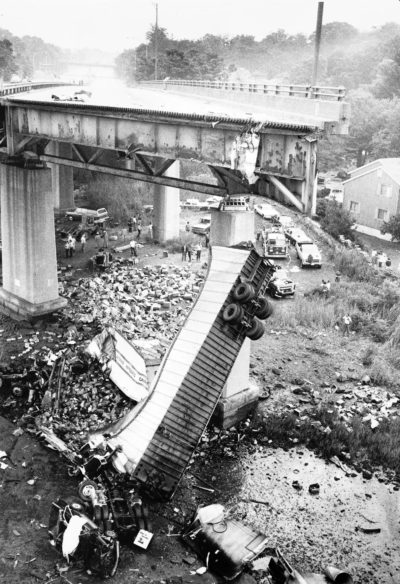
Remnants of the truck which fell when the Mianus River Bridge portion of Interstate 95 collapsed. Photo courtesy of Greenwich Historical Society.

On June 28, 1983, at approximately 1:30 a.m., a 100-foot portion of the Mianus River Bridge on Interstate 95 in Greenwich suddenly collapsed and fell into the river. Nine years later, the Oral History Project compiled or conducted interviews of twenty-two persons who remembered that momentous tragedy.

It is interesting to note that in 1970 the Greenwich Audubon Society conducted a winter bird count of starlings flying into the Mianus River Bridge roost under I-95. Joseph Zeranski, vice president of the Greenwich Audubon Society, reported that approximately 100,000 birds were counted flying in on one evening, not atypical for that time of year. “They roosted there as it was protected from rain and other inclement weather…it was one of the major roosting areas in this region.” By the 1980s there were none. “We went there each year and just shook our heads and were amazed that no birds were present.”

At 1:15 a.m. on June 28, 1983, Margot Cardozo, whose home was situated on a cove under the Mianus River Bridge, couldn’t sleep. She decided to have some milk and chocolate chip cookies in her kitchen. Approximately fifteen minutes later, a huge noise shook the house. She thought maybe a truck had jack-knifed on the bridge.

On the Mianus River Bridge, at that same early morning time, David Pace was driving a truck northbound on I-95 with his sleeping wife, Helen, beside him. Suddenly, “there was nothing under the truck, and that was it…All this happened so quick. I was on the bridge when it collapsed…I heard CRACK, like a bolt of lightning. “

Under the Mianus River Bridge, at a dock on the Cos Cob side, Werner Albrecht had been working late on his boat. At 1:25 a.m., he reached over to turn out the light when he heard “a very deep roar and a thump, like a bass drum, and a screech of tires. I looked out the window and I saw lights cascading down off the Mianus Bridge.” Werner grabbed his flashlight and “found a truck in the water with a couple (the Paces) on top of their cab calling for help…Just about that time I heard sirens from the police and fire departments and state police arriving… Several boats arrived from people who were either working or staying on their boats and they effected the rescue of that couple.”

In all, four vehicles, two trucks and two cars, fell into the river that night from a 100-foot section of I-95 that had suddenly collapsed into the river below. Three victims perished and three survived.

Greenwich first responders who arrived quickly on the scene had a chaotic and challenging task before them. They needed to deal with the traffic on the highway; to lead cars off the road before they would drive near the fallen portion of the bridge. There was a strong smell of fuel around the site in the river, which led to concerns of fire. And, of course, they needed to search for and rescue survivors as well as recover those who had perished.
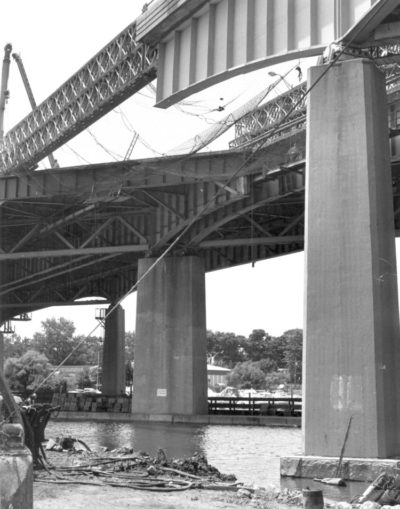
Looking up at the missing span of the Mianus River Bridge. Photo courtesy of Greenwich Historical Society.

Divers arrived, including Tom Brown, a state trooper and a diver. Their search was impeded by the fact that it was dark and that one of the two trucks that had fallen into the river was transporting meat. According to Brown, “You couldn’t see into the water… and, as you reach underneath, you don’t know if you have a body or a side of beef. And we kept pulling up hunks of beef. Fortunately, it was beef.”

Despite an initial estimate of eighteen months to repair the bridge, the highway reopened to traffic the following September. However, until that date arrived, the daily lives of many Greenwich residents were completely disrupted. Within nine days of the bridge collapse, the state of Connecticut determined that ramps would be built to enable cars and trucks to exit I95 to make their way alternatively through Cos Cob to the Post Road. That meant that over 90,000 vehicles were directed to the Post Road each day with the concomitant noise, pollution, disruption to residents and businesses, and safety concerns that would ensue.

Residents of Cos Cob, particularly the 300 families who lived in the “Diesel Triangle” of River Road, Strickland Road, and Post Road, were particularly negatively affected during that time. They stated that there was no communication beforehand of the impending ramps to be built. David Donald, Cos Cob resident, remarked, “It was probably the quickest road paving job that’s ever been done in the state, I’m sure, because they . . . had those ramps up in less than two weeks’ time… Oh, it was just horrendous. It was a nightmare. So, this was the shortest route. There’s no question about it. But it was awful for us who lived here.”

Five years of litigation followed to determine compensation for victims and to decide whether faulty bridge design or faulty maintenance led to its collapse. A determination was made that the bridge was held up by less steel than was originally designed because of undetected forces of rust and corrosion causing fracture and pieces to fall off, not because of design flaws. Blame was cast on the inadequate bridge inspections which did not detect these flaws. According to William Rush, defending attorney for the engineering firm, “. . . even the birds knew enough to get off the bridge.”

As Michael O’Connor, a first responder, remarked in 1992, “Sometimes it’s strange when you go across and you look and you say, ‘There’s the piece.’ And you go over it. But, knowing what that bridge has been through, it’s the safest bridge in the whole world now. I have no qualms about going over the top.”

The interviews and “The Mianus River Bridge Collapse” book may be read at Greenwich Library. The Oral History Project is sponsored by Friends of Greenwich Library. Visit the website at glohistory.org. Mary A. Jacobson, OHP blog editor.


Saturday, May 28, 2022

 Oystering in Greenwich

by Mary A. Jacobson


Oystering in Greenwich has a long and storied history that is indelibly intertwined with that of the Chard family of Greenwich. In 1976, Suzanne Kowalski of the Oral History Project interviewed Clarence Chard to learn about his family and its contributions to the history of oystering in our town.

Clarence Chard’s grandfather, Samuel Chard, began oystering off the Greenwich coastline in the 1870s. According to Clarence, “He had a shanty, they called it, on Brush Island (west of Mead’s Point), where he lived through the week. Then the boys would come down weekends with the horse and wagon and take him back up home to Cognewaugh (Road).”


By the turn of the century shellfishing had become a lucrative business for local fishermen. Clarence’s father, William, born in 1868 in Cos Cob, oystered there until he retired in the late 1920s. Clarence, aged 18 in 1918, joined his father and his Uncle Stanley in the oystering business after graduation from Greenwich High School. “At that time the market boats came up from New York and we loaded them…In the early days, before my time, the oyster sloops (or scows, as they were called) used to go down…most people would call them barges, but we called them scows. They had the house on them; and they opened or shucked oysters right there.”

New England was especially known for the richness of its oyster industry. Chard explained that oysters secrete their spawn from June to September. “When the temperature of the water gets right, they secrete that spawn in the water and it swims around for a dozen or so days. Then it settles to the bottom and attaches itself to the shells and pebbles…the oysters settle on the shells there and grow…It’s because they had good natural settling ground. Connecticut seed (young transplantable oysters) used to be shipped all the way down to Chincoteague, Virginia in schooners. Some of the vessels would carry five thousand bushels of seed.”

Clarence vividly recalled growing up on Indian Harbor Drive watching the oyster sloops. Of the thirty-odd there, he began to name a number of them. “Well, there was the Ann Gertrude, the Florence T., the F.E. Webster, the Fannie S., the Piano, the Emma Jane, the Sarah Lucinda, and, of course, the Susie C. and the Samuel Chard—that was my father’s sloop (built in 1900).”

Clarence and his brother Bill bought the Susie C. from his Uncle Stanley in 1932 and would sail it to Bridgeport to oyster there. “There were over three hundred boats up there, years ago. When the fleet landed up in Bridgeport, why, there were some hot old times…the tricks they used to play on each other. Put things down their smoke pipes so the smoke would come out in the cabin, and things like that.”

The Chard family oyster beds were off Field Point, outside of Captain’s Island, and outside Greenwich Point “in the neighborhood of four hundred acres.” Chard recalled that “the best price we ever got (for oysters) was four dollars a bushel…I did sell a few, in later years, for sixteen dollars a bushel.” In his father’s time, when times were lean, “They raked clams out of a rowboat, and he had clam market enough to pay his men…There were a good many years we never made anything.”


In the 1920s oystering in New York State was condemned and Connecticut was restricted. As a result, “the whole west end of the Sound was a breeding place for stars (starfish),” the nemesis of oysters. “They’ll move in like a blanket sometimes, the stars will. Just cover the bottom…There were a couple of years that there were so many stars that, when we had a nice bed of oysters coming, we took them up and sold them before they were really of marketable size. We ran them over to Oyster Bay and sold them.”

The last boat the family built, utilizing both sail and power, was the Hope, built on Brush Island and launched in 1948. “But we didn’t have any oysters, so then we started dredging clams by power.” Nevertheless, Clarence remained hopeful for the future of oystering: “We know that things come in cycles with both fish and shellfish…I think that perhaps the oysters are liable to spawn again someday and live; and if they do, why there’ll be a rebirth of oystering.”

Today, oystering in Greenwich Harbor has had a rebirth. The Greenwich Shellfish Commission, begun in 1986, is considered an example for the State. Its mission to is “manage, protect, propagate and conserve the shellfish beds for both recreational and commercial use.” Local waters are tested sixteen times a year in thirty-six locations. Roger Bowgen, chairman of the GSC, states that there are now thirty million oysters in Greenwich waters.

Clarence Chard would be pleased.

The interview entitled “Oystering” may be read in its entirety at Greenwich Library and is available for purchase at the Oral History Project office. The OHP is sponsored by Friends of Greenwich Library. Visit the website at glohistory.org. Mary A. Jacobson, blog editor.


Friday, March 25, 2022

Pioneering Mother and Daughter Flyers of Greenwich

by Jean P. Moore

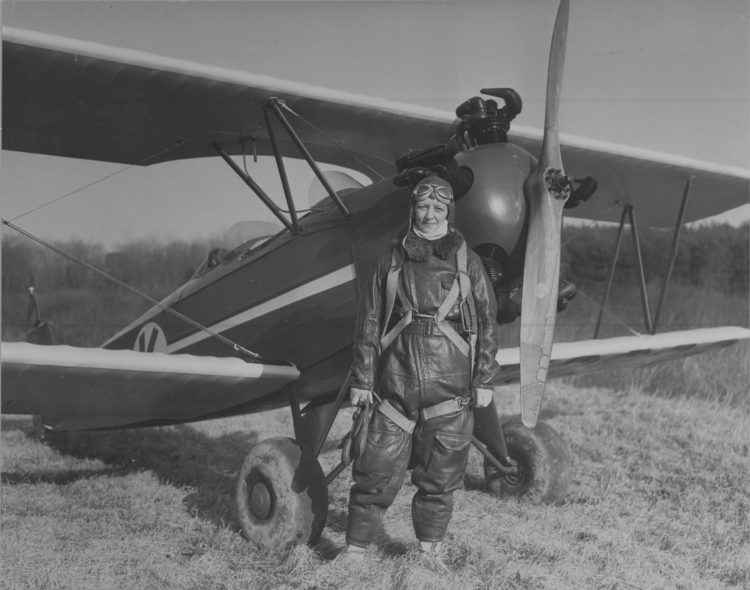
Marian Cummings suited up to fly her plane, 1934. Courtesy of the Oral History Project

What could be more appropriate for Women’s History Month than to celebrate two female aviation pioneers who achieved many of their flying feats right here in Greenwich in the 1930s?

The two remarkable women are Molly Cummings Minot Cook and her mother, Marian Engle Cummings, who died in 1984 at the age of 93. Together with Molly’s brother, Wilbur (“Billy”) Love Cummings, Jr., also a pilot, they won the nickname, “The Flying Family of Greenwich.” Molly was interviewed by Oral History Project volunteer Suzanne Seton in 2012. She died at the age of 102 in April 2020.

In her youth, Marian Cummings was a force of nature. She proved such a challenge to her parents that she was sent east from her home in Seattle to be made a “lady”- a not entirely successful venture. From sliding down spiral staircases at her finishing school in Middlebury, Connecticut, to illegally harboring kittens in her room, she was a handful for the headmistress, who nevertheless appreciated her spunk.
After graduating with honors and returning to Seattle, Marian met Wilbur Love Cummings, a young lawyer out west on assignment. Young and in love, their romance culminated in marriage on the eve of World War I. Subsequently, they traveled to New York, where Mr. Cummings would resume his work. This trip occurred at the height of the Spanish flu epidemic. Marian, Wilbur, and their two young children, Billy and Molly, wore facemasks and stayed in their cabin.

The family settled in Greenwich and bought an old farmhouse on John Street. However, life in Greenwich may have been too uneventful for Marian Cummings. To feed her love for adventure, she began taking flying lessons at North Beach, now LaGuardia airport, earning her pilot’s license in 1932 at the age of 40. Mr. Cummings congratulated his wife on her accomplishments and asked if she would like an airplane. And so Marian Cummings acquired her first Stinson Reliant. Before long, Marian and her son and daughter were all flying at Armonk Airport. According to her daughter, Molly Cook, Armonk was not a proper airport. It was called the Westchester Pasture for Select Flying Machines and was actually a potato field off Route 22 just long enough for landing small planes.

While Molly and Billy were earning their wings, their mother Marian was busy racking up firsts and awards. She was the first woman to make a parachute jump and the first woman to hold a commercial license. She then proceeded to put her training to use by flying her husband to various destinations where he had legal dealings, traveling around the States and in Central America.

Marian Cummings was a powerful influence on her two children. Following in their mother’s footsteps, they were accomplished and daring pilots. Daughter Molly Cummings Minot Cook, born in 1917, was also a flying marvel, earning her pilot’s license in 1935 when she turned 18. Soon thereafter, Molly and her brother Billy bought a small plane, a Luscombe, and began competing in meets. While still in college, they became popular at “stunting” meets at airfields in Armonk, Hartford, and Long Island, among others. Molly Cook describes one maneuver in which a roll of toilet paper would be thrown out of the plane at three or four thousand feet creating a streamer effect. “The trick was how long it took you to cut that strip twice, with your plane.”

During World War II, Molly and her mother joined the Civil Air Patrol. While her mother ferried pilots between destinations stateside, Molly taught Morse code and aerial navigation. Her brother Billy joined the Navy Air Corps as a transport pilot, flying new planes from factories in the U.S. to England, where they were deployed in the war. Tragically, it was on one of those trips that young Billy Cummings crashed on takeoff, killing this cherished son and brother.

In time, Molly Cook went on to marry and have a family of her own. She continued flying and engaging in many other interests, from teaching art, to ranching, and to conservation, making substantial donations to the Land Trust. However, flying was never far from her heart.
As she relates, “I loved stunting. In the summer…I would be in my white flying suit and helmet and goggles – oh, I was just the big cheese – and get into my little Fleet plane. All these people on Sunday, that was the thing to do in those days, that people would drive to Armonk to watch the planes, sort of a – what would you call it – a bullfight feeling. Is the matador going to make it or – I’d go up and do a spin or a loop and a something, and then come down. Then we’d sit, and then somebody said, ‘Well, I think I’ll go up and amuse them a little bit.’ It was fun on a Sunday.”

This blog was written by OHP volunteer Jean Moore from the interview, “Mother and Daughter Flyers.” The transcript of the interview may be read at Greenwich Library and is available for purchase at the Oral History Project office. The OHP is sponsored by Friends of Greenwich Library. Visit the website at glohistory.org. Mary A. Jacobson, OHP blog editor.