Friday, June 25, 2021


Daniel V. Barrett, Science Educator and Conservationist

by Mary A. Jacobson


It is hard to put the two words “educator” and conservationist” together in Greenwich and not come up with the name Daniel Barrett. In 2007, Marian Phillips interviewed Barrett for the Oral History Project in order to encapsulate his storied career as a science educator at Greenwich High School (GHS), and as an inveterate conservationist in the town of Greenwich. What emerged was a portrait of a man whose legacy will live on in the minds of the students he taught and in the heart of the community he loved.


Daniel Barrett began teaching in 1958 at GHS, after an interview that involved an unexpected, impromptu lesson to biology students on the third floor of the old GHS, now Town Hall. After his successful on-the-spot class, the immediate consensus was, “Hire him!” and thus began his 38-year career as a science educator. In the 1960s, after Russia launched the satellite Sputnik into space, the U.S. focused on more novel approaches to science education. Mr. Barrett was selected to test one of the new curriculums emphasizing ecology and field studies.
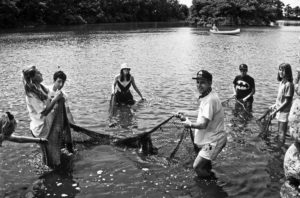
Dan Barrett and students dragging a net in Eagle Pond. Photo courtesy of Daniel Barrett.


Over the years, Barrett introduced the subject of marine biology to his students. He believed in experiential learning and frequently took his students on field trips. “My whole concept had to do with hands-on, after you would study it from a cerebral point of view.” A favorite trip was to the Fulton Fish Market. “It was a whole experience of knowing about fish, and their requirements in the ocean . . . on how you sell fish and keep it fresh. Then we’d bring it back, and how you prepare fish, and then you’d enjoy it.” It helped that Barrett had two ovens in his classroom!

Barrett had permission to hold two-hour morning classes to allow for field study. “I found I had lots of support to get out in the wild and do things. And that’s what I’ve always felt, hands-on, feeling, smelling, walking in a marsh, smelling the sulfur . . . And that’s where my strength came, was to get students to dig in. And touch it.” After a field study unit on beaches, including their sand structure, as well as their groins, stone walls, and jetties, Barrett marked off the classroom in four-foot squares. Teams of students were required to design and construct their own miniature beach communities utilizing sand, grasses, and building materials, and defend their projects. “So, it was sort of a summary of what we’d been doing all these field trips. I’m sure the custodians loved us…When we were all done, eventually we put everything away, swept up the floor, and brought the furniture in.”
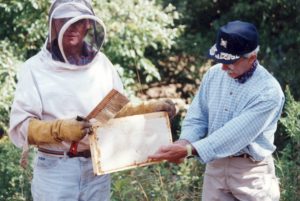
Tending beehives on Greenwich Land Trust property. Dan Barrett on right. Photo courtesy of Daniel Barrett.


In 1967, Barrett was instrumental in the establishment of the Educational Oceanographic Foundation, Inc. Donors could contribute money and equipment to be used for scientific educational research, speakers, trips, and projects that were not covered in the Board of Education budget. It also provided scholarships to deserving students pursuing marine-related science studies.
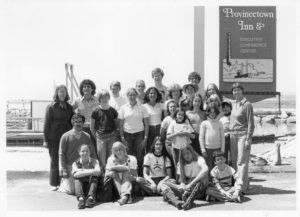
Class trip to Provincetown. Dan Barrett, second row, left. Photo courtesy of Daniel Barrett.


Mr. Barrett was appointed to the board of the town’s Conservation Commission, which he first chaired in 1964 and played a role in establishing the town’s Shellfish Commission. “We had all this activity that could take place, in shell fishing. Oysters, clams, and so on. And it was just sitting there…So, we thought we would form a commission, and start looking into the possibility of shellfishing…It took us five-to-eight years of water testing, over and over again, to show that the waters eventually were clean enough that it was safe to open the beds.” Barrett served on the Shellfishing Commission for twenty years.

In 1986, Barrett became involved with Greenwich Land Trust (GLT). Kitty Starr, then GLT president, “was looking for someone who would have an environmental background, and yet would be able to manage these properties, so that from a habitat point of view, they were being protected.” At the time of Barrett’s OHP interview in 2007, properties managed by GLT numbered 119, comprising over 600 acres. They included an island, 18 meadows, open spaces, apple orchards, marshes, woodlots, vernal pools, freshwater ponds, and the plants and animals that inhabited them.


In 2012, the Dan Barrett Stewardship Trust was established to honor his 24 years of service as Executive Director and Environmental Director of GLT, and to provide dedicated funds for the on-going care and management of present and future GLT properties. Shortly before this honor was awarded, Barrett told the reporter covering the event of the importance of cherishing the land for the benefit of future generations. He then quoted Ansel Adams: “Let us leave a splendid legacy for our children. Let us turn to them and say: ‘This you inherit; guard it well, for it is far more precious than money, and once destroyed, nature’s beauty cannot be repurchased at any price.’”

Therein lies the legacy of Daniel V. Barrett, teacher and conservationist.
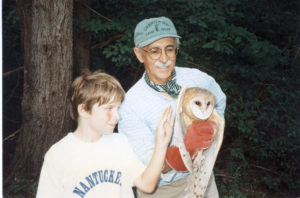
Dan Barrett with student and barn owl. Photo courtesy of Daniel Barrett.


The transcript of this interview “Distinguished Teacher and Conservationist” may be read at Greenwich Library and is available for purchase at the Oral History Project office. The Oral History Project is sponsored by the Friends of the Greenwich Library. Visit the OHP website at glohistory.org. Mary A. Jacobson serves as blog editor.


Saturday, May 8, 2021

 Village Life in Old Greenwich

The roots of Old Greenwich run deep from a tiny and close community at the turn of the twentieth century to the vibrant town center that exists today. In 1989, OHP volunteer Marian Phillips interviewed Daniel Catanzaro, a longtime resident of Old Greenwich who currently resides in Riverside. Our thanks to Elizaveta McCauley, a sophomore at Greenwich High School, for her contributions to this blog.

Daniel Catanzaro was born on October 8, 1926, in Old Greenwich. His parents were Mary Catanzaro, a nurse, and Nicholas Catanzaro, Old Greenwich’s shoemaker and a central figure in the community. Daniel’s recollections take us back to earlier days.

 “My family settled here around 1910. But Dad was commuting here, walking from Stamford to Old Greenwich. At that time the trolley ride was five cents, and it was too expensive. That was a luxury. So, we go back to right around the 1900s, when Old Greenwich was really a great town to live in. Old Greenwich was a crowded little town from, say, June 1 to September 1. Then on September 1 all the summer people moved out.”

 Life in Old Greenwich was nothing short of carefree and merry. The close, friendly bond between neighbors and families was perfect for young Catanzaro, who enjoyed being able to go out and about with his friends at just about any time. “I remember playing basketball any hour of the night down at the Old Greenwich School and then walking home ten, eleven o’clock at night. You’d never meet a soul, and you never had a fear of anyone doing anything to you, because you’d just run into somebody’s house and they’d walk you home. Old Greenwich was the safest place I could ever think of for a youngster to grow up in.”

 Taking care of Binney Park, Catanzaro notes, was a great part of his summer. “That’s where we all got our spending money. We’d go down there and pull weeds out, and that’s why Binney Park always looked so beautiful . . . Ed Sullivan used to ride by when he was a columnist with the New York Daily News, and he’d always write about the beauty of Binney Park.”

 As an older child, Catanzaro picked up and delivered shoes to and from his father. “The Shorehame Club had a lot of prominent people there, show people…I was one of the few that would actually go down there; I used to deliver repaired shoes or pick them up and bring them to my dad. I couldn’t remember many other people going down there. There were a few homes, but not many.”

 Daniel Catanzaro also delivered some items other than shoes. “One of the bad things that happened was during World War II. Lake’s Drug Store handled all the Western Union. Anyone that was killed in the service, the telegram would come into Lake’s and we would have to deliver them. If no one was home, the majority of times we’d bring them back and try and find someone who was associated with the family.”

 Catanzaro shared his memories of certain other deliveries from Lake’s Drug Store after Prohibition ended in 1933. “We had liquor down in the cellar. Sunday was our big day. In those days you packed ice cream in a quart container. Everybody used to fight to work for Lake’s on Sunday because you went to deliver a quart of liquor in a quart ice cream container. Whose ever house you delivered it to, you were always good for a nickel or dime tip, so there was always a waiting line to work in Lake’s on Sunday. You were not allowed, like you’re not now allowed, to sell liquor on Sundays. But our commuters would forget on Saturday. They’d call on Sunday, and we’d deliver it in a quart ice cream container.”

 The closeness of the Old Greenwich community extended to the canine portion of the neighborhood—that is, Sound Beach Fire Department’s beloved firehouse dog, Spot. A proud, dignified-looking Dalmatian, he was a common sight to see around the firehouse. Spot accompanied his fellow firefighters as they responded to fires and he would wear his collar—decorated with the emblem of the Fire Department. Unfortunately, Spot passed away in 1949.

 “When that dog died, it was like the most important person in Old Greenwich passed away.  He was buried in a casket and a full funeral ceremony, right in front of the Old Greenwich firehouse. That’s where Spot was buried. I’ve never forgotten that. There was an awful lot of broken hearts when Spot finally left us. They had a formal funeral for him, and everyone in Old Greenwich had tears coming down their eyes.”

 The Oral History Project interview of Daniel Catanzaro, and the book by the same name, Village Life in Old Greenwich, are available for purchase through the OHP office at the Greenwich Library. The OHP is sponsored by the Friends of the Greenwich Library. Visit the OHP website at glohistory.org. Mary A. Jacobson serves as the OHP blog editor.

Monday, March 1, 2021

As we know, the Olympic Games Tokyo 2020 were postponed for the first time in history, for a reason other than war, due to the COVID-19 outbreak. The Opening Ceremony of Tokyo 2020 is scheduled for July 23, 2021.

Greenwich laid claim to its own Olympian, Helen Meany Gravis, who gold-medaled in diving almost a century ago, at the Olympic Games Amsterdam 1928. Over the course of two Oral History Project interviews by Esther H. Smith in 1982 and 1983, the journey of Helen Meany Gravis was revealed.

Josephine Meany with Helen
The Meanys lived in a house on Steamboat Road, with its own little beach. Helen’s recollections of Greenwich are more of water than of land. “I learned to swim before I could walk,” she recalls. Across the road was the Indian Harbor Yacht Club, where young Helen also swam. Neither of these provided a true learning environment for the future Olympian, but they would suffice. She remembers winning her first meet when she was thirteen. By then, her father, recognizing her potential, had begun taking her to A.A.U. (Amateur Athletic Union) meets.

William Meany, Helen's father

Helen competed in swimming because she had no place to develop technique in diving, her true interest. She learned, however, by practicing off the dock, on top of a coalhouse, at Commodore Benedict’s home, across the inlet from their beach. Her father, more coaxing than coaching, would encourage her to take the plunge from his place in the waters below. She apparently would dive from anything he could find, high diving platforms being in short supply in the area.

Eventually, her father rigged a platform for her on the side of the yacht club. It was a makeshift float with a ten-foot board from which she could dive. Swimming in those waters was later stopped, being deemed too dangerous. Her practice sessions, as she describes them, were nothing short of perilous, with her climbing up to the board at the top, while below the float wobbled unpredictably as boats passed, coming and going out of the harbor, very near her landing mark.

“I guess if he told me to jump off the Brooklyn Bridge,” she says of her father, “I would have done it.” This is how this future Olympic gold medalist in the women’s three-meter springboard diving competition got her start.

Brothers and Sisters (minus one sister). Helen
is sixth from left.

All the Meany children were swimmers. And there were a lot of them, eleven to be exact, counting Helen, the eldest. Ms. Gravis explains that because her father liked to swim so much, it was natural for the children to become swimmers, too. She remembers “having to pick up the little ones as soon as they could walk or they’d just run right to the water and right up to practically over their heads.” She also remembers that if, in the summer, her siblings missed the boat to Island Beach, they would simply dive off the dock at Indian Harbor and swim to the island.

It was all just fun and games until, at a meet in Rye, New York, Helen Meany saw Alice Lord Landon (who later became an Olympic diver) dive from the ten-meter platform. That is when young Helen knew she wanted to be a platform diver. But the path from her childhood water exploits in Greenwich to the Olympics was not an easy one, since there were few or no diving facilities nearby. She remembers commuting from Greenwich to Manhattan Beach, on the far end of Brooklyn, to practice.

Helen Meany with Martha Norelius,
Amsterdam, 1928
Helen Meany
at Manhattan Beach

Later, as a college student at Wellesley, where there was no swimming pool, she had to decide whether to continue her studies or to make the 1924 Olympic team. After having been eliminated in the 1920 games in the first round, Helen chose to try again and left college before graduating. She placed fifth in the ten-meter platform competition in Paris, 1924, and went on to win the gold in Amsterdam in the three-meter event in 1928.

One wonders how she did it, given the amount of training and coaching that goes into competing in today’s games. “I learned most of my dives from a thirty-four-foot platform, and if you don’t hit the water just right, you can get hurt. . . . So, you just have to try it and try to correct it yourself,” she explains. And here’s the amazing thing: “I didn’t have a diving coach,” she adds.

Now there’s a champion for the record books.

Helen Meany Gravis died at her home in Old Greenwich, Connecticut, July 21, 1991, at the age of eighty-six.

Helen Meany Gravis in front of the
former Meany home on Old Church Road,
photographed by Karl Gleeson for the
1982–1983 Oral History Project interview 

This blog, written by OHP volunteer Jean Moore, was derived from the Oral History Project book, “From Greenwich to the Olympics: Helen Meany Gravis.” It is available for purchase at the Greenwich Library Oral History Project office. Visit the OHP web site at glohistory.org.