By Mary A. Jacobson
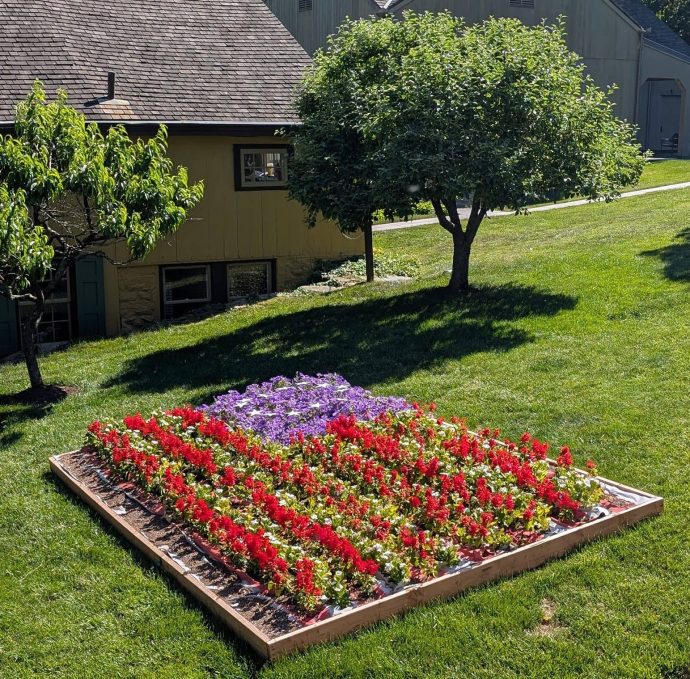
Greenwich is fortunate to have a number of local garden clubs and organizations whose membership contributes tirelessly to the beautification of our town. This year, in celebration of America’s | 250th Greenwich, three of them – Hortulus, Greenwich Garden Club, and Green Fingers Garden Club have collaborated in creating an American flag of flowers to be displayed beside the Bush-Holley House on the grounds of the Greenwich Historical Society. This patriotic floral display will reflect, from June to September, three versions of the flag which have been featured in our country’s history.
Riverside Garden Club turned to Putnam Cottage, also known as Knapp’s Tavern, for their unique contribution to our nation’s semi quincentennial. There, at the site of a former tavern that served lunch to George Washington and was later named in honor of General Israel Putnam of Revolutionary War fame, the Riverside Garden Club restored a colonial herb garden. Hops plants were discovered, possibly similar to those used to brew ale in Washington’s time. On June 7, it is anticipated that visitors will have the opportunity to taste the ale made from these hops, a contribution donated by Two Roads Brewery of Stamford.
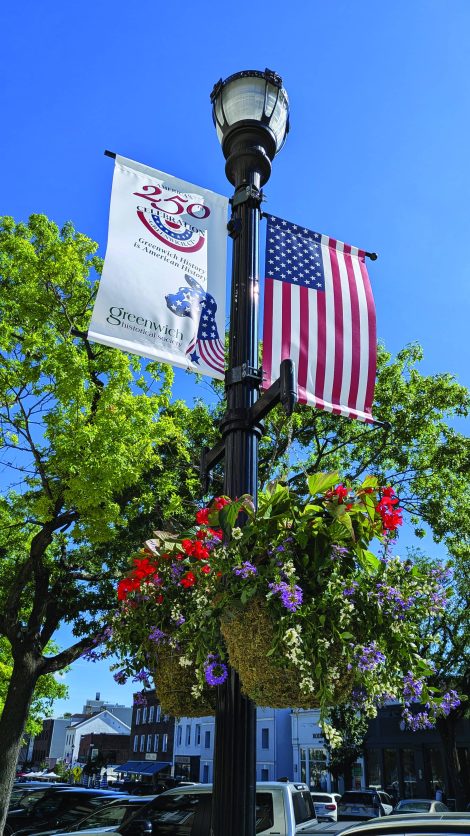
This year, Greenwich Green and Clean is celebrating its fortieth anniversary enhancing the parks, streetscapes, and natural spaces of Greenwich. One of their most visible and welcome contributions has been to Greenwich Avenue with its seasonal hanging baskets that adorn lampposts throughout the year, fashioned and hung gratis by Sam Bridge Nursery and Greenhouses. This year, in celebration of America’s 250th, these iconic and well-loved baskets will be adorned with red, white, and blue plantings throughout the town.
While these examples are just “a drop in the bucket” of the many people who work in service of beautifying the town, the Oral History Project would like to highlight one of its earlier narrators, Gertrude duPont Howland, who focused her efforts on Greenwich Avenue when there were few trees which adorned it. Her almost “one-woman” effort, as a member of Green Fingers Garden Club in midcentury, helped to translate the Avenue to the leafy street it is today. Interviewed in 1987 by Oral History Project volunteer Margaret French, Howland described the “absolutely bare looking” condition of the Avenue of the 1940s.
According to Howland, the onslaught of Dutch elm disease had infected “the beautiful elm trees that used to be up and down the Avenue. (They) were being taken down one by one… They were cutting off the trunk as low as they could get it, and then cementing over the area, and that was it. Nothing new was being planted. And as one tree after another came down, there was nothing.”
Therein, began an eight-year crusade on the part of Howland, to bring trees back to Greenwich Avenue. With each step of seeming progress, another obstacle appeared, which only strengthened Gertrude Howland’s resolve. When informed that planting trees on the Avenue could disrupt electric, telephone, water, and/or gas utility services, she set about with volunteer help from the local engineering firm S. E. Minor to map out the utility lines from each building on the Avenue in order to record where the various utilities entered from the outside. However, that information only marked the beginning of an often-frustratingly long mission to get more trees planted on Greenwich Avenue.
Howland had to deal with many governmental and landlord concerns: namely, that tree roots would make the pavement uneven; that citizens might then fall and sue the town; that tree roots would break the water mains; that the flow of air to overhead apartments would be disrupted; that the owner of each building would need to give permission; that trees might disrupt window displays; that dropping leaves would become slippery when wet, and so on. It was not until Howland obtained the support of Mayer H. Cohen, then president of the local merchants’ association, that these concerns were mollified. “Somebody told us that if we could get him to let us plant trees in front of his buildings, it would make a great difference… Not only did he permit us to plant trees, he spoke to the others at some merchants’ meeting and, in no time at all, permissions were flowing in.” In addition, Joseph Dietrich, Tree Warden of Greenwich at that time, “was enthusiastic about the idea. And he agreed that Greenwich Avenue should have trees all up and down.”
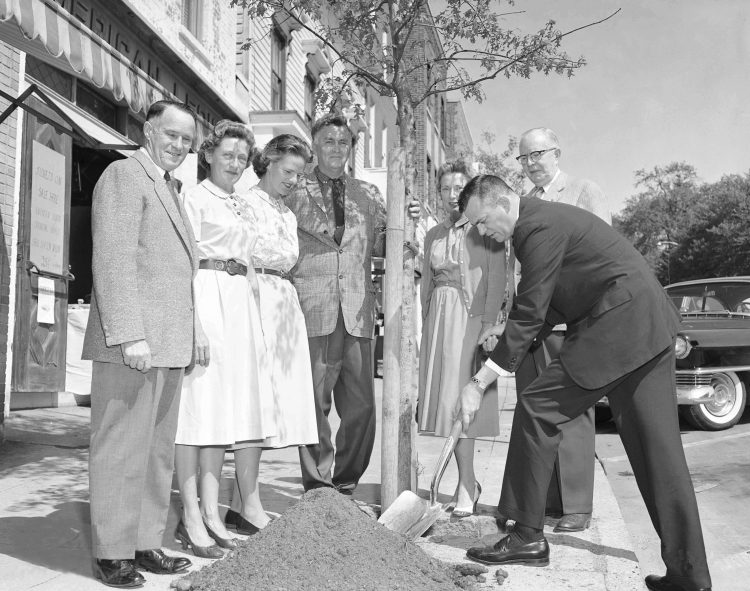
According to Howland, “There were so many obstacles to overcome, and each time I thought it was the last hurdle. But, of course, it never was.” After eight years of efforts there was finally an official celebratory planting of pin oaks, with a gathering of garden club members, the press, and Joseph Dietrich to mark the occasion. Local garden club contributions and private donations helped “to keep it going.” In 1987, Green Fingers Garden Club awarded Howland with a citation that read, “But for her, the trees on Greenwich Avenue would not exist.”
The Oral History Project is proud to present blogs derived from its collection of recorded interviews as part of the Project’s celebration “America’s 250th |Greenwich: Greenwich History is American History.” Visit the website at glohistory.org. Interviews may also be read in their entirety or checked out at the main library. Our narrator’s recollections are personal and have not been subjected to factual scrutiny. Mary Jacobson serves as blog editor.

No comments:
Post a Comment