Tuesday, November 23, 2021

Tod's Point and WW II Veterans

A mansion at Tod’s Point served as a residence for Greenwich WW II veterans and their families from 1946 to 1961


Thousands of people enjoy the beauty and sanctuary of Tod’s Point, yet few are aware of its connection to the veterans of WW II. From 1946 to 1961, the former mansion of Mr. and Mrs. J. Kennedy Tod, the original owners of Tod’s Point (known now as Greenwich Point), served as a residence for WW II veterans and their families. The home was demolished in 1961.


East side of mansion
In 1981, the Oral History Project published Tod’s Point: An Oral History, a complete history of Tod’s Point from its earliest times populated by Indians. Sixty-seven narrators were interviewed for this extensive project and it is from this rich trove that the stories of the WWII veterans are excerpted.


In 1945 the Town of Greenwich purchased the 148-acre property of Tod’s Point from Columbia-Presbyterian Hospital, to whom it had been bequeathed upon Tod’s death, for the sum of $550,000. The mansion on the property had not been used as a residence since Mrs. Tod died in 1939. Concurrently, with the end of WW II, veterans were returning home to a severe housing shortage.  Approval was given by the Town of Greenwich to lease the mansion to thirteen veteran families for one dollar a year. 

"...we were all young, just out of the army. It was fun."

Completing renovation
The thirteen families planned to move into the mansion in 1946. First, however, its thirty-nine rooms had to be converted into thirteen apartments. They formed an independent nonprofit corporation called Vetaptco (Veterans’ Apartment Corporation). Each family floated a $1,000 loan from a local bank (The Greenwich Trust Company). According to resident Nicholas Thiel Ficker, “We paid (monthly) rent to our own corporation. I think forty dollars was the cheapest and seventy dollars was the most expensive. Of that, twenty-nine dollars went to the bank. The balance went into our Vetaptco account, and from that we paid for our oil, our heat, our electric, and so forth.”


To ready the apartments, according to Ficker, “This contractor (Peter Danziger) did the basic work and we did all the finishing work. We did all the painting, and some of the plastering, and a lot of the carpentry.” Ficker continued, “To get thirteen young families living down there, it took some courage. . . . It’s cut off from the public, you know, during the dark and winter months. . . . For that particular time, we were all young, just out of the army. It was fun.”


Mansion after snowstorm
Living at Tod’s Point had its challenges. The Town plowed the snow only to the entrance to Tod’s Point. During a blizzard at Christmastime in 1947 Ficker recalled, “Well, we didn’t have any snow shovels . . . so we took these sheets of aluminum and cut them up and made long wooden handles, and nailed these rectangular pieces of aluminum to the wooden handles and made about thirteen shovels. . . . We shoveled all day long, and at six o’clock at night, we finally broke through to Shore Road where they had plowed it.”


Another emergency, that required a communal response, was the inadequate septic system. As Ficker described, “The septic system filled up. . . . There was an old, poor old septic tank, and it just couldn’t take it any longer. On Thanksgiving Day of 1946, we dug a whole dry field. Thirteen men got out there with shovels, picks, and we dug trenches through that. We honeycombed that whole field, laid tiles, filled in gravel, and connected it in with the septic tank which was across the road. . . . We worked up an appetite for turkey.”


Resident Martha Hankins credits her childhood years living at “the Point” with her lifelong appreciation of the environment. “Just the experience of everything and being able to just have so much around you, so much nature, and nature still really affects me. . . .


Aerial photo of Tod's Point

And the bird sanctuary, around Thanksgiving time all the ducks would flock into the lake. There’d be thousands of ducks in the lake.” Ficker reminisces, “. . . we’d go down to the pond. We had a big net on the end of a long pole, and we’d catch blue crabs. Oh boy! Blue crabs were all over the place.”


By 1961, the last family moved out.  According to Ficker,” I think it ended simply because time had run out on it. . . . The Town had said they wouldn’t renew the lease, and there was good reason. . . . It was really starting to get run down. It would have taken a tremendous amount of money to put it into any shape at all. . . . And then there was the decision to demolish the house. Of course, we were all sad to see it go.” Unfortunately, before it was torn down, the building was vandalized. “It was a mess.”

Demolition of the mansion


Martha Hankins returned to her apartment shortly before the demolishment. “The piano we had was pushed down the stairs. . . . I couldn’t come back to see it torn down. It was just too much for me, because we had good memories there.”  Resident Joseph Callachan agreed, “It was just a simply marvelous experience, and one that we’re awfully glad we have in our background.”


The book, “Tod’s Point, An Oral History,” may be read in its entirety at Greenwich Library and is available for purchase at the Oral History Project office. The OHP is sponsored by Friends of Greenwich Library. Visit the website at glohistory.org.

Mary A. Jacobson, OHP blog editor

Friday, July 30, 2021


Glenville – A Company Town

by Mary A. Jacobson


Today, one may walk in Glenville to a unique repurposed mill along the Byram River and its picturesque waterfall without realizing the richness of the industrial history of that site. From 1899 to 1978, the American Felt Company (AFC), once considered to be the largest producer of felt in the U.S., operated there.

From 1974 to 1992, interviews were conducted by seven different volunteers of the Oral History Project with 15 individuals associated with the American Felt Company. They encompassed everyone from machine operators to plant manager, each with his or her own perspective of living in Greenwich and working in the plant. The interviews speak to a time when everyone knew their neighbor; when manual labor was endured and respected; and when one’s pride in country, community, family, and occupation was central to one’s life.

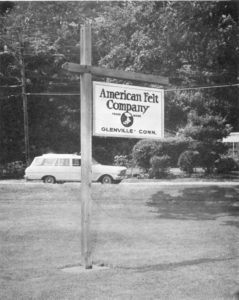
American Felt Company sign (courtesy of American Felt Company)

Felt was an ubiquitous product. It was found in everything from pianos to locomotives to refrigerators to the popular “poodle skirts” of the 1950s. Wool was the predominant fiber in the production of felt. The process began with compressed bales of wool delivered to the plant from around the world. “Pickers” would pull them apart to remove the burrs and specks. “Picking” was followed by other labor-intensive processes called “carding,” “hardening,” “hydro-extracting,” and “shearing” before achieving the final uniform surface texture of felt.

The children of Glenville had vivid memories of their fathers working at the mill. Sophia Riakowski recalled her dad working at AFC in 1908, taking care of the boiler rooms. “He used to shovel the soft coal into the furnace to keep the furnace going and going . . . as young kids we used to take a wheelbarrow and wheel it close to the furnace so that my father wouldn’t have to keep going back and forth. It was wicked, and it was awful, awfully hot in there.”

For housing, Andrew Sczesny, who worked in the cutting department of AFC from 1940 to 1978, explained, “The company had these homes, and they rented them out to the people that worked in the mill, for the company only. They only had to pay one dollar a month for one room. Of course, if there were three or four rooms, four dollars a month. They were glad to pay even though they didn’t make too much money at the time. They had a place and they didn’t have to go far from their home to get to the job.”


Worker getting the picked and blended raw stock ready for the carding machine (From “FELT, a Mechanical and Engineering Material,” published by American Felt Company, copyright 1951.)

During the Depression, AFC kept two shifts going. Chief inspector Michael Zygmont remarked, “That kept many of the people in Glenville alive.” However, help was plentiful and “if you didn’t do your job to their satisfaction, they’d hire somebody else because help was plentiful…When I started in 1933, we worked 55 hours a week. Fifty-five hours for $16.60 a week…When the NRA (National Recovery Act) came into the picture, we worked forty hours a week and made fifty cents an hour. So that was twenty dollars a week, and we didn’t know what to do with our time.”

World War II had a big impact on AFC. According to plant chemist and marketing manager Tom Gillick, “Virtually the entire production of the plant was taken over by the military, and then came the Marshall Plan and lend-lease. So, we were re-equipping armed forces around the world.” For example, every soldier’s canvas canteen cover had a felt lining.

After the war ended, there was a great demand for new products. As Tom Gillick explained, “American industry, with its new ideas and products, had been put on the back burner during World War II. Now, they were all trying to build more automobiles and refrigerators and everything else. All these G.I.s were coming home and wanted to start families. So, there was tremendous demand for every type of felt we could make. We were running twenty-four hours a day, seven days a week.”

However, by 1967, AFC became a wholly-owned subsidiary of The Ruberoid Company, which made roofing products, and then of GAF (General Aniline and Film Corporation), which produced industrial chemicals. After ten years, according to Gillick, GAF “made up its mind that it was going to dispose of the business, and the business was sold.”

In the 1980s, developers Ralph Schacter and Sy Schwartz, through careful restoration and renovation, turned the salvageable areas of the AFC plant into “The Mill,” with its restaurants, apartments and offices, keeping the historical integrity of the structure largely intact. Today, “The Mill” is undergoing another substantial renovation as its buildings are being carefully updated into high-end apartments and new businesses.

As developer Ralph Schacter observed, “Nobody makes anything anymore in Greenwich…The mill is very important historically for the people, that something was done here in Greenwich, one of the last factories that produced something.”

Overview of American Felt Company when in full operation (Courtesy of Greenwich Associates)

The American Felt Company interview transcripts may be read at the Greenwich Library Oral History Project office and are available for purchase. The Oral History Project is sponsored by the Friends of the Greenwich Library. Visit the OHP website at glohistory.org.

Mary A. Jacobson, OHP blog editor.


Friday, June 25, 2021


Daniel V. Barrett, Science Educator and Conservationist

by Mary A. Jacobson


It is hard to put the two words “educator” and conservationist” together in Greenwich and not come up with the name Daniel Barrett. In 2007, Marian Phillips interviewed Barrett for the Oral History Project in order to encapsulate his storied career as a science educator at Greenwich High School (GHS), and as an inveterate conservationist in the town of Greenwich. What emerged was a portrait of a man whose legacy will live on in the minds of the students he taught and in the heart of the community he loved.


Daniel Barrett began teaching in 1958 at GHS, after an interview that involved an unexpected, impromptu lesson to biology students on the third floor of the old GHS, now Town Hall. After his successful on-the-spot class, the immediate consensus was, “Hire him!” and thus began his 38-year career as a science educator. In the 1960s, after Russia launched the satellite Sputnik into space, the U.S. focused on more novel approaches to science education. Mr. Barrett was selected to test one of the new curriculums emphasizing ecology and field studies.

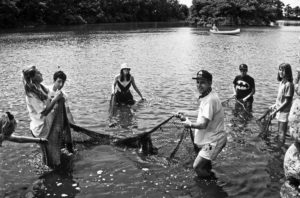
Dan Barrett and students dragging a net in Eagle Pond. Photo courtesy of Daniel Barrett.


Over the years, Barrett introduced the subject of marine biology to his students. He believed in experiential learning and frequently took his students on field trips. “My whole concept had to do with hands-on, after you would study it from a cerebral point of view.” A favorite trip was to the Fulton Fish Market. “It was a whole experience of knowing about fish, and their requirements in the ocean . . . on how you sell fish and keep it fresh. Then we’d bring it back, and how you prepare fish, and then you’d enjoy it.” It helped that Barrett had two ovens in his classroom!

Barrett had permission to hold two-hour morning classes to allow for field study. “I found I had lots of support to get out in the wild and do things. And that’s what I’ve always felt, hands-on, feeling, smelling, walking in a marsh, smelling the sulfur . . . And that’s where my strength came, was to get students to dig in. And touch it.” After a field study unit on beaches, including their sand structure, as well as their groins, stone walls, and jetties, Barrett marked off the classroom in four-foot squares. Teams of students were required to design and construct their own miniature beach communities utilizing sand, grasses, and building materials, and defend their projects. “So, it was sort of a summary of what we’d been doing all these field trips. I’m sure the custodians loved us…When we were all done, eventually we put everything away, swept up the floor, and brought the furniture in.”

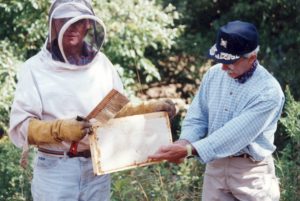
Tending beehives on Greenwich Land Trust property. Dan Barrett on right. Photo courtesy of Daniel Barrett.


In 1967, Barrett was instrumental in the establishment of the Educational Oceanographic Foundation, Inc. Donors could contribute money and equipment to be used for scientific educational research, speakers, trips, and projects that were not covered in the Board of Education budget. It also provided scholarships to deserving students pursuing marine-related science studies.

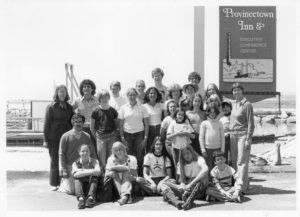
Class trip to Provincetown. Dan Barrett, second row, left. Photo courtesy of Daniel Barrett.


Mr. Barrett was appointed to the board of the town’s Conservation Commission, which he first chaired in 1964 and played a role in establishing the town’s Shellfish Commission. “We had all this activity that could take place, in shell fishing. Oysters, clams, and so on. And it was just sitting there…So, we thought we would form a commission, and start looking into the possibility of shellfishing…It took us five-to-eight years of water testing, over and over again, to show that the waters eventually were clean enough that it was safe to open the beds.” Barrett served on the Shellfishing Commission for twenty years.

In 1986, Barrett became involved with Greenwich Land Trust (GLT). Kitty Starr, then GLT president, “was looking for someone who would have an environmental background, and yet would be able to manage these properties, so that from a habitat point of view, they were being protected.” At the time of Barrett’s OHP interview in 2007, properties managed by GLT numbered 119, comprising over 600 acres. They included an island, 18 meadows, open spaces, apple orchards, marshes, woodlots, vernal pools, freshwater ponds, and the plants and animals that inhabited them.


In 2012, the Dan Barrett Stewardship Trust was established to honor his 24 years of service as Executive Director and Environmental Director of GLT, and to provide dedicated funds for the on-going care and management of present and future GLT properties. Shortly before this honor was awarded, Barrett told the reporter covering the event of the importance of cherishing the land for the benefit of future generations. He then quoted Ansel Adams: “Let us leave a splendid legacy for our children. Let us turn to them and say: ‘This you inherit; guard it well, for it is far more precious than money, and once destroyed, nature’s beauty cannot be repurchased at any price.’”

Therein lies the legacy of Daniel V. Barrett, teacher and conservationist.

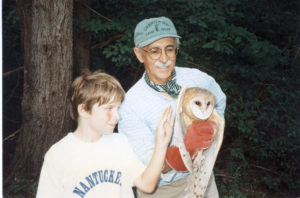
Dan Barrett with student and barn owl. Photo courtesy of Daniel Barrett.


The transcript of this interview “Distinguished Teacher and Conservationist” may be read at Greenwich Library and is available for purchase at the Oral History Project office. The Oral History Project is sponsored by the Friends of the Greenwich Library. Visit the OHP website at glohistory.org. Mary A. Jacobson serves as blog editor.