Tuesday, January 16, 2024

YEARS AGO IN GLENVILLE

“The whole town was like a big
family. We shared each other’s joys and sorrows.” Frances Chmielowiec Geraghty, on three separate occasions in 1975/76,  was interviewed by Katherine Scanlon of the Greenwich Library Oral History Project to capture memories of a lifetime in Glenville. She had much to tell about a life that had its share of hardships and setbacks, but was remembered by the joy and comfort of a loving and large family.

Frances Chmielowiec Geraghty photo by Karl Gleeson
Courtesy of Oral History Project.

Frances was the third of ten children born in 1907 to Polish immigrants.  “They had such large families. Everybody had. I don’t think there was any with less than five.” According to Frances, “We were all Polish-speaking people. . . . There was a great crowd (of immigrants) that came at once; we were all growing up together.”

Glenville was largely a company town. “Almost every house in Glenville was owned by the American Felt Company.” Rent of a dollar a room was paid to the AFC. Families who managed to snare a house with multiple bedrooms would rent them out to boarders for extra cash. “I don’t know anyone in Glenville that started with my mother’s crowd that didn’t end up owning their own home . . . without asking anyone’s help.”


1908 photo of the Chmielowiec family with sisters Mary and Eleanor and adopted son, John. Frances is seated on a cushion on the floor.
Courtesy of Frances Geraghty.

There was a strong sense of community among these young immigrants. Families grew their own vegetables and many owned chickens and pigs. “There was always an exchange. If you didn’t have a good crop of one thing and the other did . . . you just didn’t refuse anyone. . . . People were closely knit in those days.” Frances remembered that her father would be asked by “the people from the country, upper King Street” to help fulfill their needs of a seamstress, a cook, or a milkmaid.   He would then investigate which ships were coming into the Port of New York, hitch up the horse and wagon, and ride down to the docks. As the passengers stepped off the ship, her father would shout, “Who can cook? Who can sew? Who can take care of horses?” Soon he would have a wagon-load of young people who stayed with them until they procured jobs. 

In those early days of her life, Frances remembered that there was no electricity. “Don’t forget there was no water in Glenville either . . . no water till after I was married (in 1930). . . . Every bit of water had to be brought into the house, pumped in. My mother with ten children on wash day was really something.” In addition, “Everybody had an outdoor privy; and you weren’t embarrassed about it because everyone else had one, too.” Proudly, she stated, “Well, we had the best one in town. We had a five-seater.”

The house, owned by the American Felt Company, in which Frances Geraghty was born in 1907. Her father’s general store occupied space in front of the building (not visible). Courtesy of Frances Geraghty.

News traveled in a different way in those days when people did not have telephones. “There was a very unusual way of gathering people.” Someone with “a very fancy bugle with tassels hanging” would stand in the center of town and blow it. “ . . . everybody came running from the hills or they sent the children out. ‘What’s the matter? What’s the matter?’” The bugle was blown when the First World War ended. It also announced when someone had died or if an important meeting was to take place.

As Frances reminisced, she said wistfully, “I don’t think anyone today can visualize or comprehend a life like this. . . . You have to remember the quietness of the town. . . . You heard nothing except the humming of the felt mill, and that would be down toward the river. There were no airplanes, no traffic, no cars. . . . You could hear crickets, locusts, maybe a cow mooing or a rooster crowing. Those were the only sounds we heard. The smells were beautiful. You could smell sweet hay and strawberries.”

Frances remembered making deliveries by horse and wagon with her father from his general store to customers on Porchuck Road, Round Hill Road, and Banksville. In the summer, they would leave at 4:30 in the morning. “I remember coming back home at dark, at night. Sometimes my father would fall asleep and the horse would bring us home.” In the 1930s, the A&P came to Glenville; her dad could not compete with their prices and eventually closed his store.

The onset of the Depression led to difficult and challenging times for Frances and her family. “Bill and I got married at the height of the Depression (1930). There were no jobs. There was nothing; no money. . . . My mother had seventeen people in the home. My father was making a dollar a day for the WPA (Works Progress Administration) building the Glenville School playground. . . . There was nothing to do but go and do domestic work. . . . I had dresses that were somebody else’s and coats that didn’t fit.” Frances and Bill, who was recovering from tuberculosis, lived with her parents for a time. Eventually, Bill got a job as a plumbing apprentice for eleven dollars a week and they were able to rent a tiny house near her parents. “It had no water, no lights, and, of course, no heat.” They preferred to call it their “honeymoon house.” “Yet, somehow,” Frances said, “through all that, you had your garden and you had a few chickens.  You survived. And we had each other which was the main thing.”

Economic circumstances improved for them with the onset of the Second World War when she and Bill obtained jobs with Electrolux in Old Greenwich. At the time of her interview, Frances worked at Town Hall. As she looked back on her life and times, Frances stated, “. . . they were rough times, but they were happy days. . . . Those were the good old days.”

The interview “Years Ago in Glenville – Frances Chmielowiec Geraghty” may be read in its entirety at Greenwich Library and is available for purchase at the OHP office. The OHP is sponsored by Friends of Greenwich Library. Visit the website at glohistory.org. Our narrator’s recollections are personal and have not been subject to factual scrutiny. Mary Jacobson serves as blog editor.


Tuesday, December 26, 2023


Wesolego Bozego Narodzenia! (Merry Christmas!)

by Mary A. Jacobson

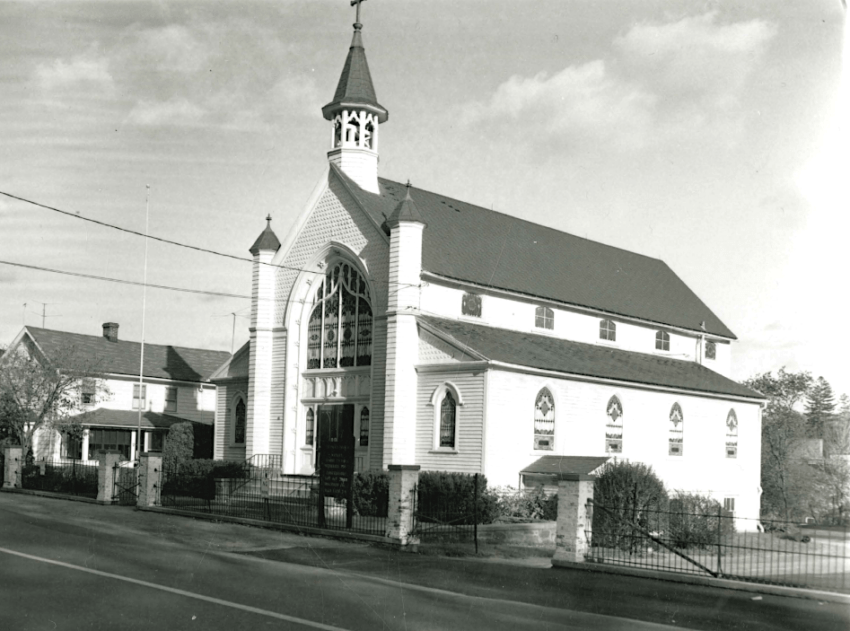
St. Paul R.C. Church in Glenville. Built in 1902 and destroyed in a fire in 1968. Courtesy of Greenwich Historical Society

For the many Polish Catholic immigrants who lived in Glenville in the early 1900s, Christmas was a time to celebrate with the traditions they had revered for generations in their former homeland.

Frances Chmielowiec Geraghty, born in Glenville in 1907, shared with Oral History Project interviewer Katherine Scanlon her early memories of Polish traditions at Christmas when interviewed in 1975/76.

“According to the liturgical calendar in Poland, all feast days begin with Christmas Eve…And it’s a great custom, handed down for generations…Christmas Eve itself was a beautiful time.” Traditionally, at Frances’s home, hay would be placed on the dinner table, under the linen tablecloth. “The hay was (to symbolize) the manger of Christ.” At the table there would always be “one place extra set for the unseen guest” Christ. “We still observe that,” she noted.

Although many special foods were enjoyed Christmas Eve, no one was permitted to eat at all that day until the first star in the sky was spotted that evening. Children were usually given the charge of citing this star, a reference to the star of Bethlehem which led the Three Kings to the birthplace of the baby Jesus. “And when you saw the star, then you could eat. That was awfully hard on little children.”

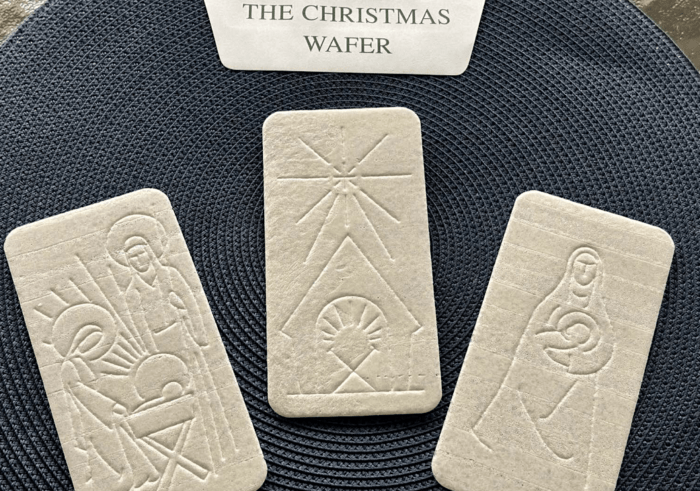
Before sitting down at the table, the family would break and share wafers. This was in remembrance of the Last Supper in which Jesus broke bread with the disciples. These wafers came either from the local parish or from Poland. “There is an exchange of letters late in November…We send our wafers; they send theirs. And then the mother takes the wafer and dips it in honey and feeds each child individually.” Each wafer featured an imprinted design of either a liturgical symbol or a nativity scene.

Frances highlighted some of the special dishes in which she delighted for the Christmas Eve meal. “Around November the mushrooms began arriving from Poland in strings, the dried ones. Oh, how we’d wait for that! We went to the post office every day. These are real field-picked, dried mushrooms. There’s nothing like it in this country – just isn’t! And that was a treat for Christmas. It’s a nutty, woodsy flavor.” Frances described how they were repeatedly soaked in water, boiled, and added to their favorite dishes.

Homemade piroghis were another delicious traditional food. Frances explained, “They’re like raviolis…They have a cheese filling or sauerkraut filling or prune filling. And they’re boiled and the next day they’re fried in butter. They’re served hot.” Of course, Frances’s mother and helpers did quite a bit of baking for Christmas. “They made what they called babkas; the braided bread with the yellow raisins and saffron . . . great big loaves yellow with saffron and egg yolks.” A cheese-filled bread was also a favorite. “That was delicious,” Frances recalled.

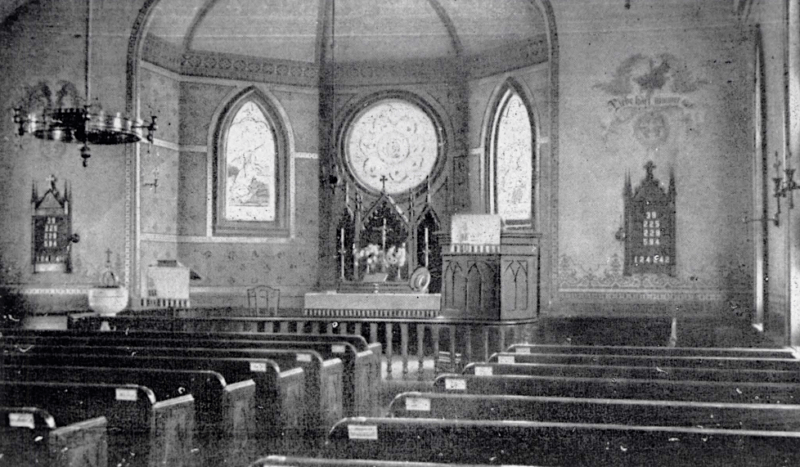
Interior of St. Paul R.C. Church in Glenville where Midnight Mass was held on Christmas Eve. Courtesy of Greenwich Historical Society.

The family would walk to St. Paul’s Church, which has subsequently burned down, for Midnight Mass. “The church used to be packed…Here in Glenville, we went to Midnight Mass, and then the feast came after Mass. No one slept Christmas Eve. This went on till daybreak.”

Frances could still see in her mind’s eye, the memorable, festive decorations that adorned her home. “My mother’s home on Christmas Eve was really something.” The search for the perfect cedar tree began the previous summer at Indian Spring. “All summer we’d be looking for the right tree for Christmas. And we’d say, ‘This is the one. This is the one.’” The tree would be adorned on Christmas Eve. “We had no ornaments. We made our own. We used to take crepe paper and make loops and strings. And we had candles on the tree with (tin) candle holders…And when that tree was lit, it was beautiful, truly beautiful…We used to hold hands and dance all around the tree… And we sang carols in Polish. I still have the books, the old books with the songs.” There was also time for games, including outdoor ones, like “Whichever way you hear a dog bark, that’s where your love is coming from.”

One of the most memorable gifts Frances remembered finding under the tree was “a beautiful sled, a Flexible Flyer; it would hold five of us (of her nine siblings). And that was the envy of the town. I think every child in Glenville got a ride on it.” Other gifts were simpler treasures. “We all got an orange. That was a treat. That was the only time we saw oranges…. And you wouldn’t want to eat it. You’d take it to bed and smell it under your pillow because it had to last a long time.”

Despite all these heartwarming festivities, Frances was quick to point out, “I forgot about the most interesting part about Christmas. The Polish Christmas lasts twelve days, and the climax of it is the Epiphany. That’s the Feast of the Three Kings, and that is REALLY great!”

The interview “Years Ago in Glenville – Frances Chmielowiec Geraghty” may be read in its entirety or checked out at Greenwich Library and is available for purchase at the OHP office. The OHP is sponsored by Friends of Greenwich Library. Visit the website at glohistory.org. Our narrator’s recollections are personal and have not been subject to factual scrutiny. Mary Jacobson serves as blog editor.
Christmas Eve dinner starts with family members sharing “oplatek,” a thin wafer embossed with a Christmas scene. Photo by Mary Jacobson.


Monday, November 6, 2023

 THE CLAM BOX 1939-1985

A Beloved Local Business

In 1939, Anna and George Gross rented a two-car garage on Salem Street and East Putnam Avenue in Cos Cob and opened the original Clam Box restaurant. It had a few stools in front and a take-out counter and was to serve customers in the summers only.  According to their son, Arthur Gross, interviewed by Penny Bott-Haughwout of the Oral History Project in 1986, “My parents started the original Clam Box restaurant with four hundred dollars… They painted the building white. They put an awning in front of it. They bought several truckloads of oyster shells which was put on the ground and then crushed by a crushing machine. And that became the area where people ate in their cars or ate at the stand.”

Original Clam Box
Photo courtesy of Greenwich Library Oral History Project

Business was good---so good, in fact, that “my father made more money in three months in Cos Cob than he’d made all year in New York (at his NYC spot called Cooper’s Fish and Chips near Grand Central Station). Shortly thereafter, the New York City restaurant was closed and George Gross “devoted one hundred per cent of his time in Cos Cob.” After the first year, Anna and George bought the building and opened the Clam Box year-round. Eventually, they built on both sides of the existing main stand and it became a restaurant of about 250 seats.


The Clam Box menu, front cover
Photo courtesy of Greenwich Library Oral History Project


What was the “secret sauce” to this successful small business? According to Arthur, “ . . . nobody had any seafood items cooked the way we did. The frying was completely new to this New England area… Our kitchens were open to the public. People got the aroma of the cooking. And the fact that we fried at such high temperatures . . . at 375 degrees, they were seared very quickly. An order of fried clams would take thirty or forty-five seconds in these special cooking machines that we had.” Fish and chips were also cooked at a high temperature and “ . . . in a matter of three or four minutes, we’d have a magnificent piece of fish cooked, very crispy on the outside and very moist on the inside.” Everything was cooked to order.

The Clam Box menu, back cover
Photo courtesy of Greenwich Library Oral History Project

Of course, the high quality of the food was fundamental. “We sent a man from Greenwich to New York City five mornings a week . . . to the Fulton Fish Market. He used to leave here about quarter of three o’clock in the morning… The fish was delivered to Cos Cob like ten o’clock in the morning, and it was served that evening.”

The Clam Box menu, inside left
Photo courtesy of Greenwich Library Oral History Project

How about the prices? The original Clam Box menu in 1939 lists “Silex coffee with cream” for five cents. “People remembered the fact that they got a good cup of coffee.” In addition, “Bottle Grade A Milk” was ten cents; clam chowder, fifteen cents; fish and chips, thirty-five cents; oyster stew, forty cents. The “Clam Box Special” with half cold lobster, crabmeat, shrimps, and clams was ninety-five cents.

The Clam Box menu, inside right
Photo courtesy of Greenwich Library Oral History Project

Customers, mostly locals at the time, had a different cycle to their daily lives in those early days. In the summer, before television and air-conditioning, “a man would get in the car and take a ride with his wife and they’d stop off for fried clams or fish and chips at our type of a restaurant. We also found that we were busier late in the evening---this would run until two in the morning.” Post-WWII, with the advent of television, people tended to stay home in the evenings. “Our business changed rapidly… After the war we never stayed open as late as we did prior to the war.”

George and Anna believed in their business. “Every dollar they made they reinvested back into the property, and they managed to survive, and it was quite successful after the second year.” In 1947, the Grosses purchased another building, with four hundred feet frontage on East Putnam Avenue in Cos Cob, in which the Clam Box remained until 1985. Fortunately, the property also allowed for enlargement of the restaurant facilities.

“By enlarging the kitchen, we were able to purchase additional equipment to make the same recipes… We were able to handle the many thousands of people that we did serve in the summertime… We had a wonderful reputation. We had the nicest people in the area coming out to dinner.” Arthur was proud that a family could be well-fed for under ten dollars.

The Clam Box, expanded capacity, outside
Photo courtesy of Greenwich Library Oral History Project

In 1963, with additional storage space made available for produce and seafood, the restaurant could serve five hundred and fifty patrons “plus the take-out business.” A bakery was also now contained on the premises in which fresh rolls, pies, cakes, puddings, éclair shells, and more were prepared. Over one hundred and thirty staff were employed. Arthur boasted that “ . . . we must have had seventy-five working here more than five years . . . and another ten or fifteen who worked here for twenty years or more.”   

The Clam Box, expanded capacity, inside
Photo courtesy of Greenwich Library Oral History Project

Arthur’s parents retired in 1957. His father George passed away in 1960. Arthur and his wife, Priscilla, managed the business from that time on. Arthur himself had worked in the restaurant from the age of 14 in 1939 to age 60 in 1985. “If people wanted to find me, they could reach me at 9:30 in the morning, and I was here until sometimes 9:30 at night, and I was here many a time seven days a week.” In 1985, the decision was made to close the restaurant and “sell the property, distribute the proceeds (among the corporation of family members), and go our separate ways… It’s the end of an era.”

The Clam Box postcard
Photo courtesy of Greenwich Library Oral History Project

Arthur did have to admit that occasionally he would see some tempting restaurant locations in town. “I’d come home and say to my wife, ‘You know, we could go back and open up another little stand again and just sell clams and shrimp and fish and chips.’ And she’d say, ‘No way, Buster.’”

The interview of Arthur Gross appears in the Oral History Project book entitled “The Clam Box and the Food Mart.” It may be read in its entirety at Greenwich Library and is available for purchase at the OHP office. The OHP is sponsored by Friends of Greenwich Library. Visit the website at glohistory.org. Our narrator’s recollections are personal and have not been subject to factual scrutiny.

Mary Jacobson, OHP blog editor.