By Mary A. Jacobson
The word “garden” is an understatement when used to describe Sleepy Cat Farm, a wondrous thirteen-and-a-half-acre delight in Greenwich. It is more of an experience, an enchanted setting, a cultivated landscape utopia.
What was the inspiration behind this horticultural gem? Pat Norcross, a volunteer with the Oral History Project, interviewed owner Fred Landman in 2024 to document the history of Sleepy Cat Farm. It all started in 1994 when Fred Landman bought a home on six acres on Clapboard Ridge Road in Greenwich. At that time, updating the house was his focus. “A wonderful house, brick Georgian house, and that sort of became fun to do, working with an architect, working with a decorator.”
As work continued, a landscape architect was engaged to help answer the question, “How does this house relate to the landscape?” In time, the vision of the property became the creation of a sense of harmony between the two. “I said, well, we’ve got this whole woodland area; we can do something there… And then we did the Golden Path with the Spirit Walk (a raised walkway made of Spanish cedar) through the Iris Garden, and it was great fun.” The Golden Path is a gold colored decomposed granite pathway, inspired by the Golden Path designed by landscape architect Russell Page in 1980 for PepsiCo’s one-hundred acre Donald M. Kendall Sculpture Gardens in Purchase, NY. The Golden Path at Sleepy Cat Farm leads the stroller to an adventure of discovery.
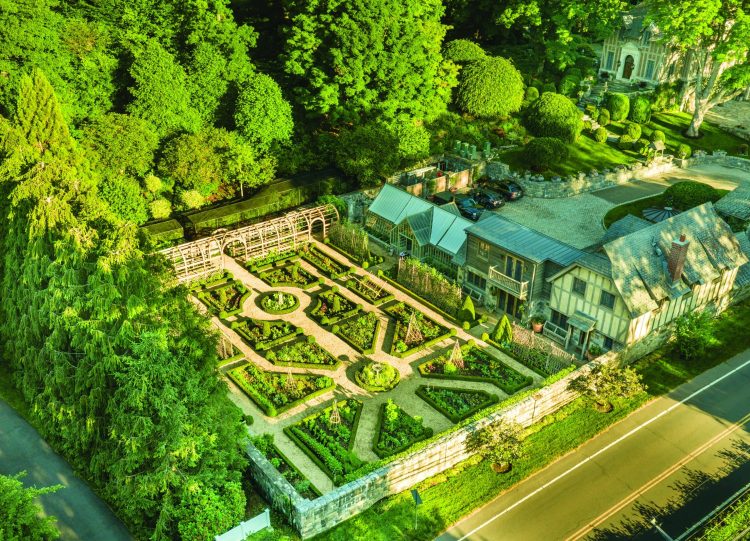
Serendipitously, four years later, a neighbor asked Landman, “Would you like to buy two (adjacent) acres?” And I said, “Sure… It was the excitement of what we could do.” This new, enlarged acreage resulted in “making a big vegetable garden, a walled vegetable garden and a big greenhouse… and then, we ended up building what we call the barn, which is a wonderful entertaining space. And the whole new vocabulary is French-Norman.” Visitors were often surprised to learn that the additions, which “were meant to look like they had been here forever,” were only four years old.
Part of Landman’s personal education for the design of his gardens came through his long-term association with Charles Stick, a renowned landscape architect, prized nationally for his work. “Whenever I’d go somewhere, he (Stick) said, ‘You know, you should see this garden, this garden, and this garden in this area.’” Landman has visited gardens in Italy, England, Ireland, France, China, and Japan, among others. The ones he appreciates the most “are the ones that draw you in. You get lost. Your sense of self has disappeared and you’re just in there.”
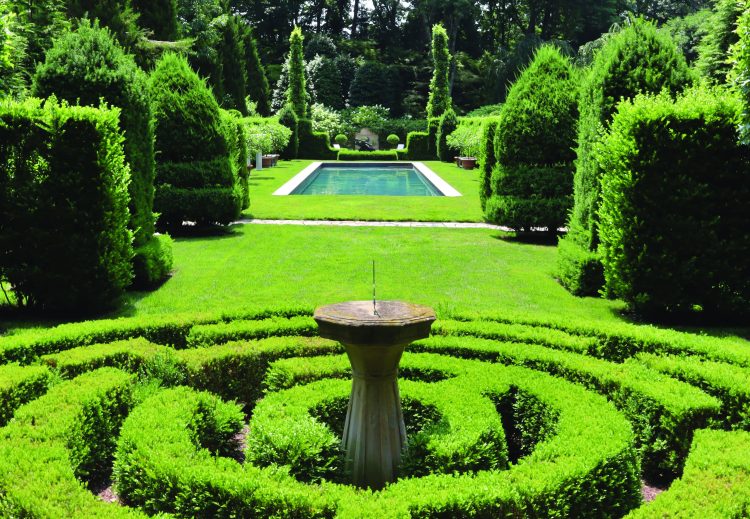
Landman views Sleepy Cat Farm as a series of rooms. “Some are rather formal with very clipped hedges. One has that undulating hornbeam hedge… and behind that, that’s an ilex hedge, which you can see crenulated. Those are adjacent rooms.” At last rendering, Landman could count eight different projects at Sleepy Cat Farm in which Stick had been engaged. “I’m not a gardener. I had no formal training, but I’ve spent thirty years listening carefully to some very good people… I listened and they listened.”
Landman regards his garden as a continuing creation. “Gardens are never done. They’re always evolving.” In 2012, when presented with the opportunity to acquire another three-and-a-half acres Landman created a limonaia, a controlled environment for lemon cultivation, where an abandoned storehouse had previously existed. Inspired by limonaias he had viewed in Italy, this rebuilt structure provided for a unique and architecturally distinct setting for Meyer lemon cultivation, as well as a place for quiet reflection.
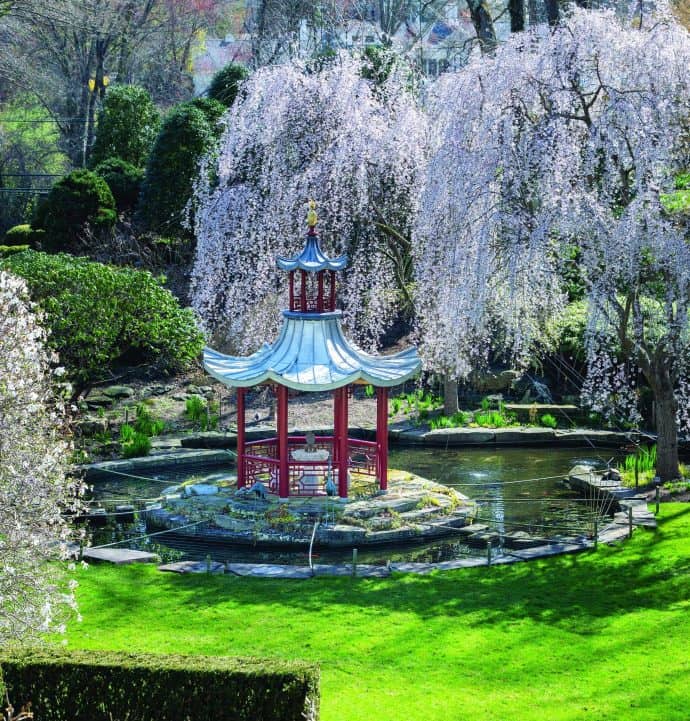
What does Landman want others to experience as they stroll through his garden? “A sense of wonder. People say, ‘Every time I turn, you had something else for me to see.’ The pathway’s meant to draw you down… you hear the sound of water, but you don’t know where it’s coming from. As you come around the bend… there’s a grotto and a water-babbling brook that goes into a pond where Venus is looking at her reflection… It’s just sort of great fun.” Over thirty statuaries have been placed throughout the, now, thirteen-and-a-half-acre property. Landman recalled, “People always say, ‘Oh, I just don’t have a garden like this.’ And I say well, you don’t need a garden like this. Do something you really like, that pleases you aesthetically, and that’s your garden.”
Sleepy Cat Farm has a close affiliation with the Garden Conservancy, a non-profit organization dedicated to “preserving, sharing, and celebrating America’s gardens and diverse gardening traditions for the education and inspiration of the public.” Since 1995, the Open Days program of the Garden Conservancy has enabled thousands of private gardens across the country to be visited by the public. For approximately the past twenty years, Sleepy Cat Farm has participated in these scheduled open garden tour days. The most recent occurred on June 7; the next one is scheduled for August 29. As the most well-attended tour in the Garden Conservancy national garden visiting program, tickets for Sleepy Cat Farm are capped at 900 visitors per day.
In July 2026, the Garden Conservancy relocated its headquarters from Garrison, New York, to 4 Greenwich Office Park and a closer collaboration with the Sleepy Cat Farm Foundation. The goal of the Foundation is to endow Sleepy Cat Farm with sufficient funds to allow it to be maintained for many decades to come. It would remain private, open to Garden Conservancy tours and to other garden interest groups. When the main house on the property is no longer occupied, the plan is for it to transition into the headquarters of the Garden Conservancy, with continuing educational and cultural programs.
As Fred Landman says, “I want this to go on forever… I can’t think of a better organization to be here.”
The Oral History Project is proud to present blogs derived from its collection of recorded interviews as part of the Project’s celebration “America’s 250th|Greenwich: Greenwich History is American History.” Visit the website at glohistory.org. Interviews may also be read in their entirety or checked out at the main library. Our narrator’s recollections are personal and have not been subjected to factual scrutiny. Mary Jacobson serves as blog editor.

No comments:
Post a Comment