Wednesday, November 5, 2025


A 1695 Greenwich Landmark Tells America’s Story
by Mary A. Jacobson

Thomas Lyon farmhouse, circa 1900. Courtesy of Greenwich Historical Society.


The Thomas Lyon House, built by Thomas Lyon the 2nd in 1695, is the second oldest house in Greenwich and bears witness to the statement: “Greenwich History is American History.” The house may easily be overlooked by the thousands of cars that drive by it each day, crossing from Port Chester to Greenwich. On one side of the road, there’s a sign that reads “Greenwich CT Gateway to New England.” Directly opposite, on the corner of Byram Road and West Putnam Avenue, stands a small, brown-shingled house. Hung across the front of it is a large, faded white banner. Ironically, the only words that can easily be deciphered are “This House… Help Us.”

Despite its current condition, the history of the Thomas Lyon House is a proud one. Julie Grey Pollock, a ninth-generation Lyon descendant, was interviewed by Oral History Project volunteer Richard M. Blair in 2010. She had traveled to Greenwich from her home in Alaska at the time, eager to join other family members on a day which was proclaimed Lyon Family Day by Peter Tesei, then First Selectman.

Julie Grey Pollock was anxious to share her knowledge of the Lyon family, and the history of the Thomas Lyon House. “This area was for most of its life a working farm. The lands that the Lyon family worked on were from as many as three hundred acres, to ninety-five acres in my great-grandfather’s (Underhill Lyon) time, to a final piece of eight acres. They had orchards; they raised livestock; they grew crops; they grew hay; they did a lot of trading in apples and making of cider and vinegar, which they traded to New York.”

The Thomas Lyon House was a participant in the American Revolution. As Pollock stated, “I have the (British) cannonball that hit this house during the Revolutionary War…. Most of that generation… were joining the Americans and fighting the British. But their father, Gilbert, was a Tory… So, I think that whole issue of the sons being for the Revolution, and the father being for the British Crown, had to be rather interesting in this house at that time.” As a child, “I thought everyone had a cannonball by their fireplace.”

Pollock elaborated on the Revolutionary War history of the house at a talk she gave at the Bruce Museum for the Greenwich Preservation Trust in 2012 and kindly sent the transcript to the Oral History Project for its records. In her words, “The neighborhood around the Lyon home at Byram Bridge was a highly strategic location between the advances of the British into New England and the Americans’ repeated attempts in 1779 to repel them… The British forces and Continental Army met up and fought several times along this border zone… Repeated forays of the British, including the destruction of homes, barns, crops, ships and churches along the coast disrupted normal life for many months.” Pollock’s grandmother, Julia Lyon Saunders, told her that family lore that included stories of “redcoats hiding behind the rocks across the road from the house.”

Thomas Lyon House moved across the street in 1927 because of widening of Boston Post Road. Courtesy of Greenwich Historical Society.

Pollock and her family members have preserved many of the artifacts that were essential to life in those times. “We have the spinning wheels that they used for both flax and for wool… We have utensils, we have implements… so that we would have something really solid to contribute to the overall knowledge of the place,” including documents that tell the economic story of the family from “about 1800 until after the Civil War.” Pollock was particularly proud of a desk she possessed called “Uncle Seth’s desk,” belonging to Seth Lyon, born in 1790. He lived in the house, “a prominent person in his time” and was acclaimed for “working with the African Americans who were in a lot of struggles during that period for freedom.”

In the 1920s, a road-widening project of Boston Post Road nearly resulted in the destruction of the house. Funds were raised, “almost $12,000 which was a lot of money in 1926,” to save it by moving it across the road where it now stands. Pollock’s grandparents moved out that year and gave the historic house to the Rotary and Lions clubs in the hopes that “a handsome visitor center and museum to be known as ‘The Gateway to New England’ would be created.”

With the Depression of 1929 and World War II, those hopeful plans for the Thomas Lyon House did not materialize. “My grandmother, I think, felt very down about what had happened to the house. It became a private rental, and it never became the Gateway to New England” as she had hoped. Instead, it became “a maintenance nightmare and a money sink.” In 2007, the Lions Club gave the home to the Town of Greenwich.

The Thomas Lyon House was listed on the National Register of Historic Places in 1977. The Greenwich Preservation Trust, headed by Andrew Melillo, is now seeking to lease the site from the Town of Greenwich. “Hopefully, we will have the lease signed with RTM approval as well as Planning and Zoning approval by December.” With its eventual maintenance and accessibility plan secured, it is hoped that the story of this historic Greenwich home may be preserved and shared with present and future generations. To quote Julie Grey Pollock, “Like old stone walls, old homes have a story to tell.”

The Oral History Project is proud to present blogs derived from its collection of recorded interviews as part of the Project’s celebration of America 250 Greenwich – Greenwich History is American History. The OHP is sponsored by Friends of Greenwich Library. Visit the website at glohistory.org. Interviews may also be read in their entirety or checked out at the main library.

They are also available for purchase by contacting the OHP office. Our narrator’s recollections are personal and have not been subjected to factual scrutiny. Mary Jacobson serves as blog editor.
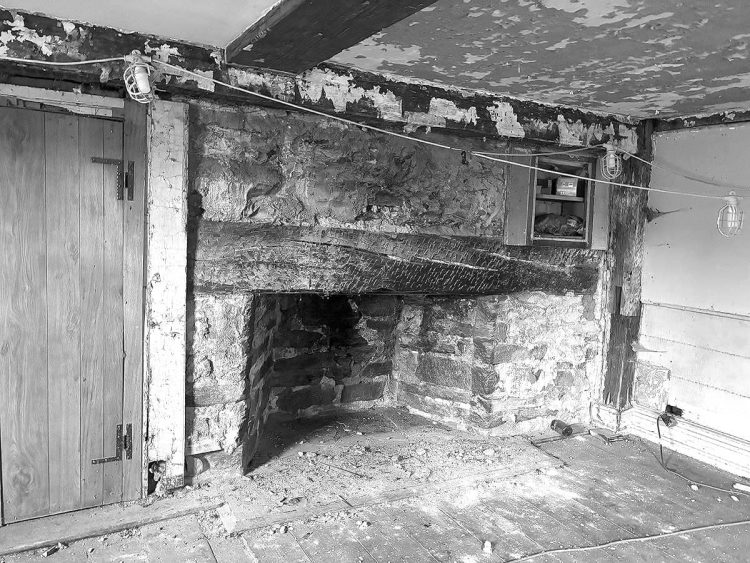
Thomas Lyon House interior room with fireplace as seen today. Photo by Mary A. Jacobson.

Monday, September 29, 2025

Andrew Bella 

From Byram Boy to High School Principal

by Mary A. Jacobson

There aren’t too many residents of Greenwich who can trace their ties to the Greenwich Public Schools from their earliest childhood years at New Lebanon School to their retirement after a career spanning forty years. Such a man was Andrew Bella for whom Bella House at GHS is proudly named.

Andrew Bella.
Courtesy of the Oral History Project.

Andrew Bella was interviewed for the Oral History Project in the 1970s by Margaret F. French and Brooks Lushington. Born in 1907, Bella’s memories of his early life in Byram are vivid in his mind. “Byram was more or less a self-contained community . . . called East Port Chester in those days because without cars people did their shopping in Port Chester.” He was born into the German Lutheran Church - a “P.K.” or “Preacher’s Kid” - as he said. Most of his dad’s parishioners were immigrants who worked at Abendroth’s, the foundry in Port Chester. “. . . as kids we could look in there, and you could watch the red-hot molten metal being poured.” His dad would advise his immigrant newcomers, “Go to church, get your citizenship papers, and buy a home.” According to Bella, “Many of the homes on Mead Avenue in Byram . . . are still owned by the sons and daughters and grandsons and granddaughters of those people who came here at the turn of the century.”
 
Bella’s description of his early school days at New Lebanon were far different from those experienced today. “We had a crowded school even when I was here, and we had to use the church on William Street for some of the classes.” Bella’s favorite game of baseball was played on a field where the ashes from the school furnace were disposed. “The playground actually was just the open field with stones for bases and ashes in the outfield . . . We passed the hat and made enough to buy the balls and bats and the equipment we needed. So that was the Recreation and Parks Department!” As Bella recounted, “No one had a car. My dad didn’t have a car till I was sixteen (in 1923). Cars and airplanes were a novelty. If you’d see a plane, everybody would look up.”
 
From New Lebanon School, Bella went to Greenwich High School, which was located on Havemeyer Place. However, for Bella, there was “no gym, no yard, no nothing.” For physical education, the students would do calisthenics in the third-floor hallway. “Weather permitting, we would run around the block.” There was also no auditorium. For assemblies, Mr. Folsom, the principal affectionately known as “Pop,” would climb on a platform in the corridor “and we would stand around him, and we’d have our assemblies there.” The year Bella graduated in 1925, however, construction began on the new high school on Field Point Road (now Town Hall).

Havemeyer School, on Havemeyer Place, eight years after its opening in 1892.
Site of the first Greenwich High School graduation in 1895.
Courtesy of Greenwich Library.

Despite the lack of facilities, “we managed, and I think we had an excellent faculty.” In particular, Bella extolled the science department. “We did have an excellent science department.” Bella excelled in physics and chemistry and enrolled at Yale, graduating as a physicist. However, “By then the Depression had struck, and no one knew what a physicist was, let along hire one.” His luck changed through a chance meeting with Pop Folsom. “I came home one vacation from graduate work at Yale and I met Pop Folsom who said ‘We have an opening in the physics department. Would you be interested?’ . . . So that’s the way I came back to Greenwich High School (in 1929 at age 22), by meeting Pop Folsom on the street one day.”
 
By 1940, with a master’s degree in educational administration from Columbia, Bella was named principal of Greenwich High School. During his tenure, until his retirement in 1969, the high school experienced much growth and development. “The athletic program evolved from football, baseball, and basketball into the complete spectrum of sports we have today (1977 at the time of interview), including lacrosse, tennis, and soccer . . . We developed ice hockey when the rink was built in Playland . . . We were the only out-of-state school that skated in Playland. Many times we were champs of the Westchester County Hockey League.”
 
Bella also supported increasing school services for students who had learning difficulties or were academically challenged. “The whole guidance movement developed during my tenure at the high school.” Bella was also particularly proud of a program developed in the aftermath of World War II. “Boys who had not finished their high school education were allowed to come back as veterans . . . they were the best students; they knew what they wanted to do.”
 
As the post-World War II baby-boom generation moved through the school, its facilities became cramped with some classes held in the auditorium and gymnasium. “Toward the end of my career at Field Point (now Town Hall), our proms were so large that we had to have two orchestras. We had one inside the girls’ gym and we had a tent on the front lawn, so there was continuous music inside and outside.” “Afterglows” (post-prom gatherings) were held at The Clam Box in Cos Cob so the students would have a place to go after the prom.
 
Bella fondly recalled an incident in which he was summoned to the second floor because there was a car in the hallway. “A crowd of maybe a hundred students followed me up and, sure enough, there in the corridor was this Volkswagen completely assembled . . . What they had done is, during the night, under blankets with flashlights, taken this car apart, and hoisted it up to the second floor . . . no gasoline . . . no scratches . . . They did it and they were fine students.”
 
Bella had definitive views about the value of discipline. “I think that discipline, if it’s fair . . . is something that students want . . . If they don’t have it, they’re going to look for it, and they’re going to look for it by doing something that demands discipline . . . Youngsters want to know what the lines are.”

Greenwich High School on Field Point Road in 1960.
Opened in 1925.
Now serves as Greenwich Town Hall.
Courtesy of Greenwich Library.

Bella’s tenure extended from the World War II era to that of the Vietnam War and the turmoil of the sixties. Through those years, he led with a steady hand. The present high school on Hillside Avenue opened in 1970, the year after he retired. Bella had championed for a new school to accommodate the swelling student population. A clandestine petition, signed by hundreds of students, requested that one of the houses in the new school be named Bella House after him, a recognition in which he took great pride. “I go to about three reunions a year and you get this outpouring of affection for the school . . . And that’s where you begin to feel the real quality and value of what went on at that time.”
 
The interview entitled “From Byram Boy to High School Principal” may be read in its entirety or checked out at the main library. It is also available for purchase at the Oral History Project office. The OHP is sponsored by Friends of Greenwich Library. Visit the website at glohistory.org. Mary Jacobson serves as blog editor.

Wednesday, July 23, 2025

Greenwich Celebrates the Fourth

“Before the festivities began, there was a reading of the Declaration of Independence.”

This Fourth of July the Town begins a yearlong celebration of America’s 250th Anniversary, culminating on July 4, 2026, our semi-quincentennial. The Greenwich Library Oral History Project has documented the remembrances of several residents whose reminisces of festive patriotic events are vivid and heart-warming. The following excerpts recall Fourth of July celebrations in the late 1890s and 1920s and Greenwich’s Tercentenary in 1940.

Bicentennial Fireworks display, 1976.
Courtesy of Greenwich Historical Society.

Gladys Husted Rungee Owen, a descendant of the storied Husted family, one of the seminal families in Greenwich, was interviewed in 1993 by Oral History Project volunteer Rhonda Barney Jenkins. Originally owners of one of two of the largest farms in town, Mrs. Husted traces her family back twelve generations in Greenwich. “There were two big farms here in Greenwich at the time, the Husted Farm…and my cousin’s farm, John Lyon, which spilled into Port Chester.”

The Fourth of July celebrations at the Husted Homestead were huge events. “Entire families of the whole town were invited here,” with as many as two hundred people. “Everybody…loved this party, even though it meant a lot of work… the last Fourth of July celebration was in 1903 on this place.” Some relatives from Brooklyn communicated their attendance by the arrival of homing pigeons, “our Morse code.” Before the festivities began, there was a reading of the Declaration of Independence “always read by some member of the Husted family, and also they never broke bread until the Congregational minister had given a prayer.” Henrietta Husted, Gladys Rungee Husted Owen’s grandmother, provided all the food and all the prizes. “In 1903 the big prize was her late husband’s beautiful shotgun.” It was awarded to the winner of the clay pigeon shooting contest. The surprise sharpshooter winner was seventeen-year-old Adeline Smith Husted, Gladys’s mother.

Lithograph reproduction of Fourth of July parade in Greenwich, circa 1800.
Courtesy of Greenwich Library.

Children looked forward to playing croquet, hoops, darts, horseshoes, and archery. Pony rides and billy goat rides were also popular activities for them. In case of rain, there were indoor games of Parcheesi, chinese checkers, charades, blind man’s bluff, pin-the-tail-on-the donkey, and hide-the-penny. “You were supposed to guess which person had the penny. Grandmother Henrietta always said, ‘You take care of the pennies, and the dollars will take care of themselves.’” Prizes for the winners included produce from the farm including apples, peaches, cherries, eggs, and potatoes.

The employees on the Husted Farm and neighboring farms also gathered together for games and activities. The different farms would play against one another in competitions including tug-of-war, wood-sawing, “bale the hay,” horseshoe pitching, baseball, and ox-pulling. For the latter, “They’d bring a great big boulder, and the oxen of the different farms would come and pull, up towards Knollwood Drive; and that was really quite something.”

Meat preparation would start the day before by heating the rocks in the large pit of the barbeque and keeping the spits continually rotating. “Almost the whole body of a steer would be on this.” The feast included beef and pork, fresh corn, baked potatoes, clams, oysters, and homemade apple pies. Around four o’clock there would be singers and musicians, followed by dancing.

At the end of the evening, guests would sit on the lawn and watch fireworks. Each child would also be given a sparkler “and they would dance around the lawn; and, of course, they didn’t have the electricity we have today. And Grandmother Henrietta said it looked like a whole bunch of fireflies descending on the group.” The one forbidden activity concerned firecrackers. “Great-grandmother would allow no firecrackers, absolutely no firecrackers…and they never had an accident because great-grandmother had very strict rules about what the children were to do and what they were not to do if they were coming to her party.”

Firecrackers, on the other hand, were the highlight of Fourth of July celebrations in the 1920s for Warren White and Frank Nicholson, interviewed by OHP volunteers Marian Phillips (in 1983) and Olwen Jones (in 1974), respectively. As Nicholson recalled of his youth, “You had to make preparation for Fourth of July. You had to save up your money to buy your firecrackers one at a time…and store them away in some place where your brother couldn’t find them so you could be the first one out here on the Fourth of July at the crack of dawn to set off the first firecracker.”

According to Warren White’s memories of those days, “We purchased our fireworks in Breslow’s News Store. Mr. Breslow had a cigar, newspaper, and magazine store on lower Greenwich Avenue… At Fourth of July time, he sold fireworks. In front of this store, you’d have two or three counters heaped with these skyrockets, salutes, the most volatile things…and just see the fire commissioners today. They’d have apoplexy… Anyway, it was something to be looked forward to and I remember it with great pleasure.”

American Legion Drum Corps marching in Greenwich Tercentenary parade, 1940.
Courtesy of Greenwich Historical Society.

On a more historic note, Marie Krumeich, interviewed by OHP volunteer Kim Klein in 1974, remembered the extravagant Tercentenary Pageant held in June 1940, celebrating the 300th anniversary of the founding of Greenwich. “…July 18, 1640 is the date of the founding of Greenwich. The founding fathers Daniel Patrick and Robert Feake landed on Greenwich Point in a small boat from Captain’s Island, and purchased the land for the first settlement from the Indians for twenty-five coats and some trinkets.” A reenactment of the purchase “actually took place right out there on the Point.” The Tercentenary Pageant lasted a week. “There were many parades, lovely costumes, musical programs, floats, and fireworks every night. It was entitled ‘Under Three Flags’ because Greenwich was first an English colony, and then it became a Dutch Manor for a few years, and finally after the Revolution, American.”

This was a town-wide event in which “it seemed everyone in town had an active part,” including the storekeepers who had their windows decorated with historical displays. Various scenes from Greenwich history were reenacted on the old Greenwich football field including the colonial period, the visits to Greenwich by General George Washington and General Lafayette, the first train passing through town in 1848, the period of industrial development, the Civil War period, the Gay Nineties, the Turn of the Century, and the First World War Years in which Greenwich lost a flyer by the name of Major Bolling, for whom a statue is dedicated in front of the Havemeyer Building. “The finale even had a scene with a vision into the future of Greenwich. But this scene I don’t remember very well.”

Tercentenary Parade Viewers, 1940.
Courtesy of Greenwich Historical Society.

To commemorate this historic event, “a special Tercentenary Stamp designed by a local artist, George Wharton Edwards, was issued by the U.S. Postal Service in Washington. And a special Tercentenary Medal was made at the U.S. Mint, and I have a few of these.” In conclusion, Marie Krumeich stated, “Yes, it was a very exciting time and made a lasting impression on me. In fact, I have been deeply interested in Greenwich history ever since.”

The interviews “Husted Family,” “Growing Up on Lewis Street in the 1920s,” “Ice Cream and Automobiles,” and “The Tercentenary Pageant,” may be read in their entirety or checked out at the main library and are available for purchase at the Oral History Project office. The OHP is sponsored by Friends of Greenwich Library. Visit the website at glohistory.org. Our narrators’ recollections are personal and have not been subjected to factual scrutiny. Mary Jacobson serves as blog editor.