Saturday, August 12, 2023

 THE TREES OF GREENWICH AVENUE

Dutch Elm Disease first made its appearance in Glenville in Greenwich in 1933. Discovered in the Netherlands fifteen years earlier, it made its way to America through shipments of logs infested with the European elm bark beetles. As the severity of the effects of the disease on elm trees became more and more apparent throughout Greenwich, and in an attempt to stop the spread of infection, aggressive attempts were made to identify, remove and destroy hundreds of these beloved elms that graced our public streets.


Gertrude duPont Howland

Enter Gertrude duPont Howland who noticed in the 1940s “that on Greenwich Avenue the beautiful elm trees that used to be up and down the Avenue were being taken down one by one. . . They were cutting off the trunk as low as they could get it and then cementing over the area, and that was it. Nothing new was being planted. And as one tree after another came down, there was nothing.”

Gertrude Howland decided to make it a personal crusade to bring attention to the “absolutely bare-looking” condition of the Avenue. Oral History Project volunteer Margaret French interviewed her in 1987 to document Howland’s relentless efforts to replant the Avenue. Contacting Joseph Cone, “head of the parks and trees department at the time,” Howland was told that “the reason he couldn’t plant any more trees, to replace the ones taken down, was that it was far too expensive to dig out those huge roots, and that he didn’t know where else he could possibly plant them.” There were concerns about disrupting utility services “which largely ran down in the street and branched out into each building on each side.” Howland was told that there was no comprehensive map of the location of the different utilities.

Looking down Greenwich Avenue from Lewis Street

Faced with these challenges, Howland decided to enlist the help of Green Fingers Garden Club to “simply trot out to the head offices of each of the utilities (electric, telephone, water and gas), get their maps and reduce them to the same scale, superimpose them on each other and presto! You’d have a real master plan of Greenwich Avenue.” This was a monumental and, ultimately, impossible task. The water company “didn’t have the slightest idea.” The electric and telephone company had sketchy maps “but they were the best they had.” The most discouraging response was from the sewer and drain department who said “some of those things went back to colonial times and were undoubtedly made of wood.” There were “no records. . . And the only way they ever found out was when something broke.”

Cone advised her to engage an engineer to examine the basement of each building on the Avenue in order to make a record of where the utilities enter from the outside. Howland approached Willard DeVaul of S. E. Minor engineering firm in Greenwich, and he not only agreed to do the job, but he did it for free. DeVaul believed the project was worthwhile and “he seemed to enjoy doing it. The three of us (including Bea Rogers, another member of Green Fingers) had a real nice time because some of those basements were perfectly fascinating. What you found there!”

This aspect of the project took a number of months. However, when the drawings were presented, yet another stumbling block to planting trees surfaced. They were told “that with all the increasing traffic up and down Greenwich Avenue, no tree would possibly live, and it was silly to spend money on planting something that was certainly going to die.” Undaunted, Howland solicited help from the Bronx Botanical Garden “to come out and advise us. . . We got a man, and he went up and down Greenwich Avenue with us, and he was terribly supportive and pleased at our idea. . . He advised two kinds: the pin oak and a very new kind of locust called a moraine.” This new thornless variety of locust was so new “he thought we would have trouble finding any big enough for a street.” After phoning countless nurseries, a number of them were found.

However, the issues that Mr. Cone, “a very respected, liked man in town and at Town Hall,” had with the prospective trees, continued. There were additional concerns that the tree roots would make the pavements uneven and that citizens would fall and sue the town; that the roots would break the water mains; that the trees would disturb the flow of air to apartments overhead; and “that the use of public moneys in so dangerous a manner” could not be approved.

Lastly, Howland lamented, before planting any trees, written permission would need to be obtained from the owner of each building. “Half the people that owned them (the businesses) weren’t even living in Greenwich.” To Howland’s surprise and dismay, she discovered that numerous store renters were opposed to trees because of their issues with leaves that drop, that become slippery in rain, and that obscure window displays.

Green Fingers Garden Club planting a
tree on Greenwich Avenue

Help came in the visage of Mr. Mayer H. Cohen, who owned several buildings on the Avenue and was president of the local merchants’ association at the time. “Somebody told us that he was very influential with the people on the street, and that if we could get him to let us plant trees in front of his buildings, it would make a great difference. . . Not only did he permit us to plant trees, he spoke to the others at some merchants’ meeting and, in no time at all, permissions were flowing in.”

Greenwich Garden Club planting a
tree on Greenwich Avenue
According to Mrs. Howland, this whole process took about eight years. Local garden club contributions and private donations helped “to keep it going.” Howland continued, “Well, you see, there were so many obstacles to be overcome, and each time I thought it was the last hurdle. But, of course, it never was.”

Joseph Dietrich, who succeeded Joseph Cone, was “not only supportive, he was enthusiastic about the idea. And he agreed that Greenwich Avenue should have trees all up and down.” At the first official planting of pin oaks, there was a gathering of garden club members, Mr. Dietrich, and the press to mark the grand occasion.

Christmas lights on Greenwich Avenue in the 1950s

Mrs. Howland concluded, “Well, it’s been satisfying. I really get a tremendous kick at Christmastime seeing those trees all covered with Christmas lights. I’m really very happy to see it.”

The interview entitled “Missions Accomplished” may be read in its entirety at Greenwich Library and is available for purchase at the Oral History Project office. The OHP is sponsored by the Friends of Greenwich Library. Visit the project's website at glohistory.org. Our narrator’s recollections are personal and have not been subject to factual scrutiny.

Mary Jacobson, OHP Blog Editor

Wednesday, July 12, 2023


Greenwich – “A Town in a Forest”

by Mary A. Jacobson

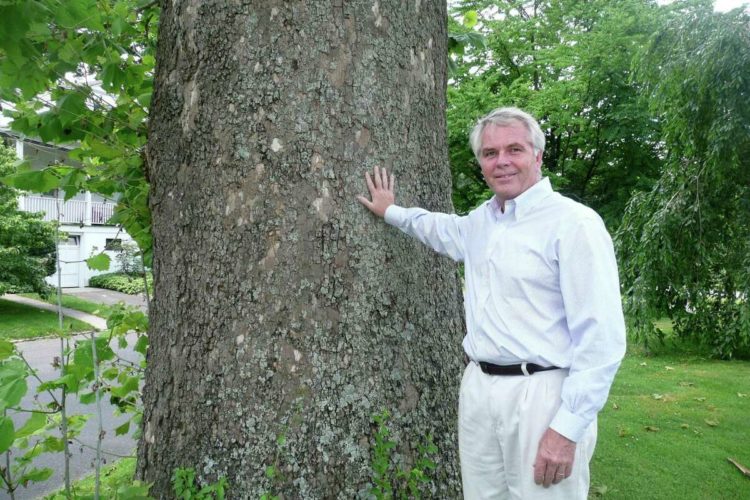
Former Greenwich Tree Warden Bruce Spaman beside a 100-year old Sycamore tree. Photo by Anne W. Semmes. Courtesy of Oral History Project.

“Don’t think of Greenwich as a town with trees in it. Think of Greenwich as a town in a forest.” So spoke former Greenwich Tree Warden Bruce Spaman, who served the Town of Greenwich from 2002 to 2018, when interviewed by Anne Semmes for the Oral History Project in 2019. “If you were to take a bird’s-eye view of Greenwich and then look down on it, you would see that…It truly looks like a town in a forest, although the part of the forest I was managing was just publicly owned trees.”

According to Spaman, Greenwich contains about 1100 acres of parks, including open-space properties, formal parks, and pocket parks. In addition, there are 250 acres of school campuses and 75 acres of athletic turf and fields. Add to that “a forest of street trees that’s probably 650 acres on over 265 miles of town roads. So, that’s a considerable forest that people drive in every day.” That responsibility only adds up to about six percent of the total land area in town.

Spaman’s interests in arboriculture and forestry began early. As a young boy, “I was in Boy Scouts . . . and I was always just out in the woods and on my own. I didn’t know you could make a job out of it.” He graduated with a degree in forestry from Paul Smiths College in Paul Smiths, New York, in the Adirondacks, in 1974. “From there, I just basically got immersed in trees in general, arboriculture doing tree work, learning the climbing, doing all that.” In the early eighties, the field of community forestry started to emerge which “brings together the arboriculture business and the forestry business . . . mostly with regards to managing municipal or town-owned trees.” Spaman worked for over thirty towns in Connecticut before being hired in Greenwich in 2002.

Spaman’s contributions over the years include a revision of the Tree Ordinance in 2009 and, within it, the Public Tree Policy “steering toward a more holistic management of the community forest.” The Nuisance Policy, for example, would enable the town to deal with a dying tree, on private property, leaning towards a public road. If, after numerous notifications, the homeowner did not remedy the situation, the town had “the power to essentially go on to the property, abate the nuisance, and charge the landowner.” Spaman was quick to point out that “we don’t remove trees for what trees do naturally. And if they’re dropping leaves, they’re dropping twigs, they’re dropping nuts, or they have wildlife living in them, that’s kind of a natural thing to us.”

One notable concern over the years was the pruning methods of power companies. “I put a section in the Public Tree Policy of how we handle utility clearing for trees in town.” Before this amendment occurred, the power companies seemed “to get more and more aggressive on their requirements for pruning trees… they said they needed to clear what they call ground to sky, which was basically taking all the branches off the wire-side of the trees. You can’t take half the green out of a tree and expect it to live very well.” The Public Tree Policy now requires a permit with rules of what can and cannot be done. “The people of Greenwich deserve reliable electric power but not at the expense of good arboriculture.”

Diversity of tree plantings was another goal of Bruce Spaman. “What we strive for when we’re managing our community forest is a diversity in species and a diversity in age classes.” Spaman could look to the destructive diseases that had plagued Greenwich’s numerous beloved Elm trees in the past or to the Sugar Maples on Lake Avenue that succumbed to old age at the same time. “…all of a sudden, we were taking Maple trees down like crazy.” Now, with replanting, “… we’ve put the large shade trees on one side of the street and the smaller ornamental trees underneath the power lines so that we don’t create problems in the future.” Spaman is also not averse to planting certain non-native trees, like Gingko or Katsura trees, that are not invasive or noxious or a nuisance. If he gets pushback for that, he responds, “… you wouldn’t want to go to a museum and only want to see American art.”

Spaman is proud of the partnerships he has maintained in the town. “… no community forestry program, park management program, can operate in a vacuum… It takes a community and volunteers and community effort and community concerns to really manage these assets.” If a garden club “wants to plant tulip bulbs, we’ll supply the tulip bulbs if they’re put on public property.” The Greenwich Tree Conservancy, founded in 2007, has also been a close and productive partner with the town, raising awareness of its tree heritage and planting hundreds of trees over the years.

In conclusion, Spaman mused, “… to make a community, it’s the people. It’s the culture. It’s the architecture… I feel the parks and the trees are part of the tapestry of what Greenwich is. It doesn’t complete Greenwich, but it’s important. And people understand that because they’re very concerned about their parks and their trees in this town.”

The interview entitled “Greenwich Tree Warden” may be read in its entirety at Greenwich Library and is available for purchase at the Oral History Project office. The OHP is sponsored by Friends of Greenwich Library. Visit the website at glohistory.org. Our narrator’s recollections are personal and have not been subject to factual scrutiny. Mary Jacobson serves as blog editor.


Friday, May 26, 2023


Inspiring Music Mentors

by Mary A. Jacobson

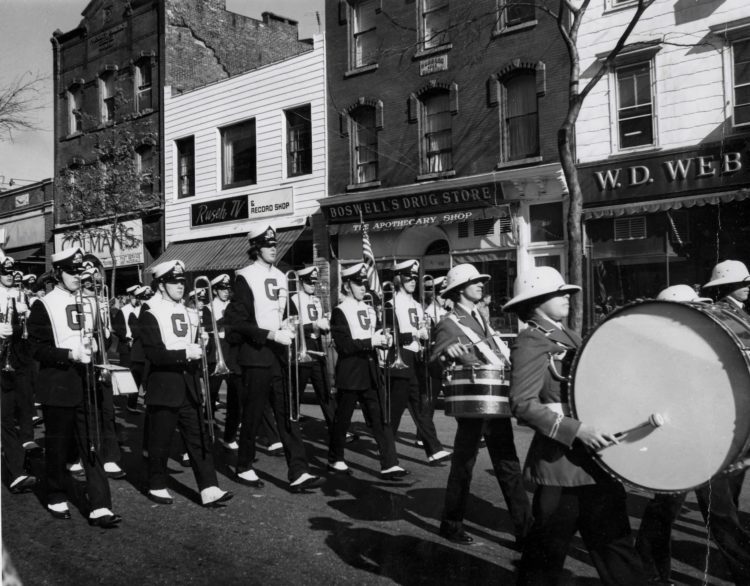
Greenwich High School marching band. Courtesy of the Oral History Project.

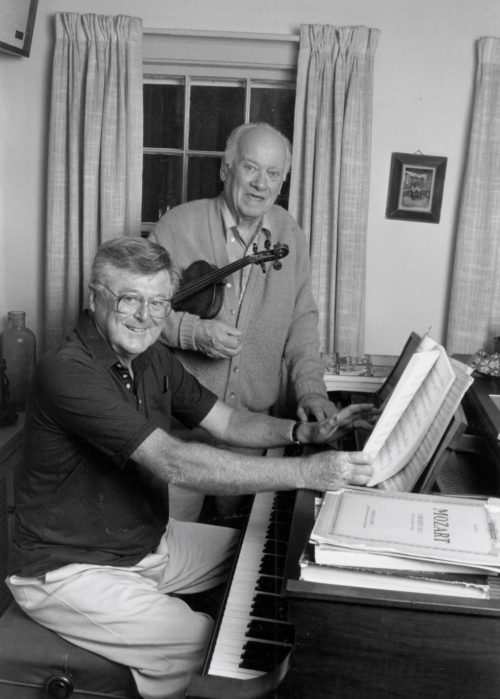
As the school year draws to a close, it seems fitting to highlight a few teachers who made an indelible imprint on the music program in Greenwich and inspired countless students to love and play music. George Gray and Raymond Malone were interviewed for the Oral History Project in 1989 by Mary B. Coan. Collectively, they served sixty-five years in the music department.

George Gray discovered his dad had a violin when he was a seventh grader in the Greenwich schools. “It happened, I guess, that somebody discovered I had a talent, so there you go.” At the age of twenty-four, with degrees from Juilliard and Columbia University Teachers College, George sought a position teaching strings. “Then this job opened up in Greenwich, a string teaching job, and I think it was one of the first in the country…It was exactly what I wanted to do.” The year was 1938 and the annual salary was $1,700.

As a novice teacher, Gray’s supervisor, Mary Donovan, instructed him to introduce himself to all the principals of the eleven district schools in which he would be teaching. He fondly recalled meeting Frank Parker, Principal of Hamilton Avenue School, whose reaction was, “What in the hell is a string teacher?” Gray’s job involved teaching in at least two schools a day. “It was about the best job that anybody that wanted to teach strings could have ever asked for…The kids enjoyed it and I enjoyed it…We developed a pretty good high school group, high school orchestra, and I also had an interschool orchestra that met on Saturday mornings.”

In the late 1940s, when the position of Supervisor of Music became available, Gray was encouraged to apply for it. One of his biggest responsibilities as Supervisor of Music was the selection of music teachers. “If I had maybe two opening for teachers in a particular year, I might have a hundred or more applicants for those jobs.” This responsibility also entailed some traveling. “If you couldn’t find a good teacher, you were really wasting your time trying to supervise a teacher that wasn’t any good, because they don’t change very much…I don’t think I ever hired a teacher unless I saw them teach…It makes all the difference in the world.”

One of the most memorable positions that George Gray filled was in the spring of 1956. Gray had traveled to Potsdam State Teachers College, one of the best New York State music schools, according to him, to interview a highly recommended choral conductor. His name was Peter Bagley and Gray heard “what a wonderful conductor he was, how the kids loved to perform under him.”

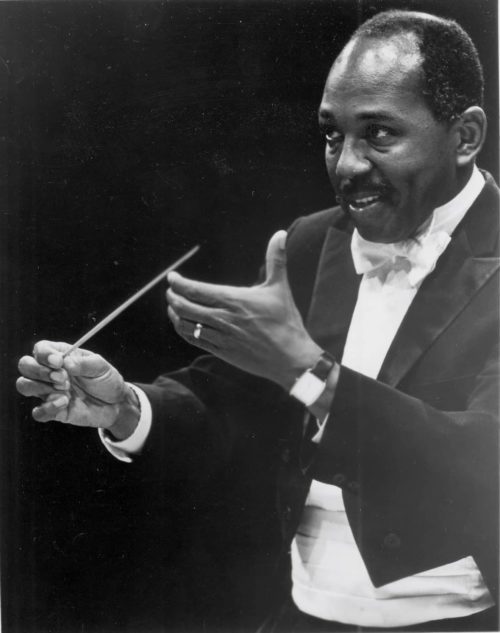
Gray brought him to a choral rehearsal at Eastern Junior High. “What a job he did with that! The kids loved him. There was an intensity and electricity about the man…He had every individual’s attention. He would look right at them, and he had a tremendous amount of energy.” After Peter Bagley taught four years, he left to pursue a doctoral degree. Later, in a 2012 interview as Professor Emeritus of University of Connecticut, Bagley said, “I loved being in Greenwich. I was the first African American teaching in Greenwich. That was a milestone; 1957 was pre-civil rights…. I didn’t know what to expect. And the unspoken response was, ‘You’re here. Teach. Be yourself. Do what you want to do. Do what you love.’ That’s what I did…I had some of my best years in that situation. I loved the parents, the students, the community, and I think I can safely say they loved me, too.”

Peter Bagley conducting. Courtesy of Peter Bagley


Another teacher Gray recalled hiring was Ray Malone in 1953. “I watched Ray teaching in a couple of classes…where all the desks and chairs were screwed down to the floor…The first thing he does, he puts his foot up on the desk and starts strumming his guitar and singing, and pretty soon these kids were singing. Then he had them stand up, and they were dancing in the aisles, and this was going on all at once. He had the kids all singing and dancing, and this music was going on…The kids just loved this for a music class. So, at that point he was hired. He was terrific.” Malone remained in the Greenwich school system until his retirement in 1983.

Gray mused, “There have been any number of students who have gone on professionally in music. A lot of them came up through Ray Harrington at the high school.” One of the students in particular that Gray recalled was Erich Kunzel (GHS graduate, 1953) who used to play string bass in Gray’s string ensemble. Among his many later musical achievements, Kunzel conducted the Cincinnati Pops Orchestra for more than three decades. In 2006, three years before his death, he was awarded the National Medal of Arts by President George W. Bush.

George Gray believed in building a strong program from the lower grades and that that was the core strength of the Greenwich music department, recognized nationally. He also believed in giving his teachers some autonomy and creative freedom. As Ray Malone said, “That was the secret to the success of the music program, because each of us had the individual freedom to follow our own pursuits, which drove us into music in the first place…The kids are going to see that. They are going to recognize here’s a guy that really loves music. That really makes quite a force on a child.”

The interview entitled “The Music Men” may be read in its entirety at Greenwich Library and is available for purchase at the Oral History Project office. The OHP is sponsored by Friends of Greenwich Library. Visit the website at glohistory.org. Our narrators’ recollections are personal and have not been subject to factual scrutiny. Mary Jacobson serves as blog editor.

Ray Malone and George Gray. Photograph by Karl Gleeson, courtesy of the Oral History Project.