Friday, November 22, 2024

Dr. Lee Losee Davenport and the Development of Radar in World War II

CELEBRATING FIFTY YEARS OF THE ORAL HISTORY PROJECT

In November 1940 Lee Losee Davenport, a twenty-five-year-old PhD student in physics at the University of Pittsburgh, received a call from the Massachusetts Institute of Technology “about a secret project…he couldn’t tell me what it was, but he wanted me up there immediately.”


Dr. Lee Losee Davenport with
World War II identification and memorabilia.
Courtesy of Greenwich Library
Oral History Project.


The group at MIT consisted of thirty college professors, “heads of physics departments of important colleges here, as far west as Chicago.” They called themselves the “Radiation Lab,” a cover name to hide the real purpose of their study, to develop anti-aircraft radar. Davenport came to the conclusion that he was included in this elite group because he had worked with one of the professors from the University of Pittsburgh who knew that “I was responsible at Pitt for making some of the most complex equipment for my thesis.” Davenport continued, “My role in this project was to get this thing built…the think tank was the idea men, the Einstein-type people… How to reduce that thought into a piece of machinery, or a piece of radio equipment, was up to other people, and I think that is one of the reasons I was chosen…I built x-ray tubes and so on. And I think he viewed me as a scientist who knows how to build things.”


Dr. Davenport was interviewed by Oral History Project volunteer Janet T. Klion in 2008 at the age of 93. He described his experiences as a member of the Radiation Lab, and their invaluable contributions to the development of anti-aircraft radar, instrumental in the Allied victory in World War II.


As Davenport described it, the secret tasks of the Radiation Lab were twofold. Firstly, “to take a magnetron…and see if you could make a radar device small enough to fit in the nose of an airplane. In that way they hoped to be able to find the German fighter planes or bombers at night, that had been bombing London with serious damage.”


Davenport was assigned to Project Two, “to see if you could make a radar system that could operate in all weather, pick out airplanes – a single airplane – and follow it automatically so that it would be accurately possible to aim an anti-aircraft gun at the plane and shoot it down.”


RADAR, the acronym which stands for Radio Direction-finding and Range, “travels at the speed of light…and you have to measure time to that accuracy to be able to find out how far it is. You have about a hundred-millionths of a second to measure the time.” After three months of work on the project with radar, it was possible to find an airplane. “In May of 1941, seven months before Pearl Harbor, “we had a system that worked on the roof of MIT, which we could follow an airplane with, track it automatically, follow that plane without human help.”


The Signal Corps was impressed with this equipment and gave instructions for it to be transported to the Fort Hancock Proving Grounds in New Jersey. To do so, it was necessary to fit the apparatus into the body of a truck. “I drove it down myself, on the Merritt Parkway” with “an armed guard sitting alongside me.” It was tested on December 7, 1941 and “we had a working machine.” After a few changes, it was sent to the headquarters for the anti-aircraft command in Virginia. After additional tests, the military decided to buy it “right then and there.” The project was now named SCR 584 (Signal Corps Radio 584) and General Electric and Westinghouse were instructed to each build 1700 of them. The instructions to these companies were, “Don’t change a thing. You’re to reproduce exactly what the Radiation Lab people are showing to you, and we want them right away.”


Exterior view of SCR 584
(Signal Corps Radio 584).
Contributed photo.

The first practical use of this anti-aircraft device “occurred in England. One of them was shipped over. I was over there with it, and a German aircraft came over Scotland, and we knocked him out of the sky, right away.” Its first use in combat occurred “at the Anzio beachhead (in Italy in early 1944) when “the two 584-directed gun batteries shot down nine out of the twelve planes that the Germans had tried to use.”


The most significant use of SCR 584 occurred on D-Day, June 6, 1944 “when we invaded the Normandy coast.” The challenge was to get the equipment there to protect our troops. “Now that was a major effort. This is a semi-trailer loaded with equipment and they had to get them ashore at, or a day after, D-day.” Nineteen of them were waterproofed in Wales to be floated ashore. “I was there to design and work that out and they did get ashore very promptly, and helped to defend our troops. We knocked down a lot of planes.” By the time the war ended, “we were tracking our own airplanes...and I was working on beacons and other systems which we used to steer them, with maps inside the 584s.” Overall, Davenport concluded “that about a thousand German aircraft were knocked down by anti-aircraft fire, all of which was directed by SCR 584 radars…After that, they became used widely everywhere in the Pacific.”


Interior view of the SCR 584 radar tracker
that guided pilots to their targets.
Contributed photo.

Before joining the Radiation Lab at MIT in 1940, Lee Losee Davenport had completed his course requirements for his doctorate at the University of Pittsburgh but had not written his thesis. In 1946, The University of Pittsburgh granted Davenport a PhD based on his classified work at MIT. “So, I got a PhD on a secret project, and it was a secret for twenty-five years after World War II ended.” Davenport mused: “I have been the luckiest guy in the world. It was luck that I got singled out to go to the Radiation Lab.”


 The interview “Radar Development in World War II” may be read in its entirety at the main library. It is also available for purchase by contacting the OHP office. The OHP is sponsored by the Friends of Greenwich Library. Visit the website at glohistory.org. Our narrator’s recollections are personal and have not been subjected to factual scrutiny. Mary Jacobson serves as blog editor.


Thursday, November 7, 2024

Riding in Greenwich

CELEBRATING FIFTY YEARS OF THE ORAL HISTORY PROJECT

These days, often-heard complaints among Greenwich residents center on the town’s ever-increasing traffic congestion. Whether attempting to traverse the Boston Post Road or North Street or the Merritt Parkway, drivers are frequently beset with frustration over the amount of time it can take to get from one end of town to the other. 

Theodore F. Wahl
Courtesy of Greenwich Library
Oral History Project

Theodore F. Wahl, born in 1898, was interviewed by Oral History Project volunteer Marcia Coyle in 1974. His memories are of Greenwich one hundred years ago and will allow the reader to pivot from thoughts of cars and traffic to horses, hounds, and the hunt in Greenwich.

Ted Wahl was at the center of horses and riding in Greenwich throughout his life. His family moved here from Florida in 1902, when Ted was four years old. His uncle, John Wahl, had opened a stable in Greenwich “down on Bridge Street. He finished that in 1902 and that’s when my father brought us up from Florida…he taught riding there, and Dad was with him.” Ted dropped out of school at age fourteen and worked for his uncle. 

John Wahl's horse stable
Courtesy of Greenwich Library
Oral History Project

In time, people desired “a little bit more riding. They had the Field Club down there, and they wanted riding connected with the Field Club.” According to Wahl, the Field Club stable, “built by the Greenwich Riding Association, had held twenty-two horses.” The stable was enlarged to accommodate up to forty horses. “Then they got a few hounds and started a little drag hunting,” a form of equestrian sport in which mounted riders hunted the trail of an artificially laid scent with hounds. This pre-determined route would be laid to take advantage of the best jumping opportunities. The hounds purchased “were English hounds bought from different places. They even got some from Detroit to drag with.”

Ted Wahl moved from the Field Club to the management of Round Hill Stables in 1924, at that time part of the Round Hill Club, with fifty-five horses. Eventually, Wahl bought the stables, land, and buildings from the Round Hill Club in 1965. Wahl was proud to say that he was involved in teaching the third generation of riders. “I was talking to a lady the other day downtown and she said, ‘You know what year you taught me to ride?’ I said, ‘I haven’t the slightest idea.’ She said, ‘1912.’”

The “country” was wide open in the early days of the sport. “There was a lot of field and there was plenty of room to hunt. We weren’t tied in ’cause where the Round Hill Club is now, that was all Wilson’s meadow. That was all open and we could go out and jump straight on up to Round Hill.” Riders could hunt in both Fairfield and Westchester counties and were known as the Fairfield and Westchester Hounds. Their hunting grounds stretched “as far as the other side of Rye…north up almost to the other side of Bedford… Then we’d cut the other way, over to Stamford… We had a big country to hunt.” 

Fairfield-Westchester Hunt
Courtesy of Greenwich Library
Oral History Project

According to Wahl, the hunt was recognized by the National Steeplechase and Hunt Association in 1915. Wahl recounts the day “we were dragging up near the North Village Church and a deer jumped up…of course, the hounds followed him and the field went with them. And then they kind of thought, ‘Well, if we can hunt a deer around here, why can’t we hunt fox…? And that’s how they come to start the fox hunting in Greenwich, after the drag [in 1921]”

Wahl recounted the story of John McEntee Bowman, president of the Biltmore [now the Westchester Country Club], elected Joint Master in 1921. “He built a beautiful kennel [at the bottom of Pecksland Road]. The old kennel building is still standing there [at the time of the interview in 1974]… We hunted one day from there all the way down to the Westchester Biltmore. We laid a drag and hunted all the way down there… They put peat moss on the hard roads then, so the horses wouldn’t slip and could jump the fences.”

Theodore F. Wahl with his horses and buggy
Courtesy of Greenwich Library
Oral History Project
 

At other times a hunt might start at the Bedford Village green with as many as fifty to seventy-five people. A favorite meeting place, particularly on Thanksgiving Day, was the Round Hill Store. Another meeting spot was located on Clapboard Ridge Road, “There’s a red gate there. Goes in back of the Boys’ Club property.” The red gate was eventually replaced by an iron sign simply stating “The Red Gate.”  Beyond Riversville Road, “we used to meet at Riversville ford. That’s where we crossed the river…the ford’s right where Mayfair Lane comes down.” Other meeting places included Middle Patent Church, East Middle Patent Church, the reservoir on North Street, and a kennel above the Merritt Parkway on Stanwich Road.

Construction of the Merritt Parkway “made a tremendous difference. We lost several hounds on the Merritt Parkway when that got there. It made us hunt further north… It cut the country right in half.” As Wahl described it, “For a long time it was dirt and that was good because we could gallop right up alongside the road when the hounds were there.”

Greenwich map drawn
by Betty Fletcher
Courtesy of Greenwich Library
Oral History Project

In 1948, fox hunting stopped. “Our last Master of the Hunt was Mr. John Howland… The country began to get built up by that time. But he went and got these drag hounds, and he hunted the drag hounds for four years…until 1952. And that’s when the hunt stopped altogether.”

According to Wahl, in its day, “The hunt here was a big addition to Greenwich. It was a big drawing card with the people coming in here to live. But they got in here and they built us up, so we couldn’t hunt anymore.” The end of an era.

The interview “Riding in Greenwich” may be read in its entirety in the main library location. It is also available to purchase by contacting the OHP office. The OHP is sponsored by the Friends of Greenwich Library. Visit the website at glohistory.org. Our narrator’s recollections are personal and have not been subjected to factual scrutiny. Mary Jacobson serves as blog editor.

By Mary Jacobson, OHP Blog Editor

Friday, September 27, 2024


A History of Emergency Medical Services in Greenwich (GEMS)

by Mary A. Jacobson

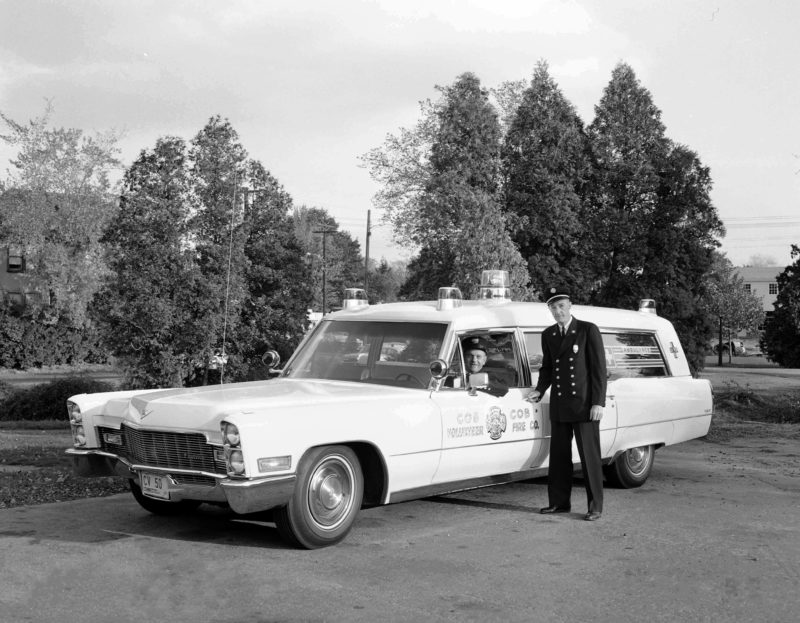
Cos Cob Fire Department ambulance, circa 1960. Photo by John Gotch. Courtesy of Greenwich Library.

Over the years, a trip in an ambulance to the emergency room of the local hospital in Greenwich has changed dramatically. In the earliest days of automotive transport in the 1920s, transportation to the then-Municipal Hospital may have been by a van that was no doubt considered a state-of-the-art vehicle at the time. For many years, ambulances were housed in local fire departments which, in partnership with the police and volunteers, provided needed and fast transportation to Greenwich Hospital.

In 2006, Oral History Project volunteer Marian Phillips interviewed Charlee Tufts, executive director of Greenwich Emergency Medical Services (GEMS), which began service in Greenwich in 1986. Tufts explained that the purpose of GEMS is “to provide Advanced Life Support, paramedic-level ambulance service for the Town of Greenwich.”

Tufts described the early history of ambulance transport in Greenwich: “Ambulance services before firehouses were actually provided by funeral homes, and so you had hearses, and, when it then transferred into the fire departments, there was still the old Cadillac.” By 1976, federal regulations started to identify what an ambulance should look like, and what requirements, equipment, and training were necessary to be as effective as possible.

In 1984, Roger Pearson, First Selectman of Greenwich, supported funding for hiring “an administrative director of EMS for the Town of Greenwich to coordinate and standardize protocols, services, and training… for the type of organization we’d like to see in town.” Charlee Tufts was selected by the town’s Board of Health for this challenge. “I don’t think in your professional life a lot of people have the opportunity to actually develop an entire system.”

As Tufts explained, “Previous to GEMS being founded (in 1986), the ambulance service was at a Basic Life Support level… it was mainly splinting, giving oxygen, bandaging, and controlling bleeding.” What it evolved into (with GEMS) was “the ability to provide just about complete emergency care that you would receive in the Emergency Department. Very sophisticated care…. So, GEMS was the product of two years of study and research.”

This study included an evaluation of six months of emergency calls to determine the breakdown of those cases that would have benefitted from Advanced Life Support (45 percent) including an IV, medication, intubation, defibrillation. “It became abundantly clear that this town was too big to cover with only one station… And so, we started looking not only at response times but at the clusters of where the calls were most predominant. We chose three stations; and, amazingly, those three stations are still in effect today (in 2006).” A fourth, on King Street, is now fully operational as well.

“So we went to the BET (Board of Estimate and Taxation) with a budget, and by that time it had been determined that we really felt that the most cost-effective way to do this was to become a non-profit…I think we were probably the first to be designed like this in the State; and I know we’ve been used as a model outside the State.” This would eliminate another employee base in town; lead to less expensive malpractice insurance; and allow for fundraising.

Tufts recalled that, in the process of seeking RTM (Representative Town Meeting) approval, “Many physicians, particularly the cardiac physicians, would come with us to all the RTM meetings… to explain the system that we were proposing and to support it from their medical standpoint, that this was something very important for the town.” On May 12, 1986, “I thought I’d never forget that date … our budget was voted in by a solid majority of members of the RTM.” Proudly, Tufts recounted, “So GEMS was the product of two years of study, research, presenting budget after budget after budget and with the culmination of going into service July of ’86.”

Recruitment of personnel was not difficult. “We offered a very fair wage and benefits. . . There was also a lot of interest and excitement about a service starting up that was dedicated to just emergency service and to patient care.” Paramedic certification and licensing required “at least a sixteen-hundred-hour course between classroom didactic and practical experience and internships.” Today, all ambulances are staffed with at least one paramedic and an EMT.

Volunteers also continue to play a part in delivering services, “a much smaller number who are actively certified and riding shifts,” many choosing to ride as “thirds” to assist, rather than replace a two-person crew. In addition, there is an active volunteer group of Explorer Post, teenagers who provide help on the non-emergency side and, once qualifications are met, may ride in the ambulance.

Tufts was proud of the fact “that each year we are improving on our technology.” About ten years into the program (in 1996), “Twelve Lead EKGs” were made available which allowed electrocardiograms to be performed on the ambulance and transmitted directly to the Emergency Department enroute to the hospital. Automatic External Defibrillators became available as well and doubled the cardiac arrest save rate. “Our biggest challenge is finding enough room on the ambulance for all the equipment we are carrying.”

According to Charlee Tufts, “We are the third arm of public safety . . . not as an adjunct to other services. And I think as time goes on people are recognizing even more that every call we answer deals with human life and not property, but human life.”

Charlee Tufts retired from her position as GEMS Executive Director in 2017 after thirty-nine years of service with the town’s ambulance corps. That year she was honored by induction into the Connecticut Women’s Hall of Fame. Under her years of leadership GEMS received numerous awards, including being cited as an exemplary system for a “save rate,” ranking GEMS among the best in the nation.

In 2023 GEMS answered 6,517 calls with a 96 percent response time of under eight minutes, including 74 percent of them under five minutes, resulting in 4,323 trips to the emergency room.

The interview “History of the Greenwich Emergency Medical Services (GEMS)” may be read in its entirety at the Main library location. It is also available for purchase by contacting the OHP office. The OHP is sponsored by Friends of Greenwich library. Visit the website at glohistory.org. Our narrator’s recollections are personal and have not been subjected to factual scrutiny. Mary Jacobson serves as blog editor.

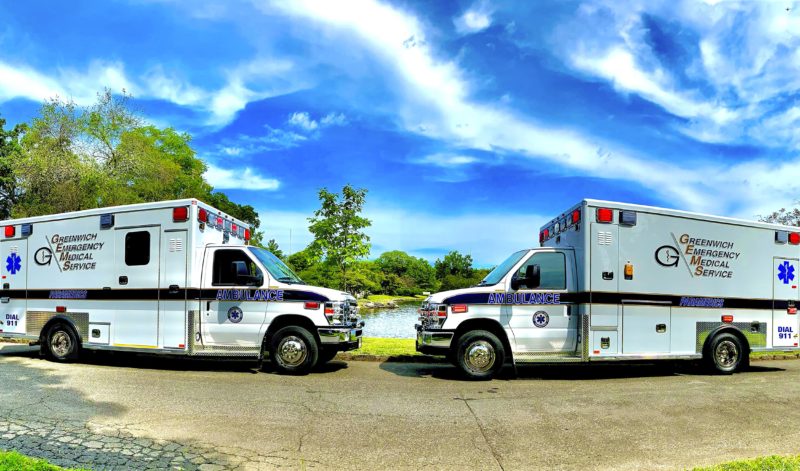
Two GEMS ambulances. Courtesy of GEMS.