Friday, March 25, 2022

Pioneering Mother and Daughter Flyers of Greenwich
by Jean P. Moore

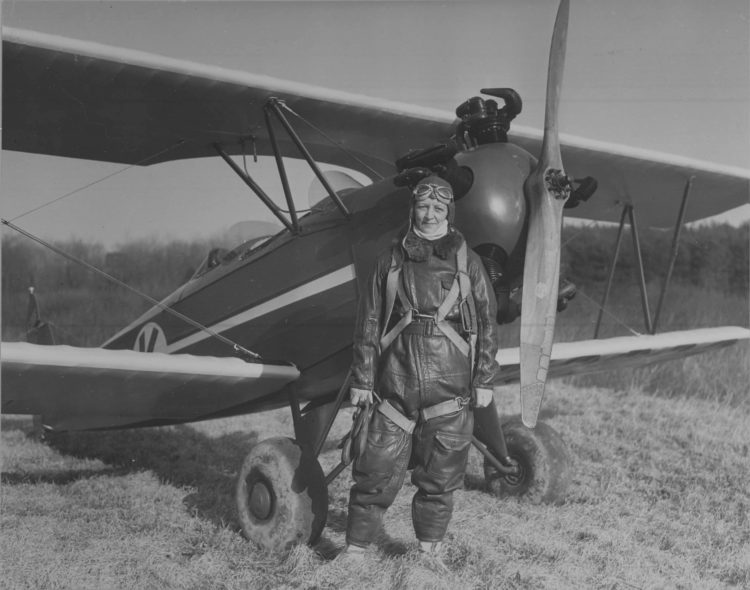
Marian Cummings suited up to fly her plane, 1934. Courtesy of the Oral History Project

What could be more appropriate for Women’s History Month than to celebrate two female aviation pioneers who achieved many of their flying feats right here in Greenwich in the 1930s?

The two remarkable women are Molly Cummings Minot Cook and her mother, Marian Engle Cummings, who died in 1984 at the age of 93. Together with Molly’s brother, Wilbur (“Billy”) Love Cummings, Jr., also a pilot, they won the nickname, “The Flying Family of Greenwich.” Molly was interviewed by Oral History Project volunteer Suzanne Seton in 2012. She died at the age of 102 in April 2020.

In her youth, Marian Cummings was a force of nature. She proved such a challenge to her parents that she was sent east from her home in Seattle to be made a “lady”- a not entirely successful venture. From sliding down spiral staircases at her finishing school in Middlebury, Connecticut, to illegally harboring kittens in her room, she was a handful for the headmistress, who nevertheless appreciated her spunk.
After graduating with honors and returning to Seattle, Marian met Wilbur Love Cummings, a young lawyer out west on assignment. Young and in love, their romance culminated in marriage on the eve of World War I. Subsequently, they traveled to New York, where Mr. Cummings would resume his work. This trip occurred at the height of the Spanish flu epidemic. Marian, Wilbur, and their two young children, Billy and Molly, wore facemasks and stayed in their cabin.

The family settled in Greenwich and bought an old farmhouse on John Street. However, life in Greenwich may have been too uneventful for Marian Cummings. To feed her love for adventure, she began taking flying lessons at North Beach, now LaGuardia airport, earning her pilot’s license in 1932 at the age of 40. Mr. Cummings congratulated his wife on her accomplishments and asked if she would like an airplane. And so Marian Cummings acquired her first Stinson Reliant. Before long, Marian and her son and daughter were all flying at Armonk Airport. According to her daughter, Molly Cook, Armonk was not a proper airport. It was called the Westchester Pasture for Select Flying Machines and was actually a potato field off Route 22 just long enough for landing small planes.

While Molly and Billy were earning their wings, their mother Marian was busy racking up firsts and awards. She was the first woman to make a parachute jump and the first woman to hold a commercial license. She then proceeded to put her training to use by flying her husband to various destinations where he had legal dealings, traveling around the States and in Central America.

Marian Cummings was a powerful influence on her two children. Following in their mother’s footsteps, they were accomplished and daring pilots. Daughter Molly Cummings Minot Cook, born in 1917, was also a flying marvel, earning her pilot’s license in 1935 when she turned 18. Soon thereafter, Molly and her brother Billy bought a small plane, a Luscombe, and began competing in meets. While still in college, they became popular at “stunting” meets at airfields in Armonk, Hartford, and Long Island, among others. Molly Cook describes one maneuver in which a roll of toilet paper would be thrown out of the plane at three or four thousand feet creating a streamer effect. “The trick was how long it took you to cut that strip twice, with your plane.”

During World War II, Molly and her mother joined the Civil Air Patrol. While her mother ferried pilots between destinations stateside, Molly taught Morse code and aerial navigation. Her brother Billy joined the Navy Air Corps as a transport pilot, flying new planes from factories in the U.S. to England, where they were deployed in the war. Tragically, it was on one of those trips that young Billy Cummings crashed on takeoff, killing this cherished son and brother.

In time, Molly Cook went on to marry and have a family of her own. She continued flying and engaging in many other interests, from teaching art, to ranching, and to conservation, making substantial donations to the Land Trust. However, flying was never far from her heart.
As she relates, “I loved stunting. In the summer…I would be in my white flying suit and helmet and goggles – oh, I was just the big cheese – and get into my little Fleet plane. All these people on Sunday, that was the thing to do in those days, that people would drive to Armonk to watch the planes, sort of a – what would you call it – a bullfight feeling. Is the matador going to make it or – I’d go up and do a spin or a loop and a something, and then come down. Then we’d sit, and then somebody said, ‘Well, I think I’ll go up and amuse them a little bit.’ It was fun on a Sunday.”

This blog was written by OHP volunteer Jean Moore from the interview, “Mother and Daughter Flyers.” The transcript of the interview may be read at Greenwich Library and is available for purchase at the Oral History Project office. The OHP is sponsored by Friends of Greenwich Library. Visit the website at glohistory.org. Mary A. Jacobson, OHP blog editor.


Saturday, February 26, 2022


Havemeyer Park – A Unique Community

by Anne W. Semmes

Gene Tunney and Arthur M. Starck reviewing construction plans for Havemeyer Park. Photo courtesy of the Greenwich Historical Society.


What does a sugar cane magnate, a professional boxer, and World War II veterans have in common? The answer, of course, is Havemeyer Park, a planned community in Old Greenwich, just to the west of the town line with Stamford, that has thrived since the 1940s. Oral History Project volunteers Carol Ashwell and Janet McDonald interviewed early residents of Havemeyer Park in the 1990s to gain an understanding of this place with its unique culture and history.

One can trace the history of Havemeyer Park to its initial incarnation, that of a 200-acre homestead, just north of Boston Post Road, where Henry Osbourne Havemeyer built a family country retreat in 1880, named Hilltop. Havemeyer, president of the American Sugar Refining Company, enjoyed the bucolic setting of Hilltop with its mansion, barn, three greenhouses, farm animals, and extensive plantings. Havemeyer died in 1907. The home was demolished after his wife, Louisine, died in 1929.

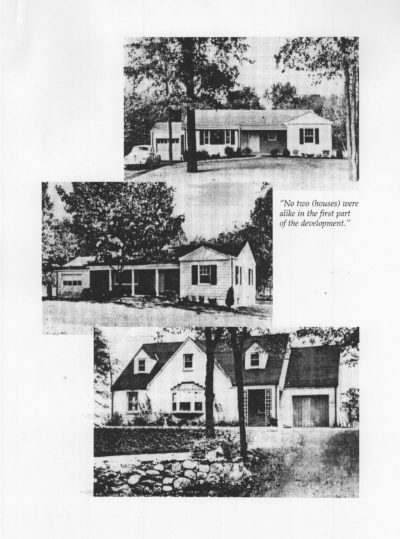
Gene Tunney, known primarily as the world heavyweight champion from 1926 to 1928, married socialite Polly Lauder of Greenwich in 1928. In 1946, he purchased the property from the Havemeyer estate for $178,000. Tunney, a former Marine, envisioned the land, now named Havemeyer Park, as a housing development for returning WWII veterans. He and Arthur M. Starck formed the Stamford Building Company. The Cape Cod-style homes were built on one-quarter acre lots. The first units were completed by 1947; eventually 360 of them were constructed. A $1,000 loan from the bank could procure a home priced at $10,000. It is no surprise that the neighborhood boasts street names like McArthur Drive, Halsey Drive, and Nimitz Place.


Ginny Ridenour, a former resident, recounted a story about Mr. Tunney. “I heard that in the early years he used to come along and check out the site; and if people would come out and say, ‘Mr. Tunney, I don’t have enough room for my garage’ or whatever, he would try to accommodate the wishes of the residents. And the builder finally told him, ‘You have to stay off the site because we can’t make all these changes.’”

Russell Vernet lived in Havemeyer Park from 1950 to 1996. When he moved in “practically everybody was a veteran…We had a Cape Cod, and it was a two-story, but the second floor was never finished; and the basement, of course, wasn’t finished. But, over a period of time I completely finished the upstairs into two bedrooms and a bath and made a playroom in the basement…Almost everybody who moved in was a hands-on handyman.” Vernet describes some of the streets as dirt roads “for a long time after we moved in…So there was a lot of roadwork that had to be done.”


Havemeyer Park’s population consisted mostly of young families. It was amusingly dubbed “Have a Baby Park” for the many children in the neighborhood. Ginny Ridenour remembered the first day she moved there in 1959. “My next door neighbor came over and she said, ‘Do you have children?’ and I said, ‘Yes, we have one.’ And she said, ‘Oh, I’m so glad because we have three.’ And from that moment on we began a beautiful experience in Havemeyer Park.”
Within the community there were many organized and impromptu social activities. From Boy Scout and Girl Scout troops to picnics, a garden club, costume parties, Valentine’s Dances and more. “We really had a whole social life right within our own area. Nobody joined the Newcomers or anything like that. They never felt they needed to,” according to Ridenour.

“No two (houses) were alike in the first part of the development.” Photo courtesy of the Greenwich Historical Society.


Russell Vernet described a Christmas tradition where a neighbor “used to put up a big screen in front of his house; and he had a projector and would project the words of the Christmas carols onto that screen. Then he’d play the accordion, and we’d all stand around and sing.”

The Havemeyer Park Owners Association, begun in 1948, grew out of concern for roads and traffic. In those days, according to Gerald Porricelli, past president of the homeowners’ association, “… we were speaking at Planning and Zoning Commission hearings, writing letters particularly about traffic, the density of traffic coming onto Havemeyer Lane and arranging for access out on Palmer Hill Road.” Over time, Porricelli commented, the population of Havemeyer Park has become more transient in nature and the number of neighborhood activities has diminished from its early days. “You see a lot of turnovers…we have working families with not a whole lot of time to give to these kinds of events.”

Ginny Ridenour reflected on her early days in Havemeyer Park saying, “It was a very positive period of our life, and I think this is what we’ve all come away thinking about it…I don’t know what the magic was, but we really did all have such fun…It was truly a unique place to start your life in Greenwich.”

The transcript of the interview, “Havemeyer Park.” may be read at Greenwich Library and is available for purchase at the Oral History Project Office. The OHP is sponsored by Friends of Greenwich Library. Visit the website at glohistory.org. Mary A. Jacobson, OHP blog editor.


Wednesday, February 2, 2022

Life on Lewis Street in the 1920s

by Mary A. Jacobson


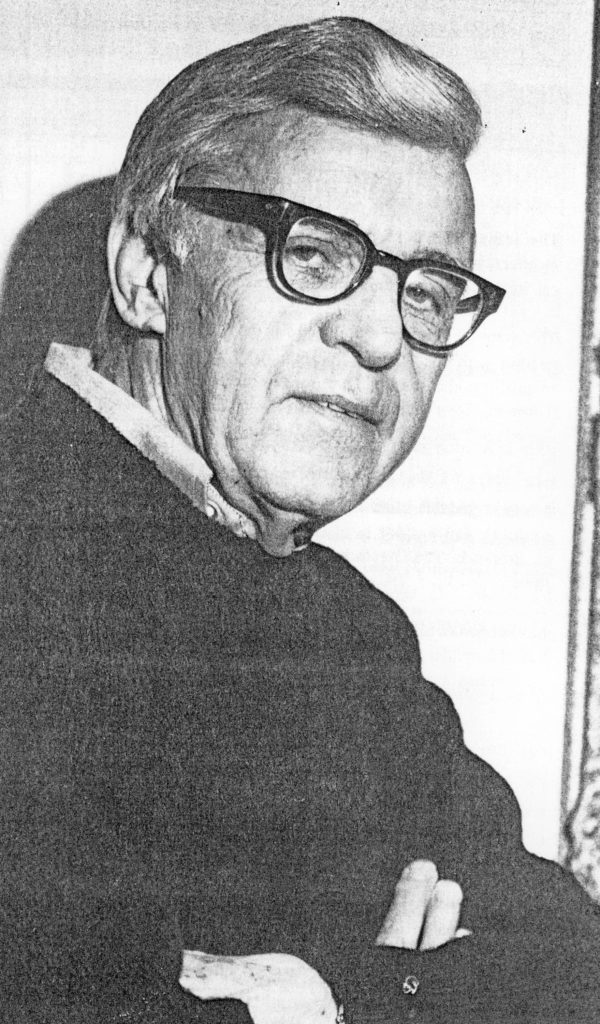
In 1974, Frank Nicholson was interviewed by Olwen M. Jones of the Oral History Project. Nicholson, born in 1915, lived at 52 Lewis Street, between Greenwich Avenue and Mason Street in the 1920s. “Lewis Street in itself at that time, as I look back at it, was more like the beginning of the twentieth century than the beginning of the 1920s.”

Frank Nicholson, photograph by Agnew Fisher

His home “which was not a new house” had a shop in its front. “At that time it was Doc Fowler’s vulcanizing shop, where they vulcanized automobile tires…And the roar that these machines made and the smell of the rubber was pretty repulsive. But that didn’t remain for too long that I remember; around 1922 it was replaced by a battery shop for automobiles.”

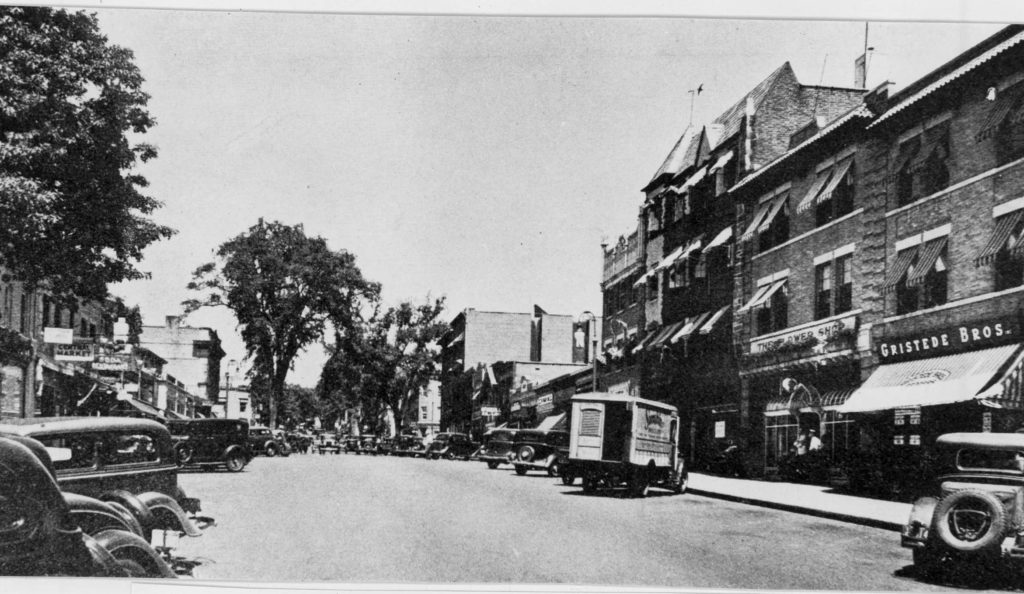
On the south side of the street was Cole’s Automobile Agency that sold Wills Sainte Claires, classic cars that were manufactured between 1921 and 1927. Next door was Clark’s garage where you could fuel, repair, wash and store your car. There was one gasoline pump “that you turned by hand and measured out a gallon of gas. Then you turned it back and measured out another gallon of gas…Everybody who had a car took care of it, I guess because there weren’t many at that time.” Between Nicholson’s house and Clark’s garage was “this great big open field and a tremendous big hay and feed barn, which was Timothy Loughlin’s’ Feed and Grain Store.” In the early 1920s, goods like milk, bread, ice and coal were still delivered by horse and wagon.

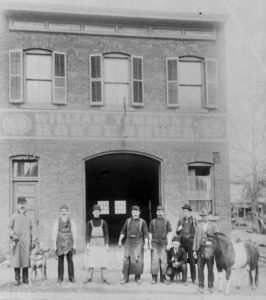
There were many diversions on Lewis Street to keep a young boy’s interest and imagination active. On the north side of Lewis Street were two blacksmith shops, William Timmons’ and Seth Mead’s. In between, was Kirhoffer’s ironwork shop which serviced carriages. Nearby, was the shoemaker Tony Ginto.

“We learned an awful lot of things as kids because you always could go into the blacksmith’s shop and you could stand around and watch…You’d see them shoeing horses and glad to have you there and watch the sparks flying…Or you could go into the shoemaker’s and sit down and watch him cut the leather to make a sole on a shoe and sew it and glue it…We could go in the battery shop and watch them. You could go in the garage and watch them tear apart a car, and you could watch them vulcanize a tire…You were in things. You were never at a loss for something to do.”

The 1920s ushered in the age of prohibition and Lewis Street was “where the action was.” Number 25 Lewis Street housed Hassett’s Saloon. “I remember the day that they padlocked the saloon and all of these men standing out in front of Hassett’s Saloon bewailing the fact that there would be no more booze.” However, although the front door was closed, the back door was open. Nicholson remembers “rushing the growler” (taking a can to get it filled with beer) for his father. “I’d go to the back window at Hassett’s Saloon and have them fill it and I’d usually get a bottle of soda as a bonus because I was, I guess, small for rushing the growler.” Nicholson recounted stories about bootleg liquor, homemade “hooch,” and speakeasies, but as he would say, “I’m telling you this as recollections of a child…This is not factual; this is things that I remember.”

Looking north on Greenwich Avenue, courtesy of Agnew Fisher

One of Nicholson’s favorite childhood amusements was going to the silent movies at the Greenwich theater. There were two organists who would play during the film, one of whom, Russell Green, was also the organist at St. Mary Church. “If it was Rudolph Valentino in Blood and Sand, there was a score that went with that, and it fit in with the action.”

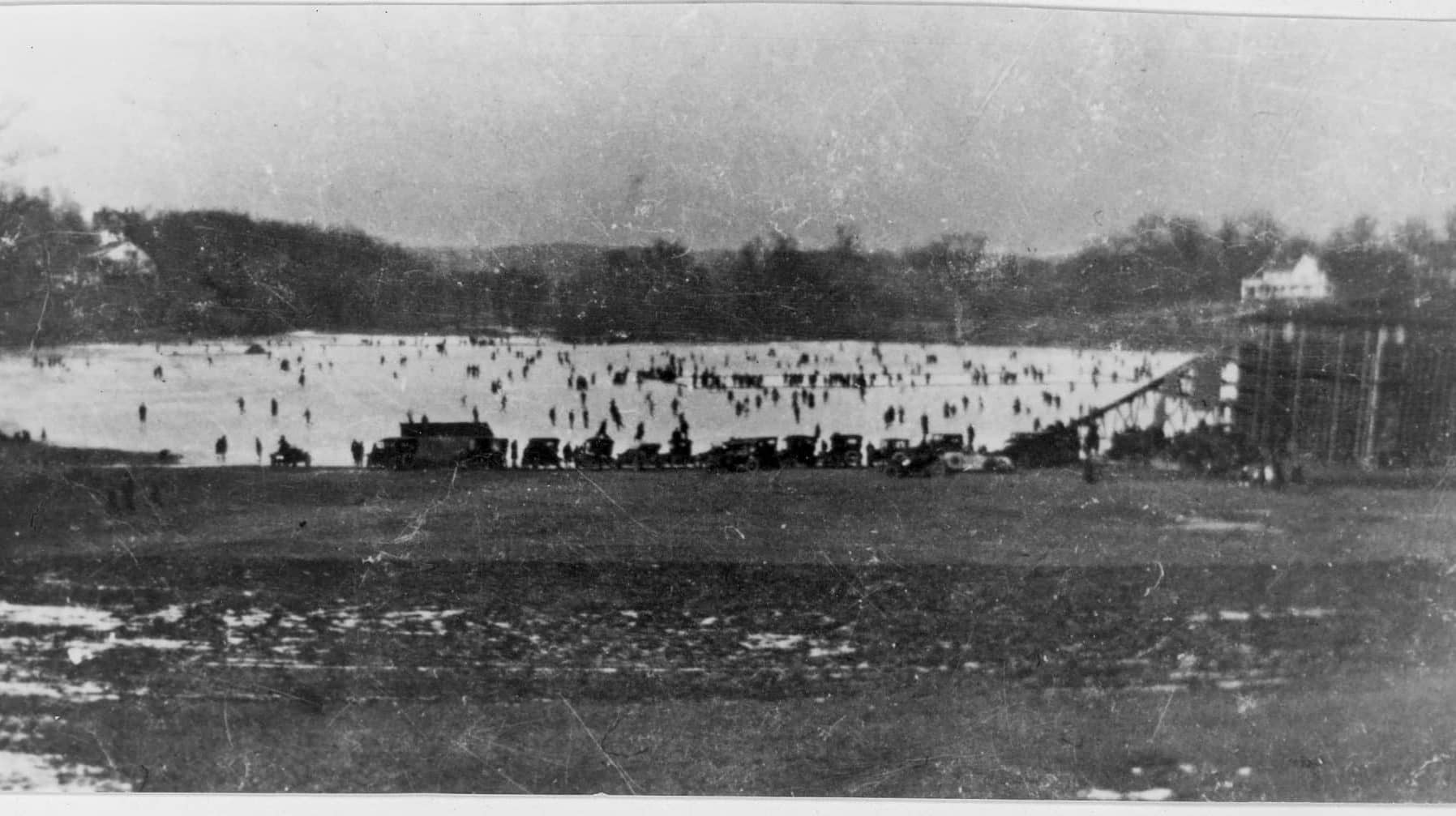
Skating at Ten Acres, now the Greenwich High School football field, courtesy of Greenwich Historical Society

There were also simple games like putting pennies on the trolley tracks before the trolley crushed them into different shapes. “And stickball, all you needed was an old broomstick and a saw…You sawed off one piece about six inches and that was your ball. At night we’d play cops and robbers and hide and seek. Hide and seek was a good way to get away from the front door… I can remember as a kid, my mother saying, ‘Don’t go away from that door,’ and I didn’t. I’d just stay right there on the curb and that’s where I saw the world go by. Great, great entertainment.”

Timmons’s Blacksmith, courtesy of Greenwich Historical Society


After graduating from Greenwich High School, Nicholson attended Middlebury College, the University of Grenoble and, as a Fulbright Scholar, the Sorbonne at the University of Paris. He began teaching French at Greenwich Country Day School in 1956.


The transcript of the interview, “Growing Up on Lewis Street in the 1920s” may be read at Greenwich Library and is available for purchase at the Oral History Project Office. The OHP is sponsored by Friends of Greenwich Library. Visit the website at glohistory.org.

Mary A. Jacobson, OHP blog editor.